
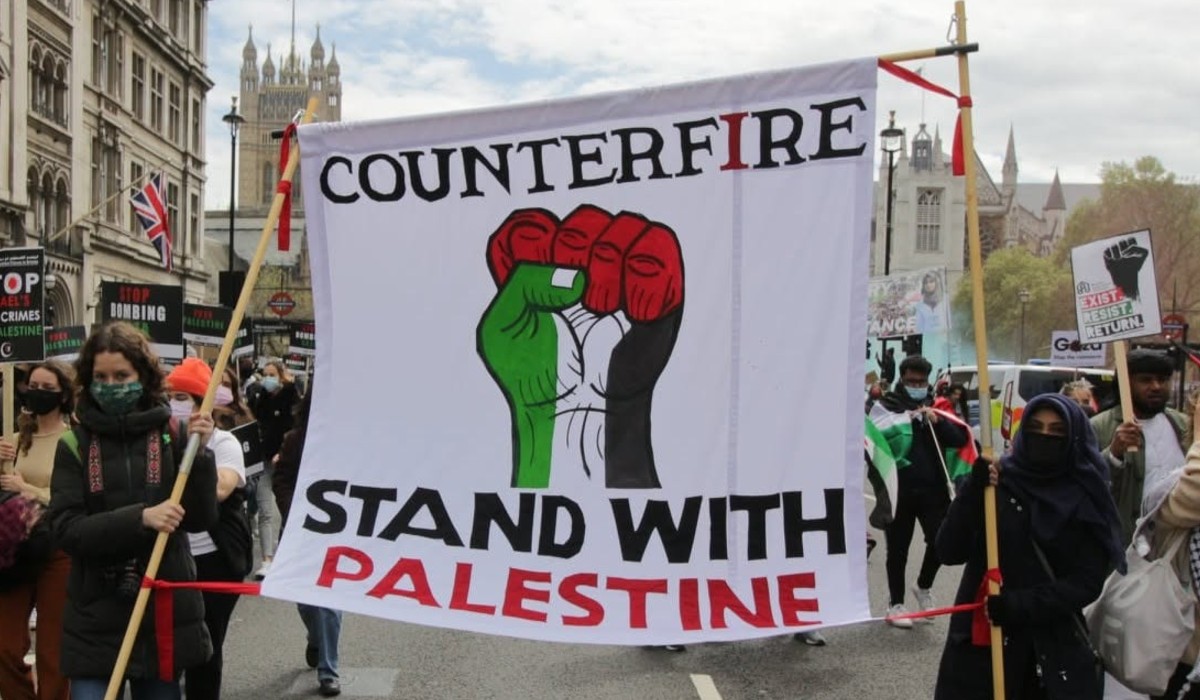
 Photo: Steve Eason / CC BY-NC 2.0
The following article was originally commissioned by the Parti Ouvrier Independent (POI) for the information of their members and others on the French left. They have kindly published it in French and other European languages. We hope to publish a similar piece by the POI shortly. In the meantime, this is the original English text by John Rees
In this article I want to describe Counterfire in terms of its political tradition, its place on the British left, and its policy on some major political issues of the day.
Counterfire is a revolutionarysocialist organisation with roots in the Trotskyist tradition. We organise through our website, our monthly 12-page free newspaper, our newly-launched theoretical journal, The Marxist Review, and our book-publishing programme. We have a network of local branches throughout the UK.
Our members play a leading role in the Stop the War Coalition, the Palestine Solidarity Campaign, the People’s Assembly Against Austerity, Keep Our NHS Public, and in the trade union movement.
Counterfire was founded in 2009 and currently has around 1,000 members and supporters. Some leading members of Counterfire were previously in the Socialist Workers Party, but we left over commitment to anti-war work and to forming a united front against austerity after the banking crash. However, most current members of Counterfire have not been in any other organisation.
We are committed to the view that the working class is the decisive agent of change in modern capitalist society, and reject views that it has been superseded by changes in its composition in the old industrial core of the system.
We are advocates of re-establishing Marxist organisation among working people and equally committed to the idea that small vanguard parties must find a way of uniting in struggle with broader layers of workers who do not yet see themselves as revolutionaries. We are mindful of Lenin’s advice to Italian socialists after World War I when he urged them to ‘break with Turati’ (the leader of the Italian reformist party), in order to found an organisationally distinct revolutionary party, but then immediately urged that very party to ‘unite with Turati’ so that the new party would remain in dialogue with the widest layers of the working class. In our tradition we say ‘a vanguard is only a vanguard if it is connected to the rear-guard’.
George Lukacs wrote a short book on Lenin in the 1920s. He explained how this vanguard must constantly interact with wider layers of the working class. It must not cut itself off from reformist workers. Lukacs referred to how a revolutionary organisation must be ‘always a step in front of the struggling masses… but only one step in front so that it always remains leader of their struggle.’
Lukacs stressed the combination of principle and flexibility, the latter being essential because the tempo and shape of struggle inevitably change. Revolutionaries’ strategies, tactics and forms of organisation must inevitably change alongside changes in the course of resistance. He put it strongly: ‘all dogmatism in theory and all sclerosis in organisation are disastrous for the party.’ Strategy, tactics and organisation must be flexible, changing according to the needs of the struggle at any particular point.
Counterfire’s strategy: the revolutionary party and the united front
Most revolutionary organisations accept that they have to relate to wider circles of workers. It is more unusual to find such organisations committed to the United Front as a structural embodiment of this idea. In Counterfire, while it is central to our perspective that a Leninist revolutionary organisation needs to be created, it is also a fundamental principle that such an organisation must, as a strategic necessity, sustain United Front organisations which connect the vanguard of activists with the wider layers of the working-class movement and attempts to lead them in struggle.
We take seriously Trotsky’s attitude towards the principle of the United Front which sees it as operative both in the everyday struggles of the working class and the trade-union movement and in the highest levels of class struggle. This is why Trotsky described the Soviet as ‘the highest form of the United Front’.
We reject both the model of the propaganda sect and the model of electoral reformism as an adequate form of working-class political organisation. We seek to combine the building of a Marxist cadre with principled organisational unity for specific purposes with the widest possible layers of working people.
We draw inspiration from the Communist International’s policy on the United Front and Trotsky’s later elaboration of this strategy. Trotsky’s parable of the bulls being driven to the slaughterhouse, designed to counter the Stalinist ultra-leftism, is still relevant to 21st century politics:
‘A cattle dealer once drove some bulls to the slaughterhouse. And the butcher came at night with his sharp knife. “Let us close ranks and jack up this executioner on our horns,” suggested one of the bulls. “If you please, in what way is the butcher any worse than the dealer who drove us hither with his cudgel?” replied the bulls, who had received their political education in Manuilsky’s institute. [The Comintern.] “But we shall be able to attend to the dealer as well afterwards!” “Nothing doing,” replied the bulls firm in their principles, to the counselor. “You are trying, from the left, to shield our enemies – you are a social-butcher yourself.” And they refused to close ranks.’
This United Front approach, of which the Anti-Nazi League of the 1970s and 80s was the first modern embodiment in the UK, has served the British revolutionary left extraordinarily well. It informed the rank-and-file trade union organisations that the International Socialists, forerunners of the SWP, launched in the 1970s; it was the thought behind the miners support groups that provided essential solidarity in the great strike of 1984–85; it was present in the Anti-Poll Tax movement launched mostly by the Militant Tendency in 1989; and it informed the Stop the War Coalition, the largest mass movement the UK has seen, and the People’s Assembly Against Austerity, initiated by Counterfire as the main labour movement response to the crash of 2008.
Our theoretical tradition
Counterfire is an adherent of the classical Marxist tradition as found in the work of Marx and Engels, Lenin, Luxemburg, Lukacs, Gramsci, and Trotsky. We seek to elaborate and develop this tradition in an open and non-dogmatic manner. We take from this tradition its fundamental method, dialectical materialism, the labour theory of value, and the theory of alienation as the basis of understanding the development of capitalism, the centrality of the self-emancipation of the working class, the irreformability of the capitalist state, the need to build a revolutionary party.
But for us all, theory has to be bent to answering a single question: what is to be done? No matter how abstract theoretical work might necessarily be, it is always ultimately meant to answer this question. Political organisation and political practice are the decisive moment where theory is proved right or wrong and where action based on theory can transform the world. Moreover, it is ultimately from political practice that new theoretical questions arise, practice being the ultimate source of, and result of, theory. Lenin learnt from Goethe: ‘all theory my friend is grey, but green is the tree of life’.
And if political practice is the ultimate proving ground, and indeed the point of theory, then decisiveness and daring in practice are necessary.
Decisiveness is necessary because a correct strategy will be ineffective if not decisively implemented. Even an incorrect strategy can only be revealed as false if it is decisively implemented, otherwise it can never become clear whether the fault lies in the strategy itself or the indecisive implementation.
Daring is also a requirement because every new strategy emerges from a previously existing practice which is rooted in a particular set of historical conditions. When those conditions change and a new practice is required then a break with the past is also required. And this in turn means the abandonment of cherished old slogans and modes of operation. This requires daring and a willingness to break with the past and adopt new approaches and methods of organisation.
Socialists must identify and then seize hold of the ‘key link’ in any chain of political events. In any political situation, Lenin argued, the myriad aspects which make it up are all connected, like the links in a chain. Whoever can identify the key link and seize hold of it would ‘guarantee it’s possessor the possession of the whole chain’.
Fighting oppression
Counterfire is committed to fighting oppression in all its forms, but we are also concerned to articulate the ways in which class exploitation and oppression intersect with other forms of oppression. We are constantly concerned with how to articulate a class perspective within struggles against oppression, struggles which otherwise often could become dominated by middle-class leaderships, often reformist or separatist in their orientation. We note historically how the explosive struggles of the 1960s were co-opted from the late 1970s.
So we start from the proposition that ‘revolutionaries always side with the oppressed’. But that is the easy bit. We also note that ‘there is no natural unity among the oppressed’. Being a member of an oppressed group is no guarantee of holding progressive political positions. Neither is it any guarantee that solidarity with other oppressed groups is automatic. It is quite possible to be oppressed and to hold reactionary views about other oppressed groups. This is also true of working-class people of course. But unlike class exploitation, there is no structure in society which brings all the oppressed together and subjects them to a common regime of oppression which can become the arena for collective struggle. Among the oppressed, collective responses can be fashioned, but they have to be consciously constructed without the substratum of collective experience which underlies working-class life.
In recent years, the fissiparous nature of political movements against oppression, and degree to which the language of identity politics and multiculturalism have been adopted by the state and its apparatuses, underline how prescient this approach has turned out to be. The turn to intersectionality proves, however partially and inadequately, that the existing models of identity politics have failed the working-class oppressed. They have been left struggling at the bottom of society while a small minority of the middle-class oppressed have levered themselves into the system.
Imperialism
We have entered a new period of inter-state competition which is ever-more clearly shaping the economic conditions and domestic political structure of all the states in the world system.
The basic paradox underlying the US imperial project in the 21st century is this – it has military capability beyond the reach of most of its competitors, but it does not have the economic capability to rebuild a world economy repeatedly suffering recession and slow growth at its core, and devastation in much of its periphery. This contrasts with the highpoint of American hegemony in the immediate post Second World War period. Then the proportion of American economic power in the world economy as a whole was much greater, underpinning its political and military reconstruction of Europe, and its inheritance of responsibility for those areas of the world left behind by the retreat of European colonialism. Then arms spending by America could sustain the longest boom in the history of capitalism. Now, however much it may assist the US economy in the short term, arms spending is not capable of once more lifting the world economy into a period of expansion in which growth rates are again double the current average for the industrialised economies.
The central feature of the new imperialism is that even the greatest of the great powers is no longer so great that it has the same capacity to structure the world, or even particular regions of the world, that the two superpowers had at the height of the Cold War. They now try to control a less stable world while still competing with each other. Sometimes they will achieve this through mutual but unstable agreement, sometimes through economic competition, sometimes by war or the threat of war, and most often through a combination of all of these. It is precisely in the combined and uneven competition that the instability of the system rests.
The recent rupture in US-European relations, rearmament in Europe, underline the new instability and point unmistakably to the conclusion that anti-war and anti-imperialist politics are a permanent requirement on the left.
The tasks ahead
The political centre is collapsing. The traditional social democratic forces that working people looked to for political representation throughout the long post-war boom have been hollowed out. That happened because the social democrats adopted neoliberal economics and neo-conservative foreign policy.
From the US Democrats to the British Labour Party to the German SPD, the decline of traditional social-democratic forces is clear. The far right are benefitting from this erosion of social democracy, posing as an anti-establishment force that will deliver what the political establishment has failed to provide. There is a deep hurt in the working class, decades in the making, which right-wing populists are exploiting.
The task of socialists, indeed of the whole labour movement including the trade unions, is to reconnect with the working class that is increasingly alienated from the political system. There can be no artificial barriers erected between the left and working people. There can be no retreat from basic principles of class politics and from solidarity with the oppressed, but at the same time the culture wars that so many on the left wish to make the ground on which we fight are at best secondary, at worst irrelevant, to the core concerns of working people.
The left must be bold and radical because working people have a very deep sense that these are qualities necessary to confront the magnitude of the crisis we face. Radicalism, and the depth of politics that the Marxist tradition provides are assets not burdens in this situation.
We founded the Stop the War Coalition on the basis that it could be both broad and radical. These are frequently seen as opposed virtues: that one has to choose to be broad or to be radical but one cannot be both. We reject that opposition. Stop the War has been resolutely anti-imperialist, but at the same time has involved social democrats, trade-union activists, religious organisations, and pacifists.
Such unity is not automatic. Indeed it requires that strategic judgement of revolutionaries to hold such coalitions together. And this, in turn, requires revolutionary organisation of sufficient scale and sophistication to act as a guiding force.
This approach is now needed more urgently than ever. The drive to war in Europe is all around us, gangster imperialism is roaming the globe, the far right are at the door of government and the fascists are attacking us in the streets, and the old centrist politicians are manifestly failing to address these challenges, even when they are not part of the problem.
Counterfire is attempting to play our part in the resistance, and we look forward to working with comrades who have been so effective in that same struggle.
Before you go
The ongoing genocide in Gaza, Starmer’s austerity and the danger of a resurgent far right demonstrate the urgent need for socialist organisation and ideas. Counterfire has been central to the Palestine revolt and we are committed to building mass, united movements of resistance. Become a member today and join the fightback.

John Rees
John Rees is a writer, broadcaster and activist, and is one of the organisers of the People’s Assembly. His books include ‘The Algebra of Revolution’, ‘Imperialism and Resistance’, ‘Timelines, A Political History of the Modern World’, ‘The People Demand, A Short History of the Arab Revolutions’ (with Joseph Daher), ‘A People’s History of London’ (with Lindsey German) and The Leveller Revolution. He is co-founder of the Stop the War Coalition.