
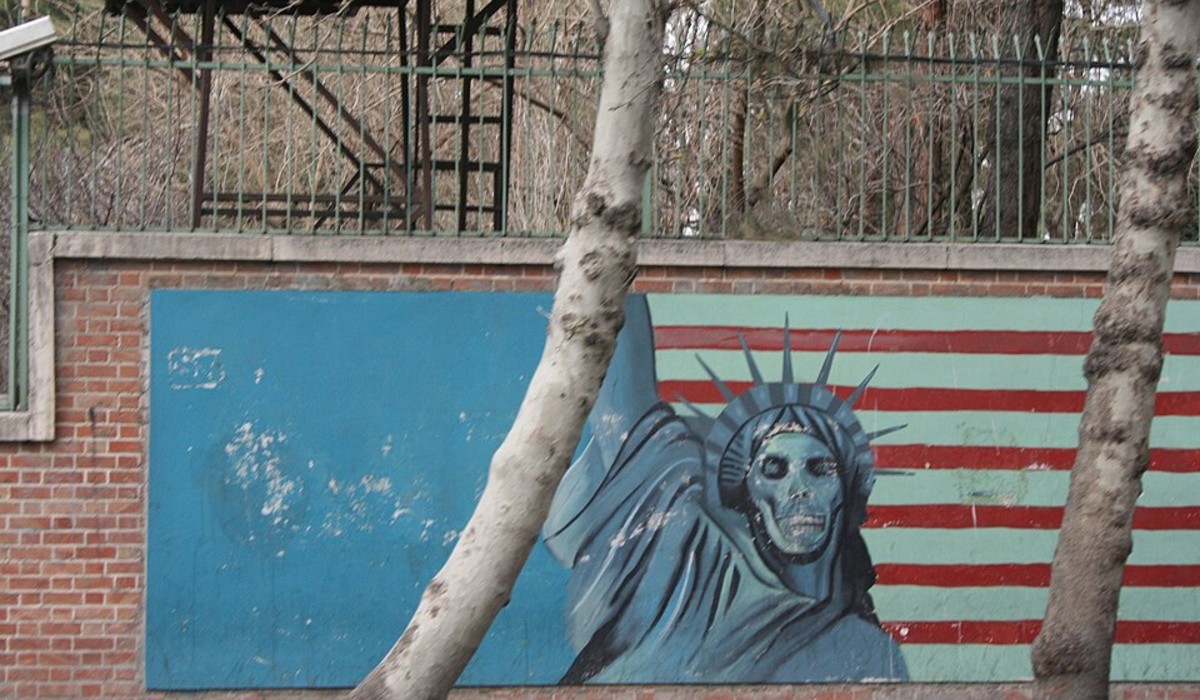
 Mural at former U.S. Embassy, Tehran,2008. Photo: Ninara from Helsinki, Finland / CC-BY-2.0
With a little more than a week since signing a deal the US and Iran continue to engage in military actions, Chris Bambery evaluates the current challenges and threats impacting on the process
As the military strikes by both Iran and the United States intensify, they obviously beg the question of whether the Memorandum of Understanding agreed by Tehran and Washington, allowing for a 60-day ceasefire across the region can hold.
But even before the latest strikes there were two major questions raised by the supposed peace deal. The first was whether the Strait of Hormuz were really open and, secondly, with oil prices back to where they were on 27 February, is the world economy out of the woods?
Let’s start with oil prices. The price of Brent crude has reached its lowest since 27 February, before the war started. The latest strikes can only drive it up.
At the outset of war prompted the largest-ever release of oil from countries’ reserves. That was particularly true in China, which helped limit the global price rise, and in the US where Trump drew on the Strategic Petroleum Reserve, which has fallen to its lowest point since the early summer of 1983, when it was in its infancy.
It is widely believed that the US oil reserves would have run out by the beginning of August, putting more pressure on Trump to reach a deal with Iran.
Across the world state’s will by buying oil to replenish their reserves. Driving up demand and therefore price. Due to the impact of the war on the Gulf experts predict prices will not return to pre-war levels until next year at the earliest.
Michael Noel, a professor of economics at Texas Tech University, points out:
‘You can’t just grab some crude oil out of the ground and a few minutes later put it into your gas tank,’ he explains. ‘It’s a very long supply chain, it takes a couple of months to get oil from the ground into barges to go around the world, then into refineries, and then through the pipeline system to eventually get to the gas pump.’
The US produces light crude but it is dependent on exports of heavy crude from the Gulf and elsewhere. It is refined into diesel and air fuel but that has to be done separately which will delay matters.
Much depends on the first question regarding the Straits.
Open for business?
There are three shipping lanes through the Straits of Hormuz into or out of the Persian Gulf. A northern one following the Iranian coast and a southern one following the Omani coast. Before the war the main route was through the middle but that is effectively shut because of Iranian mines.
In the week following the ceasefire announcement by Washington and Tehran, 125 vessels went through the Straits between 15-21 June, the highest weekly total since the war began.
On 24 June 24, AXS Marine charted 62 commercial vessel crossings making the crossing – the highest single-day count since the war started, but still only equivalent to 53% of the traffic on the same day last year.
Last Wednesday the Islamic Revolutionary Guard Corps (IRCG) declared that all ships must use the northern route through the Straits – in other swords they must use Iranian waters – and they must comply with Iranian routing instructions.
Hours later, a Singapore-flagged Evergreen container ship, the Ever Lovely, attempted to go through via the southern route off the coast of Oman. It was hit by a missile marking the first attack on a cargo vessel since the ceasefire took effect.
Almost immediately the Americans carried out air strikes claiming they hit Iranian missile sites and depots. Things might settle down but shipping owners face a problem – the high cost of insurance premiums for any vessels using the Straits.
Tim Huxley, is the CEO of Singapore-based Mandarin Shipping, which operates 50 vessels globally and has kept all of them out of the strait. He points out:
‘You’ve got this debate about who is authorizing ships to go through, what level of control the Iranians have on one side, the Americans have on the other. A lot of ship owners are just saying: I’m going to wait and see how these talks progress before I commit to sending a ship, its cargo, and most importantly, its crew.’
He then added: ‘Insurance premiums are still very high on ships and cargoes going through the straits, Until there is a more concrete set of guidelines on safe navigation, people are going to be very reticent to go through.’
Han Shen Lin, China country director of The Asia Group, put it more bluntly, saying:
‘Boardrooms aren’t asking about cargo safety — they’re asking if it is insurable. War-risk premiums have shot up from 0.05% to over 0.7% of hull value per transit. That’s not a risk premium, that’s a serious business model stress test. One vessel seizure doesn’t just cost you the cargo — it costs you the client relationship, the insurance renewal, and your board’s confidence. Speed is worthless without survivability.’
So things are not back to normal.
Complex problems remain
Added to all this even if the Straits were to fully open and shipping companies were prepared to pay a toll to Iran, as they insist, things will not return to pre-war days for some time. The bulk of the ships which went through immediately after the ceasefire were on route to China, Iran’s ally, not to North America or Europe.
Within the Persian Gulf there nearly 500 ships, including 220 oil tankers, that have been trapped there for months. When they get out they will badly need to refit, to be cleaned of barnacles and to change crew. Then they have to voyage back to the Gulf. That backlog could take months to clear.
There is also the small matter that oil, natural gas and other materials have been badly hit by the war. Much of the production and refining in the region was shut down early in the war when tankers were cut off. We also don’t know the extent of damage inflicted by Iranian missile and drone strikes. Re-starting production will take some time.
Then new oil tankers and other vessels will have to travel to the Gulf to pick up new cargoes of oil, liquid natural gas, fertiliser and much more. Shipowners will fear that any resumption of hostilities will mean their vessels could be trapped there for weeks or months.
The Iranian-US Memorandum of Understanding (MOU) agreed that the Straits would be open for 60 days after it was signed. Iran is insisting it will impose tolls at the end of that period. That’s one of a number of sticking points between the two countries. Another is the MOU stipulated that all fighting in the region, including Israel’s invasion of Lebanon, must come to a halt. Whether Benjamin Netanyahu sticks to that is a major issue.
The war has also impacted on Iran’s political order giving greater control to the IRGC, the more radical element in the Islamic Republic. By beheading the old leadership through the Israeli assassination strikes the US and Israel have helped install a more intransigent leadership. It is also confident after effectively winning the war with America and Israel and is not going to be pushed around.
Trump, one the other hand, is under pressure to bring gas (petrol) prices down before November’s mid-term elections and from multinational capital to get the Straits open and oil and much else flowing to stop the descent into a global depression. Achieving a deal between Iran and the US, however, is not going to be easy, and may prove impossible.
Before you go
The ongoing genocide in Gaza, Starmer’s austerity and the danger of a resurgent far right demonstrate the urgent need for socialist organisation and ideas. Counterfire has been central to the Palestine revolt and we are committed to building mass, united movements of resistance. Become a member today and join the fightback.

Chris Bambery
Chris Bambery is an author, political activist and commentator, and a supporter of Rise, the radical left wing coalition in Scotland. His books include A People's History of Scotland and The Second World War: A Marxist Analysis.