
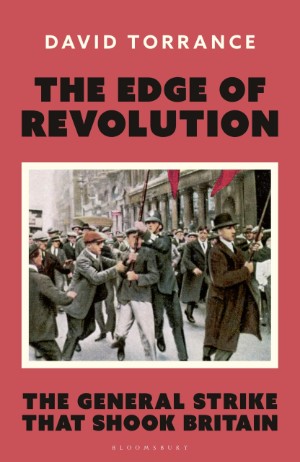
 David Torrance, The Edge of Revolution: The General Strike That Shook Britain, (London: Bloomsbury 2026) 320pp.
The Edge of Revolution is a lively look at the General Strike of 1926, but does not do justice to the biggest workers’ struggle in British history, finds John Westmoreland
The Edge of Revolution offers a history of the General Strike of 1926 very much from the point of view of its opponents. David Torrance is a biographer and parliamentary clerk working in the House of Commons library, and is well suited to researching diaries, letters and newspaper articles to write his book. As he says in the introduction, the ‘book follows the biographical approach’ of his The Wild Men: The Remarkable Story of Britain’s First Labour Government (2024)’. He then explains somewhat implausibly that his ‘high politics and middle class emphasis’, was unavoidable because ‘politicians and volunteers were more inclined to record their experiences than striking railwaymen, printers and bus drivers’ (pp.6-7).
There is hardly a quotation from a striker in person and very little from the grassroots organisations, councils of action or trades councils that were running the strike in the localities. As a result, we are left with a book dominated by the views of those who opposed the strike in government, the media, the posh strike-breakers, moralising churchmen and the trade-union leaders who did all in their power to be respectable and responsible by trying to end the strike as quickly as possible.
Torrance takes the view that the strike could have been avoided altogether, if only wise heads had prevailed. But who were those wise heads? Of course, politicians and the general council of the TUC alike lamented the strike and said it had been unnecessary. The government-appointed commissioners into the coal crisis in 1925, headed by Sir Herbert Samuel, are held up by Torrance as genuine solution-seekers who should have been listened to, and who, but for the hard-headedness of the mine owners and miners’ leaders, might have prevented the strike. This view aligns with the realpolitik of successive Labour Party leaders who have sought to reform the social consequences of capitalism without challenging the system.
In fact, the Commission’s report amounted to a declaration of war on the miners’ union, which was what the government wanted all along. It is worth explaining briefly that the strike could have been avoided, and that ‘wise heads’ had the answer. In short, the answer was basically what happened in 1945, which belatedly sorted out the most glaring causes of the strike from the miners’ and publics’ perspective. The coal industry was nationalised and invested in. There were plenty of wise heads at the time who could see this, including the vast majority of trade unionists who took strike action, but Torrance not only chooses not to give them a voice, he subjects them to ridicule.
One-sided view
Torrance’s profile of the miners’ militant leader, AJ Cook, (pp.101-3) is headed by a description given to Cook by Beatrice Webb, ‘A Quivering mass of emotions’. Webb is quoted regularly and approvingly. She was an opponent of the strike and despised the miners’ leaders, referring to Cook as an ‘ugly-featured man’ and Herbert Smith, the President of the Miners’ Federation as ‘senile’. Cook is presented as an ‘extremist’ committed to ‘nationalisation, the overthrow of capitalism and the Triple Alliance’ (miners, rail and transport unions), and as such, his stance was obdurate and a major cause of the strike. When the TUC sold the strike out, Cook was a convenient scapegoat for the general council to blame, and Torrance makes no attempt to defend him.
The biographical approach taken by the author makes for an interesting read, but it inevitably falls short as a work of history precisely because, as with the obvious case of AJ Cook, the author decides what to leave in and what to leave out. This extends to who gets to speak, and the message that they convey. Invariably the moderates win the day.
In his chapter on the origins of the strike, Torrance furnishes the developments that led to the strike being called with a mixture of what he sees as helpful and unhelpful voices. For example, Ramsay MacDonald is quoted favourably as someone who appreciated why negotiations between the TUC and government broke down:
‘The government has awfully mismanaged the whole business … But the [trade unions] have been equally blameworthy. It really looks tonight as though there was to be a General Strike to save Mr Cook’s face. Important man!!’ (pp.21).
Torrance’s favour falls far more generously on the government than it does on the TUC or the strikers. He often gives the reader interesting takes on what was happening within cabinet and the wider establishment. Prime Minister Stanley Baldwin comes out of it pretty well as a sincere bearer of national duty and responsibility, tormented by the militants who wanted to see working-class blood. But the bad guys don’t get the AJ Cook treatment. They are portrayed much more as the mischievous public-school boys looking forward to a game of rugger.
Without referencing the events taking place in Italy in the 1920s, Torrance introduces the reader to ‘Mussolini Major’ (Chancellor Winston Churchill), and ‘Mussolini Minor’ (Home Secretary William Joynson-Hicks). Joynson-Hicks is also described by his nickname ‘Jix’.
Churchill is presented as a huge, albeit controversial, personality, which he undoubtedly was, but there is nothing offered concerning the heartfelt admiration for Mussolini that Churchill expressed on numerous occasions. This is quite an oversight considering the book’s title. Churchill was one of those who thought, or said he did, that Britain was of the edge of revolution. He thought too that Mussolini had shown the way in pulling Italy back from the brink. As it is, Churchill, the fascist sympathiser, gets a pretty easy ride. Even where Torrance wants to show a bit of balance, his depiction of Churchill’s flaws like ‘egotism and poor judgement’ are always outweighed by his strengths: ‘Among his contemporaries, Churchill’s incredible energy, courage and eloquence were frequently acknowledged’ (p.69).
View from the top
The Edge of Revolution does have some strengths to its credit. In particular, the use of correspondence from the King and Prince of Wales reveals that they feared revolution and wanted authoritarian methods to deal with the strikers. The King was convinced that the strike was being led by Communists who wanted to overthrow the constitution and the monarchy with it. Amusingly, senior Labour figures were always at hand to steady the poor king’s nerves. In a meeting with Labour MP and railway men’s’ leader Jimmy Thomas, the ‘gravely disturbed king’ gestured towards his lavish surrounding and remarked, ‘If the worst happens, I suppose all this … will vanish’ (p.48). Joynson-Hicks had to calm the king by telling him that the Communists were being watched and arrests were sure to follow.
In a chapter headed ‘Blacklegs’ (pp.53-68), the so-called volunteers are treated, not as strike breakers, but as a patriotic bunch of chaps ready to do their bit for king and country. These were ‘varsity men’ from Oxford and Cambridge who couldn’t wait to get stuck into the strikers. Torrance paints a picture of toffs turning up to bus depots wearing plus fours, and figures from the nobility and retired army officers being prepared to do work like common people.
The scabs get a remarkably easy ride. There is no coverage, for example, of the role they played in trying to break the strike in the East London docks. Instead, there is a mixture of evidence that does include the failure of the scabbing operation to an extent, but there is no appraisal of what really matters: was the strike being defeated or were the strikers gaining the advantage? The chapter ends with a quotation from the left MP David Kirkwood, who said the General Strike had been ‘accepted in a spirit of fun’ and: ‘When I saw car-loads of girls driving through the streets of London looking upon the experience as if it were a picnic, I knew that we were beaten’ (p.68).
There is, however, some good material on the ‘high-politics’ of the strike that are often missing in other works by Labour historians. The strike saw interventions from religious and civil leaders that illustrate the divisions that came about in ruling circles. The Archbishop of Canterbury adopted a conciliatory stance. He was reluctant to condemn the strikers or to neglect the issue of working-class poverty. This contrasted with the Catholic Cardinal Bourne, who denounced the strike as ‘a sin against the obedience we owe to God’ and government authority (p.135). This was a blatant attempt to stop Catholic workers turning towards secular ideologies, and it backfired on him, earning the rebuke of ‘a Catholic working man’: ‘… you are trying to make Catholic workers scab on their fellow workers – the lowest of all things’ (p.136).
BBC Chairman John Reith is treated as an honourable figure, who clearly opposed the strike but nevertheless resisted Churchill’s attempts to turn the broadcaster into an arm of government propaganda. Even so, the book shows just how closely Reith worked with cabinet ministers and especially Stanley Baldwin, who was the first Prime Minister to address the nation on air. After the TUC surrendered to the government, ‘the craggy Scot [Reith] … recited Blake’s ‘Jerusalem’ … as he concluded the orchestra came in with full orchestra and chorus’ (p.202).
In summary, The Edge of Revolution is well worth a read, but socialists who have some knowledge of the strike will have to grit their teeth in places. On the whole, it is an interesting work that succeeds in bringing the characters who dominated events in those nine days to life, but this has to be set against a lack of analysis, that comes in great part by not giving voice, nor fair treatment, to those working-class fighters who led the biggest trade-union struggle in British history.
Before you go
The ongoing genocide in Gaza, Starmer’s austerity and the danger of a resurgent far right demonstrate the urgent need for socialist organisation and ideas. Counterfire has been central to the Palestine revolt and we are committed to building mass, united movements of resistance. Become a member today and join the fightback.

John Westmoreland
John is a history teacher and UCU rep. He is an active member of the People's Assembly and writes regularly for Counterfire.