
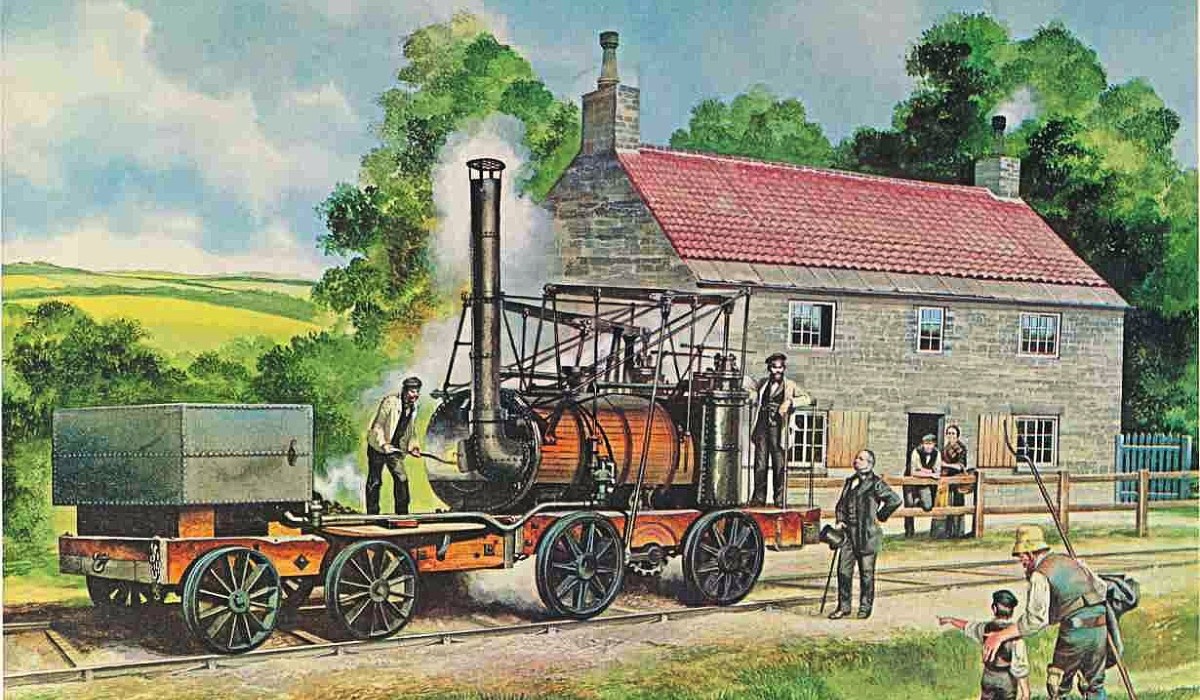
 The Stockton Darlington Railway / Art by Rob Embleton / Photo: Ausdew / Flickr / CC BY 2.0
Railways were once transformative for economy and society, but capitalism no longer supports them, even as we need them more than ever, argues Kevin Crane
On the 27 September 1825, the people of County Durham became the first in the world to have the option of commuting by rail. The Stockton and Darlington Railway adapted and extended minecart lines to link two major collieries and replaced a previous horse-drawn cart service with carriages pulled by a steam locomotive: the train had arrived, so to speak.
Britain pioneering the railways was no accident; the industrial revolution had kicked off early and the previous mode of transport that emerging industries had relied on, the canals, were reaching their limits of capacity and efficiency. Trains transformed everything in the field of transportation: you could now move people and commodities further than ever, faster than ever. Within fifteen years, a ‘railway mania’ gripped Britain, and government had to step in to manage the over-development of rail infrastructure and a major financial investment bubble. It was the internet of the steam age.
Far more than the internet, it was a technology that transformed the geography of the world around us and profoundly changed how people lived. It made urbanisation possible on a whole new scale, cheapening the cost of importing food into cities. Products could now be produced and processed centrally, but sold in distributed ways: so, consumer goods could now be factory built and sold in shops far and wide. The revolutionising power of capitalism seemed to be realised both literally and metaphorically.
No society before capitalism would have enabled the railways to be created; feudalism could barely organise paved roads. Still, capitalism’s relationship to the railways was always complicated, even in the early heroic phase. Railway companies would routinely blow through their budgets (this still makes the news but is nothing new) and relied on overblown hype to secure investment, much as the tech companies do today. They also had a similar tendency to be Ponzi Schemes, collapsing due to commercial unsustainability despite having made big money for an elite few. Analogous ghosts also haunt their sources of investment: the tech sector today is scoffing up funding from fossil fuels and the arms trade, the original source for much of the cash in the railway mania was ‘compensation’ that had been paid out to investors in recently freed slaves.
A plethora of rail companies had gradually consolidated into just four functional monopolies by the early twentieth century. At this point, the trains were vital to British life and the economy, but also increasingly under threat from the rise of the motor car. The automotive lobby has worked tirelessly to undermine the railways for well over a century (and still does, even though it too is in decline). After World War Two had demonstrated that the railways were still valuable, the post-war Labour government nationalised the system, but powerful political forces were now moving against the train. Consequently, it was under the publicly owned British Rail that the largest reduction of the railways occurred during the 1960s, a big source of regret today.
In the grand scheme of things, British Rail was a historic blip, since the Tories had pushed the whole network back into private ownership by the end of the 1990s. They probably had envisioned a managed decline of rail transport, much as they have achieved with the buses in most of the country, but it didn’t happen. This was in no small part due to Tory housing policy, since the push to get middle-class people to buy houses out in commuter belts meant rising numbers relying on the trains to get to work. Passenger numbers increased fairly consistently, right up to the Covid-19 pandemic. Rail freight was also surprisingly resilient, even after coal mining was done away with, thanks to the good old shipping container. All this being said, privatisation has been a clear bust: the infrastructure company had to be renationalised, none of the train-operating companies were profitable, and the rolling-stock companies are simply bleeding their assets to get public money.
We find ourselves in a strange place with the railways today. In theory, the threat of climate change should see us moving towards a new rail revolution, since electric trains are by some distance the most carbon-efficient way to do large-scale transport. In practice, capitalism’s impossible requirements for profitability from rail infrastructure is getting completely in the way. The ruling class is focused on doing irrational economic alchemy to try to make private profits out of the system, not actually meeting the transport needs of society. The railways could have a fantastic next 200 years or more ahead of them, if we could run them in a socialist way.
