
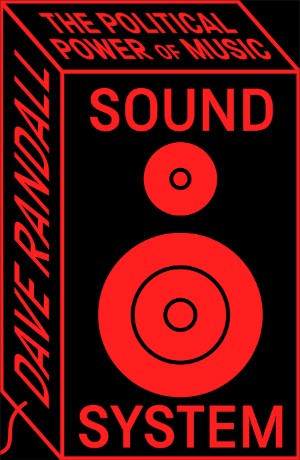
 Dave Randall, Sound System: The Political Power of Music (2nd edition, London: Pluto 2025), 208pp.
The new edition of Sound System extends the book’s nuanced and insightful analysis of the politics of popular music with more discussion of Palestine, and AI in music, finds Morgan Daniels
What is this thing we call culture? How is it made? How is it unmade? Is there a comfortable line between ‘high’ and ‘low’ culture? Does ‘popular’ culture express popular interests, or is it a tool of social control? If there appear to be no immediately satisfactory answers to these questions—and there aren’t—we do well to note that the great Marxist Raymond Williams described ‘culture’ as ‘one of the two or three most complicated words to define in the English language’. And we should be clear that this is not simply a linguistic problem, but rather a murkiness born of class society.
Dave Randall’s Sound System: The Political Power of Music revels in the murk. First published in 2017 and now updated, this book by a seasoned musician and activist sees popular culture as neither inherently hegemonic, distracting and propagandising to the masses, nor as something to be championed per se, as in certain strands of cultural studies. Instead, Randall sees a ‘contested’ space in which ‘context is key’ and meaning is up for grabs (p.17). ‘Usually music and politics are presented as two different spheres,’ he writes. ‘Different subjects at school, different parts of the newspaper, separate, discrete’ (p.27). What if, instead, we understand music as part of a totality, something affecting no less than affected by ‘politics’ and countless other things besides?
Sound System traverses considerable time and space in its exploration of music and class struggle. One of Randall’s earliest topics is the humble steelpan, a mainstay of carnival and testament to ‘the creativity and determination of ordinary people facing political repression’. For decade upon decade, the British plantocracy in the West Indies sought to curtail the music of the colonised, outlawing the skin drum and, later, other percussive substitutes (if music doesn’t matter, why ban it?). Thus, and so, the steelpan, the Trinidadians’ ingenious repurposing of the oil drums left behind in slums by the American Navy in the Second World War. Randall also discusses, for instance, John Lennon’s wisecracks at the 1963 Royal Variety Performance; the Nigerian ‘bohemian, maverick and punk provocateur’ Fela Kuta; and the folk culture of the Arab Spring. ‘It seems that whatever musical style we choose, they all emerge from and are subject to ongoing struggles. The complex, often hidden, political tug-of-war persists. Culture is a battleground’ (p.46).
In perhaps the most impressive chapter of Sound System, ‘Unity Lost’, Randall explores the roots of music in pre-capitalist societies and their collective labour on the land: take the Bayaka people in the Congo Basin, who turned the river into a sort of drum as they washed their clothes together, or the ancient Chinese choirs singing to encourage healthy crops. These are examples of ‘working communally without class divisions or private property. They remind us that it is in the intimate connection between human beings and nature that music has its origins’ (p.47). In Randall’s analysis, it is no coincidence that the charts are dominated by songs of loss and confusion: the violent rupturing of more communal ways of living was, after all, a necessity for the rise of capitalism. Popular music now constitutes a vast archive of alienation, with many of its foremost songs relaying our separation from one another and the world around us. ‘When human society started to divide into classes, music divided with it’ (p.176).
AI and now Gaza
There are two substantial additions to Sound System in its updated version, both of which convincingly extend Randall’s original arguments. One is a whole chapter on artificial intelligence, something stimulating significant and disturbing changes in the music industry at present. You might say that AI ‘music’ is the mirror image of music in its earliest forms: in contrast to communal songs wedded to nature, Suno and Gemini cannibalise the recorded history of human creativity whilst burning a hole in the planet. Threatening jobs and ripping off musicians’ labour, AI is quintessentially neoliberal technology, reflective, like those Chinese choristers, of the dominant form of social organisation. But this is not a deterministic relationship, and even here Randall senses opportunity, citing a bass-player friend who sees in AI’s capacity to mimic endless styles something tremendously exciting: ‘we are forced/freed to become creative; to take the music in unexpected directions; to be ourselves’ (p.148).1
The other big update to Sound System concerns the genocide in Gaza which continues apace at the time of writing. Randall has a long-standing commitment to Palestinian liberation, and in the original edition of Sound System he told the inside story of his 2011 protest song, ’Freedom for Palestine’, for which the author received acclaim and death threats. The story is appended here by some reflections on the musical responses to the horrors faced by the Palestinian people since late 2023. Here it is obvious that music—and popular culture more generally—is a ‘battleground’, to use Randall’s term. For sure, there has been a vibrant and impassioned response from some famous musicians to events in Palestine: think of Paul Weller’s Gig for Gaza extravaganza at Brixton or, even, the fairly astonishing sight of Eric Clapton touring with a guitar decked out in the Palestinian flag (p.128). Towards the end of 2025, Brian Eno pulled together an all-star line-up to perform the beautiful, gut-wrenching ‘Lullaby’, a reimagined Palestinian folk song released in time for Christmas.
But there has been considerable repression of such solidarity, too. Witness the (failed) prosecution of Kneecap and the BBC’s (failed) censorship of artists showing support for Palestine at the 2025 Glastonbury Festival. And, for that matter, witness repeated attempts to outlaw chanting in support of a Palestine liberated ‘from the river to the sea’. We are not in the realm of radio hits here. Rather, singing on demonstrations takes us much closer to music’s origins, a form of performance that is collective, ritualistic, often rudimentary, and very much bound to and transformative of the environment (talk about popular culture!). As with many of Randall’s case studies, Palestinian solidarity has responded creatively to heavy-handed repression.
All of which implies two conclusions. The first is that, if culture is contested, then contest we must. We might not make culture in circumstances of our own choosing, but we can change circumstances in so trying. A second point is that the repression of the songs of Palestinian solidarity suggests that Dave Randall is right to talk about the political power of music. In this context, it hardly seems convincing to put song and dance in one box and politics in another. If music doesn’t matter, why ban it?
1 I must confess to Luddite impulses on the AI question.
Before you go
The ongoing genocide in Gaza, Starmer’s austerity and the danger of a resurgent far right demonstrate the urgent need for socialist organisation and ideas. Counterfire has been central to the Palestine revolt and we are committed to building mass, united movements of resistance. Become a member today and join the fightback.
