
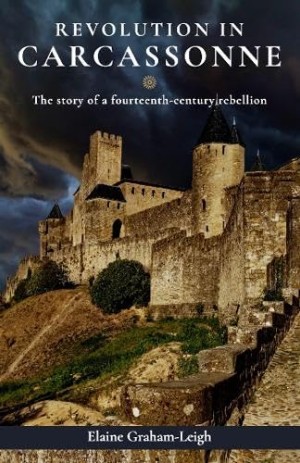
 Elaine Graham-Leigh, Revolution in Carcassonne (Whalebone Press 2025), xvii, 181pp.
Revolution in Carcassonne is a compelling account of a little-known medieval revolt in which class and religious issues were tightly bound together, finds Jacqueline Mulhallen
This is a fascinating book about an early-fourteenth-century revolt by poor townspeople in Carcassonne, Languedoc, which, the author argues, amounted to an attempted revolution. Languedoc, even today, is inclined to consider itself distinct from the rest of France but at that time Carcassonne ‘had been under French royal authority for only a little over eighty years’ (p.9).
Languedoc had been largely autonomous for centuries, inclining as much towards Spain as to the French monarchy in the north, but this changed in the early thirteenth century, when a war against heretics, the Albigensian crusade, was called against the south, and mainly northern French forces captured and sacked some of the main southern towns, including Carcassonne. This began a long period of effective occupation of the south, which was deeply resented. Also arousing mounting opposition was the oppressive activities of the Inquisition. These sparked the uprising, close to a century after the crusade began.
The geography of Carcassonne was important to how the revolt played out. The bourg, where the tradespeople and lower sections of society lived, was distinct from the cité on the hill above where the ecclesiastical administration and the élite lived. Just outside the cité, was the Inquisition prison, the Wall, where conditions were dreadful: insanitary and dark with prisoners shackled together so that they could not stand up or lie down. What is more, the Inquisition, mostly staffed by Dominicans, were arresting many, even leading members of the bourg and imprisoning them in the Wall, torturing them until they confessed to heresy. The problem with the so-called Cathar heresy that the Albigensian Crusade had targeted was that it was an inchoate mixture of dissent and ascetic enthusiasm in the first place.1 By the 1280s, Inquisition accusations of heresy targeted almost anyone showing resistance or any dissent from the new order.
A first heretical offence was punished by a penance, and having to wear a yellow cross, but a subsequent one ran the risk of being condemned to being burnt at the stake as a heretic. The property of heretics was forfeited even if the victim was accused posthumously. In 1285, a rebellion in Carcassonne had led to twelve leading members of the bourg being excommunicated, a sentence which meant that no one was supposed to communicate socially or commercially with them. However, the whole population largely ignored this and so they in turn were excommunicated. Then the consuls negotiated an agreement with the Inquisition and the general population was absolved, apart from the original twelve. Some of these had taken refuge in the Franciscan convent. When the Inquisition attempted to enter the convent, the Franciscans barred the way and rang the bell for help and the town supported them – people were already coming! The Inquisition retaliated by accusing of heresy someone who had died in the Franciscan convent, but they did not succeed and his son became one of the leaders of the revolt.
People from Albi were also imprisoned in the Wall. Appeals continued and in 1303, a Franciscan, Bernard Délicieux, began to preach in the streets of Carcassonne. There was a suspicion that the agreement with the Inquisition meant that the townspeople had been classified as supporters of heretics, putting them all in grave danger in the face of the Inquisition. Bernard told a parable about a field of rams where each day one was taken away to be butchered. The rams agreed that although they had no one to act for them, they had horns, that is, they could resist together.
Supported by a crowd from the town, Jean de Picquigny, the royal inquirer in Languedoc, went to the Wall and demanded that certain prisoners be freed. They were then transferred to a royal prison where (we hope) conditions were better! Made aware of the discontent in Carcassonne, King Philip IV of France visited, but his response to the bourg’s concerns was so disappointing that the townspeople took down the decorations they had put up to celebrate his visit. One of the leaders of the revolt shouted at the King the equivalent of ‘Go to hell!’ but it is notable that there was no punishment for this.
Some of the leaders offered Carcassonne to a younger son of King Jaime II of Majorca. This was not as strange as it may now appear, since nearby Montpellier belonged to King Jaime and Perpignan was his capital. As there were close links with the Kings of Aragon, it may have seemed that Languedoc might become Spanish rather than French. But Jaime II was not keen to offend the French king so this did not happen.
There was an attempt to spread the revolt to other areas, and this was certainly successful with the town of Limoux. Despite this, by November 1305, the leaders had been arrested and tried, and hanged at a gibbet specially made on the road to Narbonne, while heavy fines were imposed on the bourg. The consuls were suspended but they were restored the following year. There was a papal enquiry into the conditions in the Wall; guards were replaced and a pro-bourg governor appointed.
The revolt had kept going for nearly two years, during which time, the fiscal and judicial government of the bourg was controlled by the rebels, whose rule began with the ‘breaking of homes’, a targeted attack on the houses of the rich leaders of the bourg. This shows that the revolt in its radical phase, had a significant class dimension, and was not merely a dispute about heresy, since the social and the religious aspects were linked and both important.
In 1319, the radical Franciscan preacher Bernard Délicieux, who was in Paris at the time of the arrest of the rebel leaders, was arrested and tried for his part in the rebellion. In such cases there was only evidence for the prosecution and no opportunity for defence. Testimonies were not verbatim and recorded in Latin, whereas many of the witnesses would have spoken in Occitan, the language of Languedoc. They were taken in private, perhaps with torture and certainly with leading questions. By judiciously looking at the records of this trial, Elaine Graham-Leigh was able to piece together the story. Her original research, her knowledge of the period, the background, and of parallel stories enlightens her account of this revolt, including its aftermath, and her analysis is compelling. It is written clearly and concisely, disentangling much complicated material.
The book is compact and attractively produced with maps, and, unusually for a book this size, four colour photographs. There is a note on money, and a helpful list of the characters mentioned. Although the chronology is clear, since a great deal of material is discussed under each heading, a timeline would have been useful.
Altogether, it is a triumph, bringing to life a rebellion of the Middle Ages, which makes you want to learn more.
1 The author points out that this term would not have been applied at the time (p.62).

Jacqueline Mulhallen
Jacqueline Mulhallen, actor and playwright, has co-ordinated King’s Lynn Stop the War since 2003 and initiated and organised 14 Women for Change talks for King’s Lynn & District Trades Council (2012/2013). Her books include The Theatre of Shelley (Openbooks, 2010), and a Shelley biography (Pluto Press, 2015). Her plays include 'Sylvia' and 'Rebels and Friends’.