
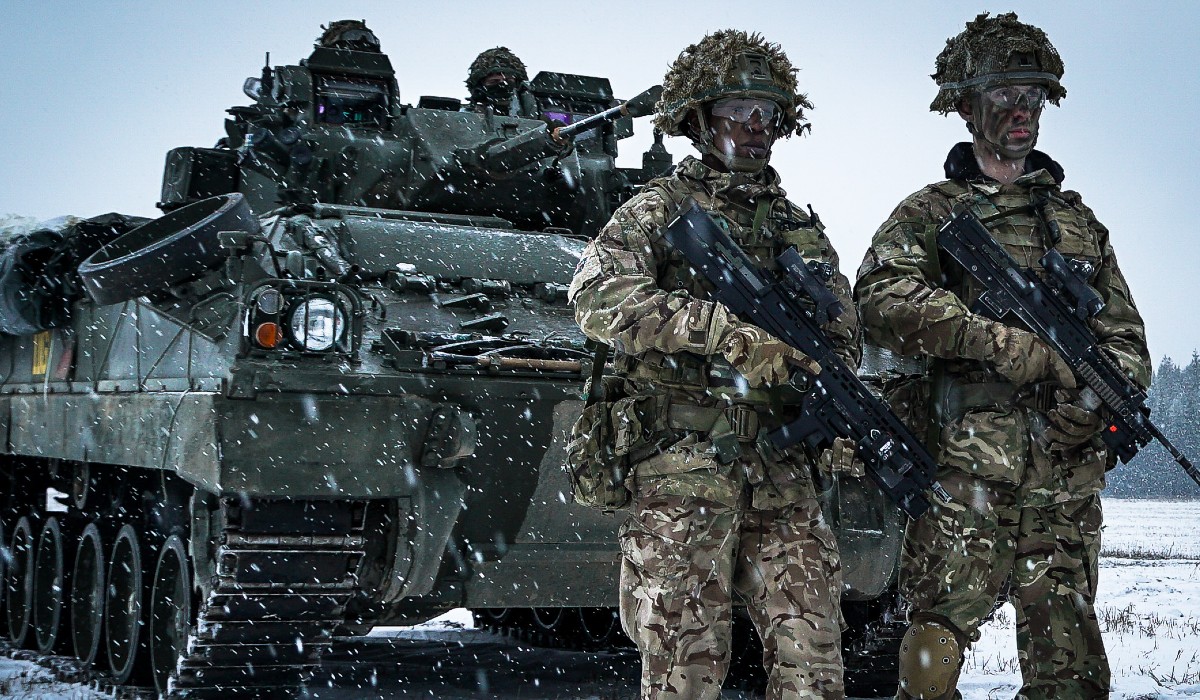
 British troops. Photo: NATO / CC BY-NC-ND 2.0
Our unstable and violent world is a product of the military and economic competition built into capitalism, argues Alex Snowdon
In August 1914, Europe went to war. Over the next few years, millions of working-class people were killed. It was a massive clash between the great imperialist powers.
August 1914 shocked Marxists who opposed the war. It was not the outbreak of war that shook them. They had warned of that happening. They had traced the long-term factors leading up to it.
The shock came from supposedly socialist parties across Europe capitulating to their own ruling classes. These parties had previously passed resolutions pledging internationalism, working-class solidarity and opposition to war. Now they backed the ‘national war effort’.
This created a massive crisis on the left. It also prompted some Marxists, most notably Lenin, to analyse modern imperialism as the latest stage in capitalism’s development. Marxists traced the economic roots of the war and worked through the implications for socialists.
Lenin wrote that by 1914 capitalism had become ‘the financial strangulation of the overwhelming majority of the people of the world by a handful of ‘advanced’ countries.’ This dominance by the European ‘great powers’, rooted in their advanced economic development, was imperialism.
Karl Marx had analysed the development of capitalism as a competitive system. From the 1870s onwards, capitalism developed in ways that would reach their climax in world war. This involved the growth of monopoly capitalism.
Marx observed that competition between rival capitalists pushed them to increase exploitation of workers in order to sell goods more cheaply than their rivals. He noted, however, a paradox. Competition, over time, produced what might seem to be its opposite – a monopoly. Successful capitalists would take over their failing competitors and increasingly dominate their field.
These bigger and bigger companies wanted new markets to sell in. They sought fresh raw materials (and fresh human materials) to exploit. They pushed, more and more, beyond national frontiers.
This was a deeply competitive system between the major capitalist states. Each national ruling class protected the interests of its biggest industrial and financial firms. An age of inter-imperialist rivalry began.
Monopoly capitalism created a genuinely global economy for the first time in history. Capitalist firms, based in the advanced capitalist countries, spanned national borders in the workers they exploited, the natural resources they relied upon and the markets where they sold their goods.
The Scramble for Africa and the expansion of European empires saw the great powers carve up the world. It was plunder for profit.
Along with it went the brutal subjugation of people in what we today call the Global South. Capitalism had, wrote Lenin, ‘grown into a world system of colonial oppression’.
All parts of the world were dragged into the inter-imperialist conflict. The economic and social development of subjugated nations was conditioned by what happened in the wider system. Lenin understood that national liberation struggles were shaped by the global context of competition between imperialists.
The First World War was an expression of the competition between the largest imperialist states. The growth of a global economy dominated by these powerful states meant that the war would, unlike any previous conflict, be truly global.
The same would be true, on an even greater scale, in the Second World War. Since 1945, the old formal empires have collapsed, but the system of imperialism has continued because its economic roots have remained.
Lenin’s anti-war internationalism involved opposing war on the basis that it expressed the material interests of national ruling classes, while it was working-class people across all nations that would suffer. He also viewed the First World War as reflecting, and aiming to reinforce, the colonial domination of large parts of the world by western Europe.
Lenin identified that there was an alliance of interests between working-class people in the advanced capitalist countries and the oppressed people of subordinated nations. Lenin and the Bolsheviks supported national liberation for those who were subordinated to the imperialist powers.
A great deal of ruling-class ideology was geared towards obscuring these common material interests, with workers encouraged to identify with the ‘national interest’ while viewing those in the colonised countries as inferior. Nationalism and racism remain powerful barriers to working-class unity today.
Eighty years after the end of World War Two, we live in a world still characterised by the economic and military competition documented by Lenin.
The US is the globally dominant power, but one that has experienced long-term economic decline and is vulnerable to challenges, in particular from the growth of China’s economic weight. Ours is an unstable and violent world.
Before you go
The ongoing genocide in Gaza, Starmer’s austerity and the danger of a resurgent far right demonstrate the urgent need for socialist organisation and ideas. Counterfire has been central to the Palestine revolt and we are committed to building mass, united movements of resistance. Become a member today and join the fightback.

Alex Snowdon
Alex Snowdon is a Counterfire activist in Newcastle. He is active in the Palestine Solidarity Campaign, Stop the War Coalition and the National Education Union. He is the author of A Short Guide to Israeli Apartheid (2022).