
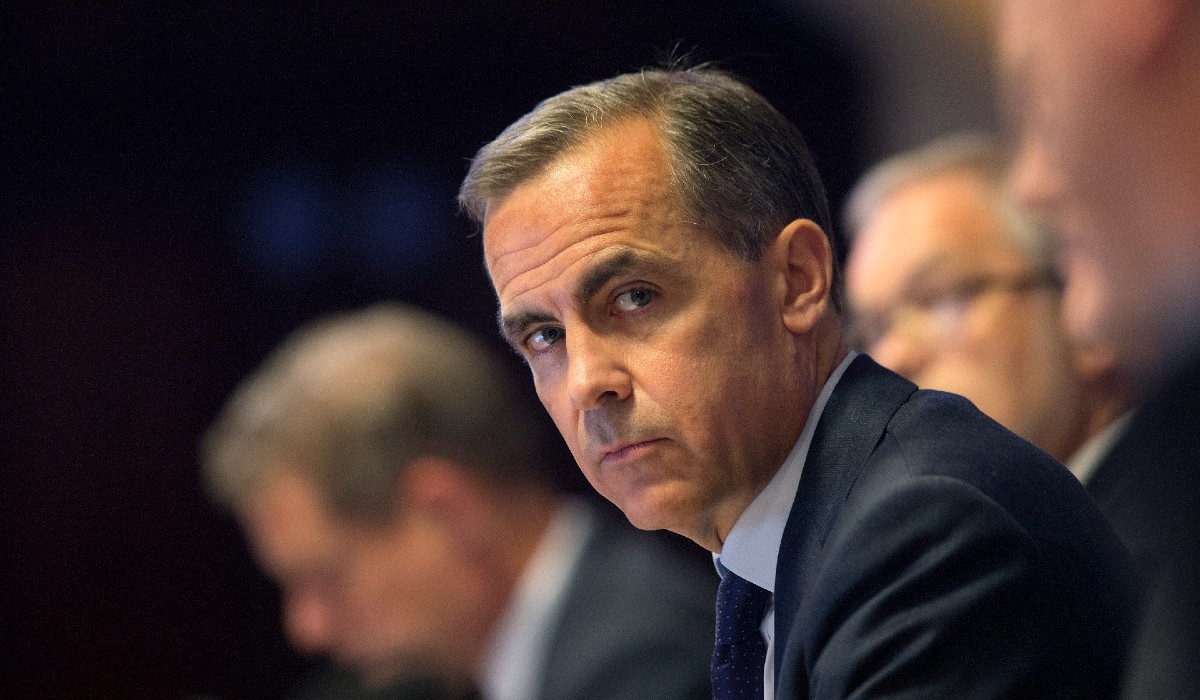
 Mark Carney, Canadian Prime Minister. Photo: Bank of England / Flickr / CC BY 2.0
John Clarke analyses the Canadian Prime Minister’s turn towards austerity and cuts
As a former central banker and functionary of Goldman Sachs, Mark Carney knows a thing or two about stabilising capitalism and preserving profits. Now that he is the prime minister of Canada at a time when the country is facing the Trump administration’s protectionist measures, Carney is using his skills to the full and developing a strategy to impose the burden of the trade crisis on the working class.
Carney’s Liberal Party has issued a statement making the case for massive cuts and an agenda of austerity that will be one of the greatest of such exercises ever seen in Canada. Putting a positive spin on the process, it informs us that ‘(n)ow is the time to build Canada into the strongest economy in the G7. Doing so…will mean spending less on operations so we can invest more in the things that build Canada, like homes, naval ships, roads, and the capacity of businesses to invest in technology, production, and ideas.”
Austerity and deregulation
There are some significant clues in this formulation that warn us of what is actually being prepared and David Moscrop, writing in Jacobin Magazine, provides an outline of the real significance of Carney’s plans and the political calculations that underlie them. It is clear that harsh spending reductions, programme cuts and attacks on public sector workers will be linked to increased efforts to eliminate regulations that offer limited protections to workers, communities, consumers and the environment.
Moscrop explains that ‘…in a bid to “spend less and invest more” — a mantra Carney often repeats — he ordered a whole-of-government review through the new Red Tape Reduction Office to target potential regulatory cuts. The order came two days after Finance Minister François-Philippe Champagne launched a “comprehensive expenditure review” and asked his cabinet colleagues to identify potential operational and program cuts.’
The Liberals are ‘planning to reduce spending between now and 2029, beginning with a 7.5 percent cut in the coming year, rising to 10 percent, and then 15 percent cumulatively by 2029.’
The parliamentary budget officer observes that, when it comes to cuts on this kind of scale, “(i)t’s just a matter of how much pain that will inflict on public servants and on Canadians.”
The imperative to cut deeply will be increased dramatically, moreover, by the fact that the Carney government is going in the opposite direction when it comes to military spending. It will be hiked by $9 billion this year alone, ‘with further increases to come in a bid to meet NATO targets pushed by, among others, Trump and the United States.’
Moscrop suggests that the Liberals are motivated, in mounting this assault, by a desire to refocus government policy and state spending in line with two contradictory priorities. On the one hand, they want to ‘placate the Trump administration in hopes of finding tariff relief.’ To this end, they must spend ‘billions on border security and defense’ to comply with Trump’s demands. To the extent that the impacts of US protectionism can’t be avoided, however, they must also ‘find new strategies to grow the economy without relying on the United States.’ In order to facilitate this, ‘infrastructure investments and deregulation’ will be pursued.
Others have commented on the enormity of what Carney is setting in motion. An article in The Breach quotes economist David Macdonald, who suggests that we are facing “the worst cuts in modern history.” He adds that “(f)or cuts this deep,” it would require across-the-board job losses and major service reductions.”
The closest point of comparison to the process of austerity that Carney has embarked upon is to be found in the huge assault on Canada’s social infrastructure that was undertaken in the 1990s. At that time, it was the ‘moderate’ Liberal Party and not its more overtly right-wing Conservative rival, that took the major step in imposing the kind of social cutbacks that were associated with the period of neoliberal restructuring. In that sense, history is repeating itself in the present context.
Writing in the Tyee in 2015, Michal Rozworski set out the enormity of the measures that were taken in the 90s. In 1994, Paul Martin, finance minister at the time but later prime minister, vowed that “(o)ver the next three years, for every one dollar raised in new revenues we will cut five dollars in government expenditures.” Based on this approach, ‘(t)he subsequent austerity drive was one of the most severe in the global north.’
The federal government cut massively into programmes that it delivered directly, especially with regard to social housing, but it also reduced transfer payments to the provinces and municipalities, setting in motion a chain reaction of austerity measures that has never subsided since.
Under conditions of trade crisis and, with a view to boosting the competitiveness of Canadian capitalism, Carney is looking to replicate or even exceed the assault that was unleashed in the 1990s. He will do so, however, by attacking a social infrastructure that is considerably less robust than it was when his predecessors went to work three decades ago. Their knife cut into flesh but Carney will be cutting into bone.
Carney’s alliance
The America First turn by the Trump administration, including the emerging conditions of trade war, pose very major problems for those countries that might have been considered junior partners of the US. These lesser imperialist powers must now deal with a much harsher and far more uncertain situation than existed under the post-war system of US ‘world leadership.’
For Canada, with an economy that is highly integrated with that the US and that has developed a huge dependency on trade with its far more powerful neighbour to the south, the problems generated by this changed situation are especially severe. Carney’s government is seeking to ensure than Canadian capitalism weathers the storm and that profits are preserved in this unstable period.
Any accommodation with Trump will mean concessions by Canada but the alternative strategy of greatly diversifying the country’s trading partners will require that Canadian exports are highly competitive. In either case, the objective will be to increase lagging productivity and profitability by increasing the rate of exploitation and removing restrictions that impede profit making, even if they constitute vital social protections.
This class war agenda is now taking on the dimensions of a broad political alliance under the leadership of the Liberal government in Ottawa. At the federal level, electoral developments have been kind to Carney. His party won the last election, held this April, because the Trump like nature of the hard right Conservatives, under the leadership of Pierre Poilievre, suddenly became a political liability. Poilievre even lost his own seat in parliament and is now having to wait for a byelection in August in order to try and re-enter the House of Commons.
Having clung to the political centre, propping up the Liberals when they lacked a parliamentary majority, the social-democratic NDP was almost obliterated in the election and has lost its official party status in parliament. This ensures that Carney can proceed with his assault on workers and communities without even a tokenistic parliamentary opposition from the left. For that matter, the opposition from the right is likely to be quite tepid.
On secure ground federally, Carney is focusing his efforts on heading up a de facto alliance with the provincial governments. This focuses on an agenda of deregulation and a massive drive to expand fossil fuel extraction and mining projects. In this regard, the Conservative government of Ontario is working in lockstep with the federal Liberals, going so far as to set up ‘special economic zones’ where worker protections, environmental standards and agreements with Indigenous communities can all be set aside.
The alliance that Carney is fashioning, however, isn’t confined to right-wing governments. Provincial and territorial premiers have eagerly submitted plans for ‘nation building projects’ that will supposedly, as a recent Yahoo article put it, ‘supercharge Canada’s economic growth and mitigate damage from tariffs levied by the United States.’ Provincial and territorial governments headed by the NDP haven’t hesitated to participate in this scramble, their supposed commitment to Indigenous rights and climate justice notwithstanding.
At the present moment, we can expect only the mildest opposition to Carney’s drive to impose the burden if the trade crisis on workers and communities to emerge in the parliamentary arena. As the attack intensifies and its impacts are sharply felt across the country, social mobilization and mass action will be urgently required if Carney’s agenda of austerity, deregulation and environmental degradation is to be effectively resisted.
Before you go
The ongoing genocide in Gaza, Starmer’s austerity and the danger of a resurgent far right demonstrate the urgent need for socialist organisation and ideas. Counterfire has been central to the Palestine revolt and we are committed to building mass, united movements of resistance. Become a member today and join the fightback.

John Clarke
John Clarke became an organiser with the Ontario Coalition Against Poverty when it was formed in 1990 and has been involved in mobilising poor communities under attack ever since.