
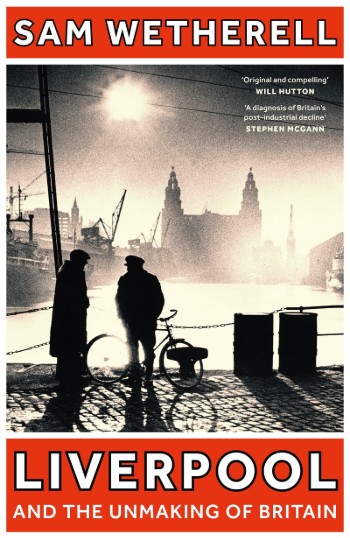
 Sam Wetherell, Liverpool and the Unmaking of Britain (London: Bloomsbury 2025), 448pp.
This ambitious and insightful history of the working class of Liverpool uncovers a vast history buried by mainstream memory, finds Kevin Crane
Liverpool looms large in the popular imagination of England and of the world’s image of the country, even though it is both a relatively small city and also a young one. It is also, in the view of author Sam Wetherell, an extremely atypical city, which you might think would make for his version of its a history to be a highly parochial affair. This is, however, the opposite of what the writer set out to do: he opens up his book with a theory that ‘obsolescence’ is a driving but underexamined force in British capitalist society for which Liverpool’s unique history can be used as guide.
The left has every bit as much reason to be interested in Liverpool as do fans of football and rock and roll. Having some family ties to the city and also having spent my student years there, I was particularly curious to see how this book could make topics with which I had some familiarity novel. I am glad to say that it did manage this, even if many of the new angles that it brings to the story of the city are not a happy read.
Rising and falling tides
Central to Wetherell’s obsolescence motif is, of course, Liverpool’s famous dock front. The docks absolutely made the city – which was an obscure village until the industrial revolution – and are also the interface by which most of the population arrived. The sheer scale of this operation throughout its (literal) imperial phase was absolutely mind-boggling and required an enormous concentration of waged workers on never-before-seen scales.
The rise and fall of dockworkers as the core of Merseyside’s working class is accordingly epic. Dockers were initially employed on a near-exclusively casual basis, making their lives not just hard work, but also stressful and dangerous in the extreme. It took a very long period of struggle for dockers to obtain regulated jobs and guaranteed pay, only for these measures to arrive with barely a generation to go before a series of historical shifts – such as decolonisation and the invention of the shipping container – saw their numbers finally contract to the near-nothing it has been since the 1990s. Some older readers may well remember the popular 1995 Liverpool dockers’ strike, but while this gets its due in the book, Wetherell is clear that final dispute should be viewed as defiant last stand by a workforce and trade union that were aware they were on their way off the stage of history.
The truth is that, despite what is popularly remembered about dockworkers, large formal industrial disputes were the exceptions rather than the norm. Remarkably, the author relates, the Transport and General Workers’ Union did not actually authorise a single strike during the 1950s and 1960s, despite mainstream culture remembering this as when strikes would have been ‘normal’. When strikes took place in this period, it was either as fully ‘wildcat’ actions without using union structures or bypassing them through workers affiliating to a rival union called the National Amalgamated Dockers and Stevedores (often called the ‘Blue Union’ because of its distinctive membership cards) that achieved co-recognition after a two-day shutdown in 1955.
The bourgeoise was never totally ignorant about Liverpool’s solipsistic relationship with the docks, and one effort they made in the post-World War II period to both compensate and capitalise on a large, fairly low-waged, population was to introduce manufacturing, particularly in the car sector. The men in my own family found their employment there, and that gave me additional interest in reading about the high tide of motor making. Much like in the docks, these employers did not succeed in keeping the unions out of the car plants, and employment conditions became fairly good for a time. Unfortunately, also like the docks, the tide of the economy would eventually turn, and leave the majority of car workers just as obsolete as most of the dockers had become.
One thing the author does not do during these parts of the narrative, however, is romanticise, or even particularly talk up, the quality of life even before hard times hit. He continually returns to first-person accounts of how hard dock work was, and how boring and stultifying Fordist manufacturing was. The point being made here is that even when times were ‘good’, life for these people was never cushy, and it’s a mistake for the left to imagine it had been.
Other voices
Something else that Wetherell thinks the left should not do is forget that working-class history contains diversities that are all too often forgotten. So, while he is clear the dockers’ and car workers’ stories are a major chapter in working-class history, they are still ones from which non-white people and most women were systemically and structurally excluded. To balance this out, the author gives an equal amount of space to the struggles of mostly non-white and mostly female groups, which are both a fascinatingly diverse set of other narratives.
On women’s struggle, for instance, stories about the feminist movement in the city – which are perhaps the most familiar version of women’s liberation to us now – are also accompanied by absolutely fascinating accounts of working-class women leading neighbourhood-based campaigns that are mostly forgotten today. Some of these were classically economic in their demands, such as rent strikes, or movements of solidarity with workplace industrial action.
Others, however, were more unusual but arguably a bit of ahead of their time, such as the major roadblocks organised by working mums in the streets in which they lived to protest the way that an increasingly car-focused economy and establishment was disturbing their living space and putting their families in danger. Still more excitement is to be found in the underground railroad that scouse women organised to assist Irish women fleeing into the city to seek abortions, or the highly innovative ways that black women organised to deal with their exclusion from proper public services.
Of course, the latter issue touches on one of the most important, but also most complicated, issues in Liverpool’s history: race.
From city of Empire to a ‘World in One City’
Establishment histories of Liverpool inevitably trip up on a problem, which is how to talk about it without engaging with its status as a corner of the Triangular Trade. Slavery is only part, however, of the city’s difficult cultural history, even if it is the single the most import one.
Rapid growth from a literal backwater to one of the most important ports in the world, kick-started by slavery, created a huge demand by capital for labour, and this was far too great for England to supply internally. In addition to large numbers of black sailors, from colonies on both sides of the Atlantic, significant numbers of men from Asia were used, most importantly from China. There was also, in the mid-nineteenth century, the influx of Irish people fleeing the famine Britain had created in their country.
The Irish remained a distinct, and somewhat excluded, community in Liverpool for an astonishingly long time, and a sectarianism most people today would expect to see only in Northern Ireland or Western Scotland persisted well into the twentieth century. Wetherell reckons that it was not until large-scale slum clearances pushed Catholic and Protestant people out into new-build estates that it finally started to abate – something that definitely chimes with the stories I have heard from older Liverpudlians – which would have a number of strange effects on the party politics of Merseyside almost to the 1990s.
The Irish, however, had to a large extent arrived as families, had support from co-religionists, and happened to have white skin. The African/Afro-Caribbean and Chinese arrivals, by contrast, were overwhelmingly younger men hired for manual work and considered culturally undesirable by the rich folks who were ultimately exploiting their labour. Their exclusion from ‘good’ society in Liverpool was nakedly systematic; politicians would freely discuss them as an underclass, and the University of Liverpool became a major hub of wildly offensive ‘race science’. Academics were extremely useful to bigoted bosses and landlords, who kept the visible ethnic minorities as much as possible confined to undesirable jobs and crowded guesthouses.
The fact that black and Chinese incomers were mostly men was a particular source of anxiety for this elite. White women entering into relationships with them were universally described as being prostitutes, even after years of marriage, and at the University the inane term ‘half caste’ was coined as a respectable slur to use against the children of such relationships.
Aggression against the Chinese reached an early crescendo in 1945, when hundreds of Liverpool Chinese men were rounded up by the police, taken away from their families and deported without process to the Far East. It simply lumbered on for decades against black people. As the century progressed, the culmination of discriminatory employment and housing policies, and also sporadic riots by white people who had been deliberately radicalised by racist propaganda, had resulted in what had previously been England’s blackest city actually becoming whiter while others were diversifying. The black population who tried to stay on being confined, as they were, into an area whose name has since become evocative: Toxteth.
Wetherell regards it as quite appropriate to call Toxteth, by the early 1980s, a ghetto. But he does not accept that the event most closely associated with the place was a ‘riot’. In his view, the clashes between Liverpool’s black working class and its openly racist police force and political establishment can be legitimately considered only as an uprising. The chapter on this conflict is amongst the most gripping in the book, and marks something of a fulcrum point in the author’s narrative about the new and the old in Liverpool.
For a start, it began a process of long-overlooked debate about the city’s racial history, albeit one that has had nuanced outcomes. Liverpool now has, for example, a museum of slavery and a colourful China Town, but the former is a somewhat sanitised annex of the city museum and latter is lived and worked in primarily by more recent generations of Chinese people. It is debated by activists within both communities how much any of this really reflects a restitution of past suffering. The author points out that there was something rather glib about the way that Liverpool marketed itself (successfully) to be European capital of culture with the tag line ‘the World in One City’, as if that diversity was the result of a triumph of cosmopolitan inclusivity and not a by-product of the mechanics of imperialism.
A clash of urban utopias and city hall revolutionaries
The response to the Toxteth rising also included a national-level response about how to give a future to a city that had lost its past. The book contains a lot of conflicting ideas about this over the decades, but the most dramatic clash is also one that takes place in the mid-80s: the direct battle between Margaret Thatcher’s Tory government and the ‘Militant council’ in Liverpool town hall. Wetherell takes some visible care when talking about this, because he sees it as a historic event that is often alluded to glibly, but seldom talked about illuminatingly.
The chapter on Militant focuses on how paradoxical the group was. Despite officially being revolutionary socialists, the organisation was focused on growing itself as a faction within the Labour Party. This is one thing when you expect to be oppositional all the time, but quite another combination if you suddenly gain control over the machinery of reformist politics and actually administer a chunk of the state. This is even more true if that chunk is one as dysfunctional as a functionally bankrupt northern city’s municipal authority.
Militant in government can best be described as a very strange experiment in trying to use the machinery of local government as a proxy for the organised working class, at a time of widespread defeat and retreat for the actual organised working class. Their means of doing this was to try a series of intentionally economic overreaches, primarily getting the council to spend money it didn’t have on building working-class housing, in a bid to stimulate wealth-acquisition locally and (somehow) force the national government to fund it. For all their theoretical roots in the traditions of revolutionary Russia, it ultimately all looks lot more like a backyard interpretation of John Maynard Keynes’ theories about using state spending to overcome capitalist contradictions than it does anything from the Marxist left. Even the ‘progressive’ outcomes of this policy agenda wore a certain capitalist conformity: with the resulting new estates being designed on a private-transport orientated suburban geography model that was weirdly similar to Thatcherite ideas about housing.
Wetherell argues that the limits to Militant’s radicalism were not confined to the purely economic, however. Their vision of how the working class should be viewed completely rejected ‘new leftist’ ideas about being more open to social movements like anti-racism, women’s liberation or LGBT rights, and they scoffed at other left-Labour administrations – such as Ken Livingstone’s in London – that embraced these movements. They, in fact, ended up alienating many women in the movement, getting into direct (sometimes violent!) confrontation with black activists and nearly derailed a highly successful LGBT-led project to tackle the HIV-epidemic.
After all this commotion, the scene was set for Liverpool to be used as the pioneer city for another phase in British capitalist development: post-industrial gentrification.
The city goes from a centre of production, to being the product
Towards the end of the book, Wetherell depicts the various strands of Liverpool’s story as culminating in a city reinvented as a cultural destination. His argument that the version of the city that is now promoted as a key destination for music, football, partying or history is not that these things are entirely spurious, but nor are any of them an entirely ‘authentic’ experience that late-period capitalism likes to sell.
Football, to pick a particularly relevant example, has only been the big-money, family friendly cultural juggernaut it is today since it’s reinvention in the wake of the Hillsborough atrocity: a mass killing-by-negligence of Liverpudlian football fans. The fight for justice for the victims of this appalling incident has been a defining political struggle for decades since by the people of the city, but it’s really not what Liverpool Football Club want the massive international audience to have in their minds when they are paying a pretty penny for today’s luxury sporting experience, even as it encourages them to sing along with ‘You’ll never walk alone’. It’s another case in point of how the difficult history of the city has been given a consumer gloss. Just like how the history of the docks and the diversity of Merseyside’s population have become a colourful, edgy thing to explore, all controversial edges have been quietly smoothed off for marketing.
At the end of reading Liverpool and the Unmaking of Britain, I have to say I wasn’t totally convinced by all of the author’s ideas. His argument on obsolescence isn’t entirely wrong, but I’m not sure it works as the total theory he hopes it will be. He argues that all of Britain will, one way or another, be a giant Liverpool. I don’t think this is a certainty, and indeed if we look at the ways that other parts of deindustrialised England are being eyed-up for use as sites of pure extractivism (see proposals for fracking and AI datacentres in Yorkshire), it might even be too optimistic!
Even if I don’t think this book does quite point to the future in the way that it hopes to, it is a really good and enjoyable history. I’ve barely scratched the surface of the fantastic research that Wetherell did on working-class lives and organisations through the late twentieth century, many of which are genuinely a joy to discover after so much has been deliberately lost in mainstream memory. Indeed, if you were planning a trip to Liverpool any time soon, this book might be a great thing to read beforehand in order to really grasp the true history behind the glossy twenty-first-century veneer.
Before you go
The ongoing genocide in Gaza, Starmer’s austerity and the danger of a resurgent far right demonstrate the urgent need for socialist organisation and ideas. Counterfire has been central to the Palestine revolt and we are committed to building mass, united movements of resistance. Become a member today and join the fightback.
