
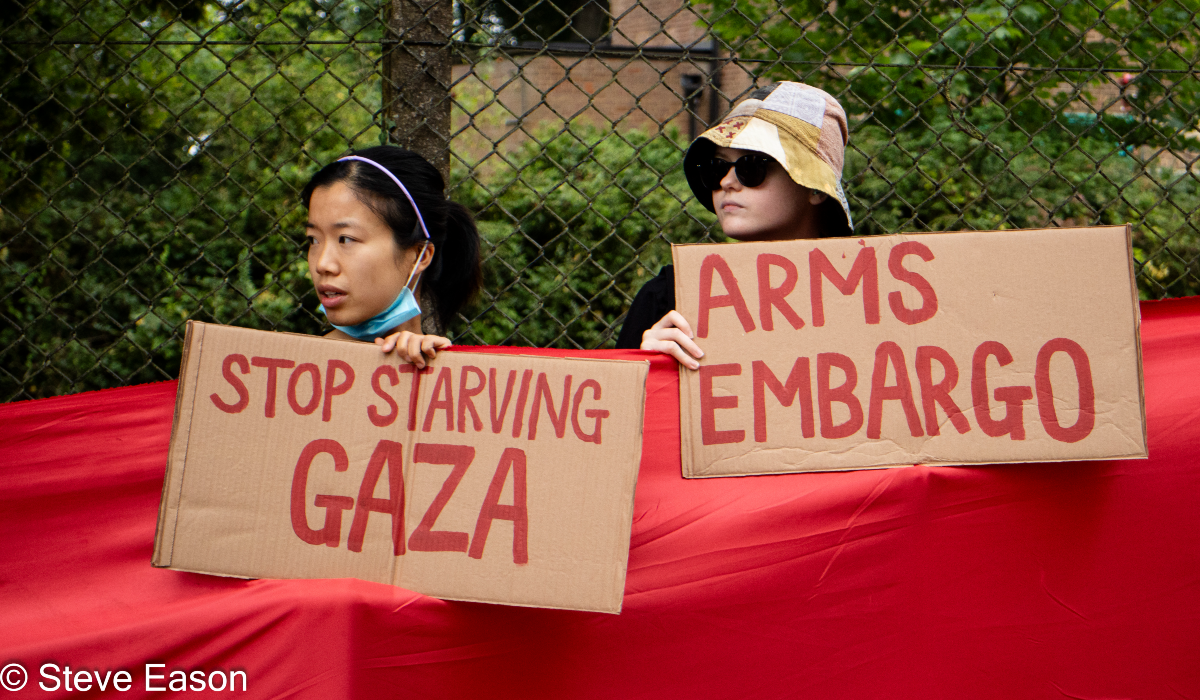
 Protestors at RAF High Wycombe, August 2025. Photo: Flickr/Steve Eason
Alex Snowdon continues his reflections on the fledgling electoral alternative
The process of launching a new leftwing party, though in its early stages, has already generated some debate. The best of that debate is informed by past experiences of leftwing electoral politics and by the record of building leftwing parties or campaigns elsewhere.
It is worth taking seriously what we can learn from historical and international examples of socialists intervening in mass electoral politics. There is much to draw upon. There are three areas in particular that I think are centrally important.
The party and the movements
Firstly, there is the relationship of a party to social movements. It is the movement against genocide in Gaza that has, to a great extent, got us this far. It fuelled the election of five independent MPs in last July’s general election, has created a layer of new activists and accentuated the crisis of both the current government and the British state.
In 2015, Jeremy Corbyn’s successful campaign for the Labour leadership emerged from the anti-austerity and anti-war movements. It was Corbyn’s long association with protest movements, more than anything else, that made him a popular candidate with large numbers of people.
However, there was very little focus by the Labour left on participation in the movements during the Corbyn period. It was noticeable that many activists who had previously been active in these movements shifted their focus to campaigning for Labour or to internal Labour Party politics.
Momentum, in its early days, was keen on rhetoric about being a social movement. That was never realistic: it was established as an internal Labour Party faction and it played that role throughout Corbyn’s leadership.
Real movements, in any case, are not limited to members of a given political party. They cannot be run as outreach projects of a party.
A number of leftwing parties in Europe have arisen out of – or in a close relationship with – social movements. Syriza in Greece and Podemos in Spain were prominent examples. However, these parties moved away from a movement orientation under the pressures of electoralism. It also proved damaging when particular protest movements went into decline.
The new party will experience external and internal pressures to focus overwhelmingly on electoral activity and to distance itself from protest movements. That would be a mistake – partly because close interaction with such movements can be a sustaining force for a leftwing party, but also because our real power ultimately lies outside council chambers and parliament.
Tribunes for our communities
The second major issue is to do with the purpose of achieving elected office. It is worth first taking a step back and considering the purpose of election campaigns. The obvious goal is to win elections. Yet there will, for a new leftwing party, surely be many situations where this isn’t a realistic possibility.
Often the purpose is more modest than winning. It is to popularise leftwing demands and ideas, raise the party’s profile, establish roots in a community, influence the political debate, and lay down a marker for future challenges. Crucially, it is about using elections as a platform for projecting socialist politics to an audience, regardless of whether there is any chance of winning.
Many members of the new party will be ex-Labour members and may, quite understandably, struggle with this concept. They have previously been in an extremely well-established party with hundreds of MPs and thousands of councillors. This will require adjusting to a different approach to campaigns.
Nonetheless, we will hopefully be standing many candidates who actually stand a chance of winning. The Labourist tradition is very much to see elected office as important because it means exercising power. This has always been partly illusory – much real power lies in corporate boardrooms, the City of London and the institutions of the state.
In as much as it reflects reality, this approach rests upon Labour being successful enough to run councils and form governments. That is not, for the foreseeable future, likely to be a viable prospect for the new party. It should also be remembered that – after 15 years of cuts to local government funding- the main function of councils is to manage social decline.
The purpose of being an elected councillor will therefore be rather different. It should be seen as a chance to be a megaphone for social movement and trade union struggles, amplifying their messages and demands.
There is an old (but almost entirely dormant) tradition of seeing councillors as shop stewards for their communities – representing the interests of a community, just like a union rep will represent those they work with. They can take up issues around housing, transport, public services, community spaces and more.
But we can go further: just as an effective union rep will seek to collectivise grievances at work and take a collective approach to resolving them, a socialist councillor should aim to organise with their constituents. They can facilitate collective action and community campaigns.
There are positive examples of this approach to be found in the closing years of the nineteenth century and the early years of the twentieth century. Leftwing councillors often operated as tribunes for their communities and were prepared to put up a fight. For example, in 1921 Labour councillors in Poplar refused to increase rates (as demanded by the wider London municipal authorities), leading a popular rebellion in the area.
One of the dangers of a leftwing party seeing electoral office as primarily about wielding power is that it encourages opportunistic alliances with other, more established, parties. This has been damaging, even fatally damaging, for a number of European left parties that have made huge compromises and tail-ended parties to their right.
This does not mean that all alliances are wrong, but that vigilance is necessary. It helps to have a broader vision than thinking that achieving office is all that matters.
The need for anti-imperialism
The final issue to highlight is that of international affairs. Labour has a rotten history in this area. Too often the Labour left has been little better than the party’s right wing.
This was true even in Labour’s best period. The 1945-51 government was the most progressive in history, yet it shouldn’t be forgotten that Attlee’s government took the UK into Nato, secretly began a nuclear weapons programme, turned a blind eye to the ethnic cleansing of Palestine in the Nakba, and often attempted to slow down decolonisation.
Foreign policy was the area where the left made the least headway during Corbyn’s leadership, with policy lagging a long way behind Corbyn’s own anti-war and internationalist positions. This was influenced by the massive pressure exerted by the Labour Right, which was in many ways a transmission belt for the interests of the British state.
However, it is notable that leftwing parties and candidates elsewhere have often compromised on global affairs more than on anything else. Italy’s leftwing PRC flourished in the early 2000s, but was permanently ruined by its conduct as junior partners in a coalition government after 2006. By far the most devastating ‘compromises’ were its backing for sending troops to Lebanon and for extra funding for the military occupation of Afghanistan.
Bernie Sanders’ left economic populism has been repeatedly undermined by his weak stances of international issues, including his liberal Zionism. Such weaknesses have allowed elements of the Trumpian MAGA movement to tap into anti-war sentiment more successfully than most of the US left.
In Europe, too, left parties have frequently adopted weak positions. In Germany, Die Linke has proved poor on Palestine – even in response to genocide in Gaza – while several European left parties have been reluctant to break from capitalist institutions like the EU and Nato. The response of such parties to massive continent-wide rearmament has been uneven, despite the appalling implications for welfare and public services.
War in Ukraine has proved a divisive issue, with many left parties buckling under pressure to avoid criticising the Western powers for their role. This has been a problem here too: all the leftwing Labour MPs have, since the Russian invasion in March 2022, scrupulously avoided any association with the Stop the War Coalition over Ukraine. In the trade unions, the left has suffered defeats when trying to win anti-war and anti-militarist positions.
Proponents of Red-Green alliances ought to be reminded of how awful Europe’s Green Parties have been on Nato, Ukraine and the new militarism. It would be naive to assume that the Greens in this country are immune from such tendencies. We desperately need a strong leftwing party, in a major European country, that retains principled anti-imperialist positions. If we can create that here, it will be a beacon for others.
All of the three areas I have discussed will be highly contested as the new party takes shape. We cannot wait until a founding conference. It is essential that socialists do everything possible now to influence the direction of travel.
Before you go
The ongoing genocide in Gaza, Starmer’s austerity and the danger of a resurgent far right demonstrate the urgent need for socialist organisation and ideas. Counterfire has been central to the Palestine revolt and we are committed to building mass, united movements of resistance. Become a member today and join the fightback.

Alex Snowdon
Alex Snowdon is a Counterfire activist in Newcastle. He is active in the Palestine Solidarity Campaign, Stop the War Coalition and the National Education Union. He is the author of A Short Guide to Israeli Apartheid (2022).