
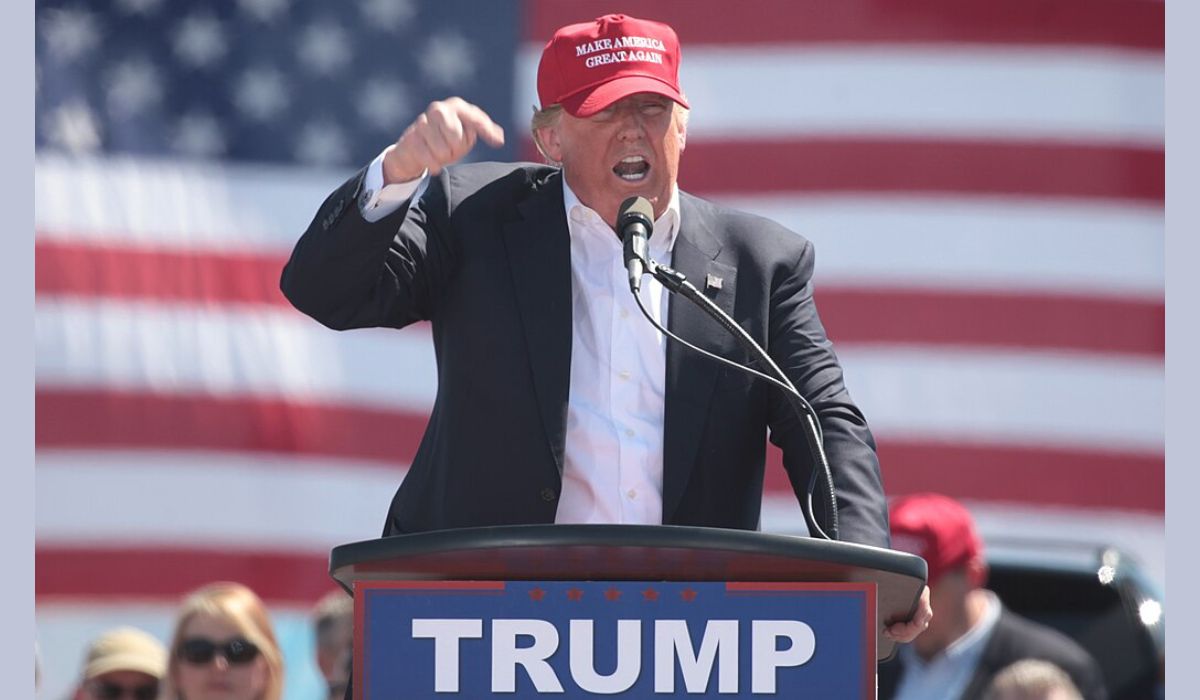
 March 2016: Donald Trump speaking with supporters at a campaign rally in Arizona. Source: Gage Skidmore - Wikicommons / cropped from original / CC BY-SA 2.0
There are many disturbing parallels between today and the 1930s. John Westmoreland explains how the Nazis were able to crush Europe’s largest organised working class
History does not repeat itself, but similar patterns in history recur over and over again. The events in the USA connect to events in 1930s Germany, which resulted in the Nazi dictatorship, is apparent. Could we really be heading towards the horrors associated with the Third Reich? Only experience will answer that question.
It used to be the case that liberal intellectuals would scoff at such a suggestion. Our institutions, they would say, have resisted extremism for over three centuries, and they will (with a pompous flourish) endure. But that confidence has gone. There is a strong fear among some American liberals that Trump is leading the USA into dictatorship and fascism.
Liberal fears have led to the constant recitation of the clauses in the constitution that, they say, safeguard American freedoms. This has found expression in the ‘No Kings’ anti-Trump demos that have taken place across America, and account for the mass rallies addressed by Bernie Sanders. Make no mistake, the rage against Trump is real, but unless the demos and rallies turn into serious forms of working-class protest, Trump will carry on regardless.
The institutions that are supposed to protect Americans are being turned against their rights and liberties with remarkable ease. Those institutions that are supposed to stand above the arbitrary use of presidential powers are crumbling. From the Supreme Court to Congress, to the National Guard, Trump is usurping their authority and power for his own personal ends. There is a very real threat that he will serve a third term as president, which is forbidden by the constitution.
As the crisis of capitalism deepens, we will need to look back again and again to the 1920s and 30s and the rise of Nazism, and the methods they used to take power.
The midnight of the century
Back in 1933, European intellectuals were shocked and bamboozled when Hitler was made chancellor. Germany was the most cultured nation in Europe. It had an educated population. Germany was at the cutting edge of innovation. Art and literature flourished. Yet it would give way to a country of unparalleled capitalist barbarism, including repression, war and genocide. The limits of capitalist civilisation, already apparent to colonised peoples in the southern hemisphere, were brought home in the countries where the system had taken root.
As Trotsky commented on the culture shock, and in words that chime with the looming nightmare today: ‘In the sphere of modern political economy, international in its ties and anonymous in its methods, the principle of race appears as an interloper from a mediaeval graveyard.’
This is something we need to shout in the faces of our ruling class and the craven parliamentary sock-puppets that serve them. Fascism is the bitter fruit of three hundred years of capitalist progress!
Hitler liked to claim that he had come to power by leading a revolution against decadent elites, but the truth was rather different. A capitalist class that wanted to act decisively in the world felt constrained by the trappings of social democracy, just as the capitalist class is now waging war on human rights and environmental protections.
In Weimar Germany, there was a militant war party with powerful economic levers to pull. Today they would be Trumpian. They imagined German greatness through war and the subjection of international law to their power.
Hitler did not seize power; he was gifted it because the conservative elites needed a thug to brutally smash democracy and unchain Germany’s inner dynamic. In doing so, they set in train an increasingly radical turn of events, fired by a racist nationalism that went well beyond what they thought would happen.
After the war, industrialists who had backed Hitler said by way of apology, how were we to know what would happen by 1945? Yet Hitler had made no secret of his intentions to wage war on democracy and smash the democratic aspirations of the working class. Once in power, Hitler gloated over the feebleness of his democratic opponents. He loved to recall how he duped them. Their mistake, he liked to say, was that they thought I was one of them.
What lies ahead is impossible to predict, but history offers us a clue. We can say with certainty that the fortunes of humanity won’t be decided by the laws and constitutions that the capitalist class has used to sanctify their centuries of misrule, but in that stubborn ‘old mole’ of history that has emerged at every critical point: the working class.
Democracy, dictatorship and the working class
One of the defining features of Hitler’s dictatorship, especially during the early period, was the desire to pacify and win over the working class while simultaneously smashing working-class organisations.
Hitler was a servant of the ruling class. He had been taught his politics during the revolutionary years after the First World War, when he had become an agent for army intelligence. Hitler imbibed the hatred of communists from the powerful Prussian military elite. This hatred was reinforced when he started to meet with the leaders of German industrialists, like the steel magnate Fritz Thyssen. The entire story of Hitler’s rise to power and his time as Führer is of him serving the interests of a powerful ruling caste with the utmost determination.
Mussolini’s fascists had used appalling terror before Hitler came to power, but the Nazis set a new benchmark in organised inhumanity. Precisely because Germany was a world power with much greater and achievable imperialist ambitions than their southern neighbour, the fear and loathing towards a powerful and organised working class was much greater too. And the terror required to defeat that class went beyond anything Mussolini needed to do.
Hitler loathed the leadership of the labour movement. Workers with a loyalty to their class threatened loyalty to the nation. Leaders of the workers’ movement were therefore traitors, in cahoots with Soviet Russia, and had to be eliminated so that workers could partake in his nationalist ideal.
This explains the duality of Hitler’s approach to the working class. Undisguised hatred for the leadership on the one hand, and a desire to persuade the working class into submission on the other.
Once the leadership was in the concentration camps, where many of them would perish, Hitler wooed the workers in an attempt to show that even though there was repression, the standard of living would be better than under democracy. The fact that Germany was coming out of the Great Depression by 1933 worked in his favour.
Hitler knew the power of the working class. He had bitter memories of the German revolution, which had ended German participation in the First World War and got rid of the Kaiser. He made major efforts to ensure that it would never happen again. He remembered too the ill-fated attempt to overthrow democracy in 1920, when an attempted putsch led by Freikorps officers was defeated by a general strike that paralysed Germany, demonstrating collective strength.
That is why Hitler pulled out all the stops to win over the working class through job-creation programmes; building roads and digging ditches, as well as expanded job opportunities through investment in engineering and the arms trade, all reduced the level of unemployment. If wages were still poor, at least there was, as Hitler had promised, ‘work and bread’.
While women, mainly from the middle-class professions, were made unemployed, they started to receive financial incentives to start a family. There were also increases in the number of national holidays and a programme of ‘Winter Relief’ for the poor.
However, terror was the policy of choice when dealing with the working class. On May 2 1933, four months into Nazi rule, storm troopers invaded trade-union offices across Germany. The buildings, printing presses and typewriters were wrecked. Files were confiscated, union officers were beaten up, some were arrested, and trade unionism was outlawed. The beatings were vicious, with reports of police-station walls and steps covered in blood.
Workers were then made to join the Nazi trade union, which was designed to control and instil obedience. The working class lost its independence and became a subservient part of the nation. They were required to listen silently to the ‘Hitler Speaks’ broadcasts when work stopped for Hitler’s rants. Sometimes a bag of spanners accidentally hit the floor as Hitler’s fury became climactic.
The Nazis understood far more clearly than the leaders of the democratic parties that the working class is the leading and most important force for democracy, and was the most dangerous threat to the dictatorship they planned.
The chained beast
A terrifying fact, and one that historians have often pondered, is that Hitler, responsible for mass murder on an unprecedented scale, died by his own hand in 1945 rather than that of a revolutionary. And on top of that, Germans fought to the bitter end. There was no revolutionary surge as there had been in 1917.
Too many undefended minds have fallen for the message that the Nazis themselves put out: that they had succeeded in uniting the nation behind Hitler and the promise of national greatness. It is an analysis constructed from social-democratic and liberal prejudices that see workers as forever led by their social and intellectual superiors. And that by the way, is another component of our current problems.
Terror was the main reason for limited working-class resistance in the Nazi years. The Nazi cadres were overwhelmingly middle-class. They had no sympathy with working-class causes and joined in the terror to vent their spleen and testify that they were loyal comrades.
The terror was widespread in the early years. After the Reichstag was set ablaze less than a month after Hitler became chancellor, a communist was made to admit responsibility, and a vicious crackdown started. Hitler’s role was simply to provide the legal framework within which the terror squads could get to work. The Emergency Decrees were to remain in force to the end of the Reich.
‘Communist’ was widely interpreted. Anyone with radical views could be arrested and terrorised. Anti-Semitic conspiracy theories branded every Jew a communist sympathiser. Every democratic organisation was suspected of being ‘Jewish’.
In the first six months of Nazi rule, the head was ripped off the working-class movement. Derelict buildings were seized by wild gangs of storm troopers and turned into camps where communists and socialists were detained, tortured, humiliated and murdered. It was a frenzy of blood-letting.
The terror accompanied a programme of ‘coordination’ where every organisation was made to fly the national flag and the swastika. From scouts’ groups and chess clubs to professional bodies of doctors and lawyers, Nazis marched in, demanded the expulsion of Jews and made the members submit to the national ideal. Society became militarised with the Roman salute and the greeting of Heil Hitler enforced at all public events.
In 1934, the army and state were fully coordinated when President Hindenburg died and Hitler became Chancellor and President in one, the Führer.
Students of the period often get asked whether Nazi consolidation was down to terror or propaganda, but that’s a silly question. Terror and propaganda were complementary means of persuasion. State powers were developed to enforce both.
Heinrich Himmler led the terror state with cold efficiency. Attempts have been made to say that the Gestapo (secret police) were not that numerous, and they operated more by Germans shopping their neighbours than through active investigation. However, the Gestapo was one organisation among many, headed by the terrifying black uniforms of the SS state. Himmler and his minions sat in the centre of a spider’s web of terror organisations and information sources. Resistance was minimal.
Terror neutralised the class-conscious workers, but the remainder had to be won over. And here we have to remind ourselves that the end goal of Hitler was war. War to dominate Europe and the world, but also a race war against the Soviet Union and ‘Jewish Bolshevism’. Propaganda was organised disinformation, of course, but it was cleverly packaged and delivered, and without doubt played an enormous part in maintaining a grumbling acceptance of Nazi rule.
Terrorise the body, subjugate the mind
The Nazi leadership was not without talent. They were invariably weird, but they were also dedicated to Hitler and the national idea.
Hitler’s favourite was Josef Goebbels, Minister for Propaganda and Public Enlightenment. Goebbels was, without doubt, a propaganda genius. He read the national situation and responded with propaganda to suit the moment, whether at peace or at war.
Goebbels cemented Hitler’s role as Führer. He created a cult of personality known to historians as the Hitler Myth. Hitler, a bit like Donald Trump of late, was chosen by God to save Germany. Hitler was able to act the part with great effect.
Goebbels understood that to be effective, propaganda had to cultivate different tastes, and he used an array of media forms. The Editors Law (1933) gave his department control over the press. And Germans read a lot of newspapers. The strategy was to filter out anything that would stain the Nazis and amplify all that gave them credit. There was no way that anti-Nazi views could be expressed, and if they were, terror was called for.
However, Goebbels did not really bother about the newspapers that much. Once un-German books had been burned and journalists brought to heel, the printed word was not his main concern.
Film and radio were much more exciting. Film studios were brought under control, and Goebbels made a huge personal contribution to commissioning films to meet his needs.
Once the working-class movement had been smashed, Goebbels got to work on the remaining workforce, the middle classes and the young. He wanted the masses to come to him. And therefore, he wisely instructed his people to avoid politics at all costs.
Goebbels hated the sycophantic Triumph of the Will made by Leni Riefenstahl. It was simply too obvious. Goebbels didn’t want a direct political message on screen because it could lead to rejection and declining interest in the cinema. Instead, he opted for entertainment. He greatly appreciated the feel-good factor that Walt Disney’s Snow White gave the audience.
That didn’t mean his output was unpolitical. He simply left the political message unsaid. Better if the audience could work it out for themselves and claim ownership of the idea. In a similar vein, Goebbels never demanded that an audience should have Nazi prejudices thrust on them. He believed that it was better to promote hatred rather than demand it.
His favourite metaphor was that a film should be like a meal with a little drop of Nazi poison within. A poison that would provide a lasting aftereffect and make the overt demands of the regime more palatable.
There are lots of parallels today. Goebbels said that the radio, the equivalent of the internet now, belonged solely to the Nazis. It was a vital propaganda tool bringing news and entertainment into the homes of Germans through the mass-produced People’s Receiver. Programmes acted to reinforce nationalist values and maintain the Hitler Myth. It was best, Goebbels thought, as the background noise of home life.
But here’s the thing. Lying about reality is always necessary for our rulers, but sometimes reality breaks through the propaganda soundtrack. Gifted propagandist that he undoubtedly was, Goebbels could never completely dominate the spirit of the German people. He was labelled the Poison Dwarf and was despised for his sycophantic glamorisation of Hitler. Wages remained low on the whole, and shortages regularly hit working-class families. Educated Germans could see through the tawdry and often banal radio plays, and in any case, free choice was denied.
Much to his dismay, Goebbels knew that many Germans were prepared to risk arrest by listening to forbidden radio stations, notably the BBC. Goebbels was also a thoroughly evil man who turned his talents to assist in some of the most bestial acts of the regime.
He made films that portrayed Jews as rats in need of extermination as German troops encountered the more numerous Jews in Poland and the east after 1939. He also made films portraying disabled people as unworthy of national membership and supported the extermination of those deemed unfit. Goebbels and his wife killed their children before committing suicide in 1945. Fittingly, it was death by poison.
The recurring nightmare
At the end of the excellent documentary series, The Nazis: A Warning from History, the audience is told to understand the history of the Nazis in order to stop anything like it from happening again. Yet once again, the spectre of fascism is on the rise.
The problems facing the USA as a declining imperial power are not the same as Germany’s in the 1930s, but there are definite similarities, not least in Trump and the Maga crew wanting to increase presidential power and hobble democratic accountability. Militarism and war demand authoritarianism and the submission of the working class in ways similar to what happened in the Third Reich.
The banning of demonstrations, sacking of educators and journalists, and the control of information by a billionaire caste would all be approved of by Hitler and his henchmen. Indeed. it would all seem very familiar.
But let’s go back to the start, and those backers of Hitler who claimed they could never have predicted what would happen by 1945. As the checks to Nazi power were removed in all aspects of state and society, those with power moved forward with their intentions of making Germany great again.
Radicalism was encouraged. Prejudices evolved into policies, and the radicalism started to become cumulative. As one area of policy fell to the Nazis, another opened up. And a spiral of barbarism was the result.
The Holocaust, the best-known outcome of Nazi rule, was not planned. It evolved. It was the product of ambitious Nazis trying to win favour with Hitler and make a name for themselves. They solved problems in the name of the Führer. No door could be barred to the SS. Reason and compassion became synonymous with treason. Brutality and mass murder were synonymous with patriotism.
The main lesson to be learned from the Third Reich, and that we need to act on today, is the failure of the German left to smash the Nazis before they got to power. There is only one way to confront the street violence and hatred that fascists bring, and that is a mass movement.
Big demonstrations and rallies united against fascism and for a better world give hope and drive away the despair that the right feeds on. The lesson of history is to act together and act now, before it’s too late.
Before you go
The ongoing genocide in Gaza, Starmer’s austerity and the danger of a resurgent far right demonstrate the urgent need for socialist organisation and ideas. Counterfire has been central to the Palestine revolt and we are committed to building mass, united movements of resistance. Become a member today and join the fightback.

John Westmoreland
John is a history teacher and UCU rep. He is an active member of the People's Assembly and writes regularly for Counterfire.