
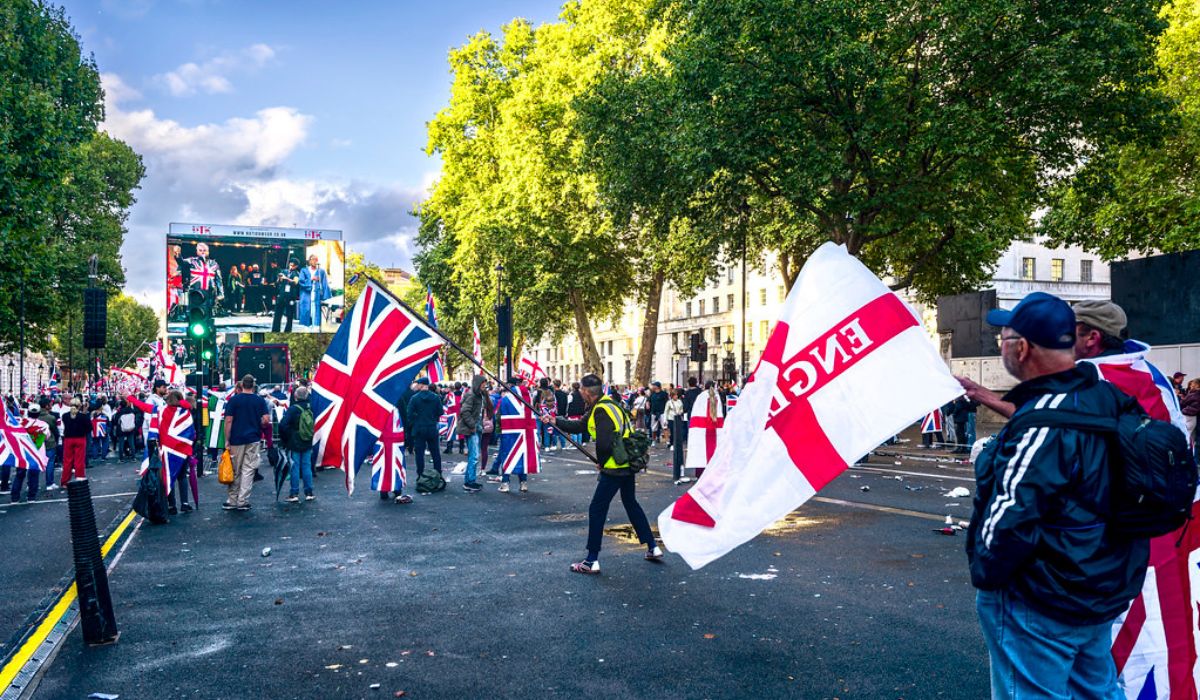
 Unite the Kingdom Rally, London. Source: johnlsl - Flickr / cropped from original / CC BY-NC-ND 4.0
The appeal of nationalism is rooted in the gap between people’s experience of capitalism and their received ideas, but collective action is the key to confronting it, argues Chris Bambery
Why does nationalism have such a hold? That’s an important question as we see St George’s flags flying from lampposts and painted on roundabouts and bollards; and of course, the sea of flags on the Unite the Kingdom march. To answer the question, we have to look at the position of the working class within capitalism.
The Italian Marxist, Antonio Gramsci, described existing working-class consciousness as ‘dual’ or ‘contradictory’; workers accept the permanence of the system, but at the same time reject much of how it impacts on their daily lives. So, he wrote:
‘The active man-in-the-mass has a practical activity, but has no clear theoretical consciousness of his practical activity, which nonetheless involves understanding the world in so far as it transforms it. His theoretical consciousness can indeed be historically in opposition to his activity. One might almost say that he has two theoretical consciousnesses (or one contradictory consciousness): one which is implicit in his activity and which in reality unites him with all his fellow workers in the practical transformation of the real world; and one, superficially explicit or verbal, which he has inherited from the past and uncritically absorbed.’1
For example, the vast majority of workers accept the wage system but often reject the particular wage rise they are offered. Nevertheless, capitalist ideas extend into every aspect of our social life.
The working class grew up within capitalism. The capitalist class in the last decades of feudalism had developed economic and intellectual power (the French Enlightenment philosophers Denis Diderot, Jean-Jacques Rousseau, and Voltaire in the build-up to the 1789 revolution, for instance). The working class within capitalism has neither.
The ideas which dominate our lives filter down to us in a fragmented way, often finding expression in a way different to how those philosophers and intellectuals first expressed them.
Popular consciousness contains all sorts of modern and progressive ideas, together with some terrible throwbacks.
For Gramsci, a worker could be a ‘walking anachronism, a fossil’ expressing all sorts of racist and sexist ideas but at the same time a loyal trade unionist who would never cross a picket line.
Popular consciousness ‘contains Stone Age elements and principles of a more advanced science, prejudices from all the past phases of history at the local level and intuitions of a future philosophy which will be that of a human race united the world over.’
Capitalist nationalism
Central to the birth of capitalism was the idea of the nation-state, supposedly uniting all its citizens regardless of class. In fact, capitalism needs a state to create a legal system to guarantee property and to administer and police the population. As Trotsky wrote: ‘The national state is erected as the most convenient, profitable and normal arena for the play of capitalist relations.’2
When Britain went to war with revolutionary France in 1793, many intellectuals, artisans and members of the emerging working class identified with the French Republic. The reactionary government of William Pitt the Younger responded with direct repression, but it also used every means – the press, pulpit and state occasions like Nelson’s funeral – to create a sense of British nationalism. As a working class emerged, so did the ‘danger’ workers might identify with their class not the ‘national’ interest of the state.
The historian Robert Gray argues that British workers in the industrial revolution were not just pushed into accepting their lot through the workplace experience but also through ‘poor law reform, the beginnings of elementary education, religious evangelism, propaganda against dangerous “economic heresies”, the fostering of more acceptable expressions of working-class self-help (friendly societies, co-ops, etc.), and of safe forms of “rational recreation”.’3
As the Empire grew in the nineteenth century, this process intensified. By 1900, every schoolroom had its map of the globe with swathes coloured red. That was washed down with racism in order to justify slavery and colonialism.
This history is important because British (and English) nationalism was grounded on anti-revolutionary reaction, racism and war. You simply cannot unpack that. So, we cannot, somehow, reclaim it.
Nationalism also has an appeal in other ways. Working people – if they don’t identify with their class – lack identity, a sense of belonging. They work every day in a job over which they have no control. They are encouraged to relate to others through the market and so on. Helping to overcome that alienation, nationalism offers a compensation for the daily sufferings they experience; it fulfils a psychological need.
This was reinforced by the growth of the Labour Party, which not just looked to bring about change through the British state but identified with that state in every way. In August 1914, the Labour Party and the trade-union leadership rallied behind the war effort on the outbreak of World War One, enforcing a no-strike law. Reformism reinforces nationalism, as we see today with Starmer.
My paternal grandfather and his two brothers enlisted. Two minutes in the grim former mining village in Midlothian, where they came from, might allow you to see why they thought military adventure might offer escape. One brother lives in Belgium. My grandfather was bitter about what he experienced in the war and after, unemployment and the defeat of the general strike in particular.
Contemporary surge
A sense of a lack of identity has grown under neoliberalism in communities torn apart in the era initiated by Margaret Thatcher. There is little or no pride in work, and Britain seems to be falling apart. Success equals conspicuous consumption, which very few can afford. Blaming migrants is one response, but that’s tied into a hatred of a globalised elite who run this country,y but who seem to have dropped national identity: David Cameron is a good example of that. In this situation, nationalism provides a psychic compensation for working people who can never emulate the consumption held up as the mark of success.
For the ruling class, faced with an alarming fall in social cohesion, it offers a way to mobilise ordinary people once again behind the state. We are increasingly presented with ‘others’, Russia and China, who we are assured threaten our way of life and our nation.
However, Brexit provided a problem here. Many ordinary people seized on a ‘No’ vote as a way of getting revenge on Cameron, Richard Branson and all the other elite voices urging a ‘Yes’ vote. Despite Cameron, for two and a half decades, Tory MPs had whipped up a national-imperial opposition to the EU to distract attention from their own failures.
The Brexit result was a blow to the British elite. Like Starmer, they want to retain close links with the EU (Nato being one important way) while they, finally, had to accept that formal membership was over. That has created a sea of mistrust among both Tory and Labour voters, which has benefitted Farage and Reform UK. Via social media, people can access right-wing influencers from across the Atlantic and President Trump himself. People want to believe they can ‘make Britain great again’.
Leaving aside the question of how we deal with the fascists, let’s ask how we can break down nationalist, and indeed reformist, ideas. So, let’s turn to Gramsci again. Workers can act in ways which contradict what they say. This contrast between thought and action is the central contradiction within popular consciousness. Workers spontaneously fight back despite the dominant ideology they might espouse.
Gramsci’s answer
The most important clash is that between a worker’s perceived view of the world and the reality they experience through struggle. That gives rise to an awareness of class, that workers stand in opposition to the power of the ruling class. This is ‘good sense’, a mighty step forward from ‘common sense’. That can develop to a second higher stage, to a common class identity which transcends sectional interests.
Then:
‘A third moment is that in which one becomes aware that one’s own corporate interests transcend the corporate limits of the purely economic class, and can and must become the interests of other subordinate groups too.
‘This is the most purely political phase.
‘It is the phase in which previously germinated ideologies become “party”, come into confrontation and conflict, until only one of them tends to prevail.
‘This brings about not only a unison of economic and political aims, but also intellectual and moral unity, posing all the questions around which the struggle rages on a “universal” plane, thus creating the hegemony of a fundamental social group over a series of subordinate groups.’
Gramsci further explained: ‘Every revolution has been preceded by a long process of intense critical activity, of new cultural insight and the spread of ideas through groups of men initially resistant to them.’
So, during the First World War, the initial wave of patriotism gave way to a growing anger at both the carnage and deteriorating economic conditions, which led to revolution in Russia and revolutionary situations in Germany, Italy and Hungary.
Gramsci stressed the importance of the revolutionary party: ‘One certainly cannot ask every worker from the masses to be completely aware of the whole complex function which his class is destined to perform in the process of development of humanity.
‘But this must be asked of members of the party. The party can and must, as a whole, represent this higher consciousness. Otherwise, it will not lead them but will be dragged along by them. Hence, the party must assimilate Marxism.’
The party and its ideas cannot be separated from daily reality: ‘Modern theory [Marxism] cannot be in opposition to the “spontaneous” feelings of the masses. A passage from one to the other and vice versa must be possible.’
Gramsci was writing these notebooks for his own studies, in code to beat the censor in the fascist jail in which he was held. It’s often not so easy to unpick what he is saying, but it is certainly worth the effort.
In simple terms today, we have to confront both fascism and wider racism and nationalism, but we also need to build resistance to war and austerity. When workers fight back, they can begin to see the world in new ways. Of course, that also depends on success. Defeats, and we’ve seen too many, will see them turning back to old ways of identifying, such as nationalism.
1 All Gramsci quotes from Antonio Gramsci, Selections from the Prison Notebooks, Edited by Quinton Hoare (London: Lawrence and Wishart 1971), p.641: https://www.marxists.org/archive/gramsci/prison_notebooks/selections.htm
2 Leon Trotsky, The History of the Russian Revolution, Volume lll, (London , Sphere Books 1967), p.39
3 Robert Gray, Bourgeois Hegemony in Victorian Britain, in Culture, Ideology and Social Process: A Reader, ed. Tony Bennet (London: Batsford Academic and Educational 1981), p.244.
Before you go
The ongoing genocide in Gaza, Starmer’s austerity and the danger of a resurgent far right demonstrate the urgent need for socialist organisation and ideas. Counterfire has been central to the Palestine revolt and we are committed to building mass, united movements of resistance. Become a member today and join the fightback.

Chris Bambery
Chris Bambery is an author, political activist and commentator, and a supporter of Rise, the radical left wing coalition in Scotland. His books include A People's History of Scotland and The Second World War: A Marxist Analysis.