
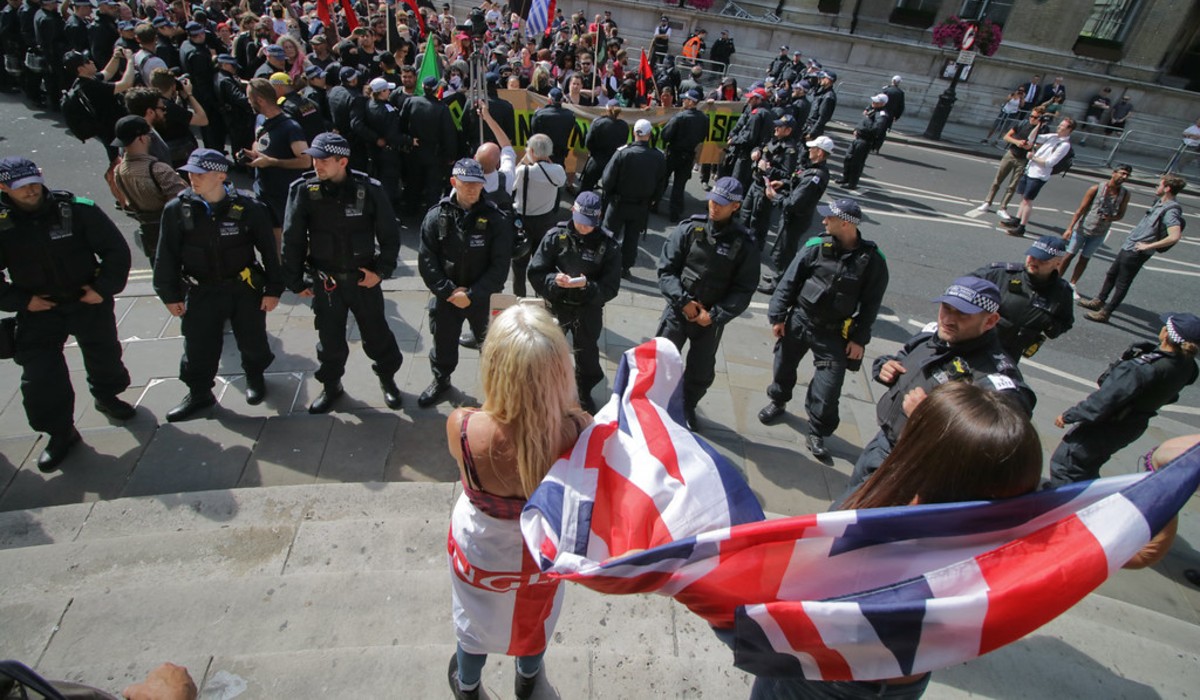
 Tommy Robinson supporters and counter-protesters face off. Photo: Steve Eason / Flickr / CC BY-NC 2.0
Anti-racists have the numbers to turn back the fascist surge, but we have to think carefully about our strategy and tactics, argues Chris Bambery
On Sunday, I attended a social event on a housing estate in inner West London. Arriving, I was amazed to see three flats flying St George and Union flags. Amazed, because the overwhelming majority living on the estate were non-white. It would be interesting to know who had put up the flags.
At the event, I got into conversation with a white guy who told me that the day before he had been on the Unite the Kingdom march. As we talked, he expressed a visceral hatred of Starmer, in particular, and the globalised elite (he didn’t use that term) who run Britain. He was bitter about how working-class communities had been torn apart and at the state of things where he lived.
Who did he blame for this? Well, Starmer, but then migrants (he believes Starmer is letting them in). How did I respond? Did I call him fascist scum? That would have been inappropriate at such an event but it was also not true. His partner and child were mixed race.
Instead, I had to argue that the lack of housing was because successive governments, Tory and Labour, had destroyed the council-house system. There is precious little social housing available, and migrants aren’t eligible for it. That’s why they are in seedy hotels whose owners are laughing all the way to the bank.
Regarding the NHS, I pointed out the midwives who helped deliver both my kids were migrants; migrants built the NHS and keep it working today. Lastly, I asked him what sort of Britain would there be if Tommy Robinson gained power?
I didn’t convince him, but I hope I gave him something to think about. Above all we both kept it respectful. It was a discussion, not a rant by either of us.
There was another thing that struck me. The vast majority in the room were non-white, but none had the confidence to join in on my side, despite a number having been on Palestine marches.
Lessons from last Saturday
So, how do we respond to Saturday’s march? Firstly, by admitting it was a defeat for our side. Secondly, by recognising that the core organisers of the march are fascists but the majority on the march were not. They were soft racists who had swallowed the lie that migrants are to blame for Britain’s ills. They also believe Britain has been betrayed by a globalised elite, for whom Starmer is the figurehead.
Shouting ‘Nazi scum’ at a family with young kids waving flags, as I witnessed, is not appropriate and is more likely to drive them into the hands of Tommy Robinson (also, shouting ‘Whose Streets, Our Streets’ was grossly inappropriate on a day when the cops were protecting us from a beating).
The success of the Anti-Nazi League in both the 1970s and 1990s was based on more than just confronting the National Front and the British National Party. As I have written elsewhere, the ANL also sought to split the soft racists from the Nazi core.
That involved hard work building into communities, workplaces, colleges, schools and anywhere where we could. ANL members organised meetings on their estates; workplace groups sprung up across both the private and public sectors; college and school groups formed; pensioners organised; above all thousands of people simply wore a badge. A small thing like that gave confidence to other people around them that anti-Nazis could be seen and heard. The problem today is that in so many places from where there were banners on Saturday, such as Nuneaton, Northampton, or Dunstable, the left scarcely exists, if at all.
So, we have to start from our strengths. The Palestine movement has brought people from across our communities on a scale even greater than Saturday’s march. Those people need to be mobilised; in their mosques, colleges, schools, estates and in their workplaces and trade unions.
The crucial job is to organise in these places to counter the racist lies. More important than anything else, it means uniting all those opposed to Tommy Robinson and his ilk regardless of party label, religion, ethnicity or whatever. That means organising wherever you are.
One more thing, on Saturday the majority of marchers were not fascists. The organisers were. In such a situation trying to physically confront that march, which would have required half a million people, was not appropriate. Physically stopping Nazi marches, as we did in the 1970s and 1990s, remains valid but the strategy needs careful thought about the circumstances. If we look back into the darkest moment in history, small groups of streetfighters were unable to stop the rise of Hitler and the Nazis. The crucial issue is to isolate the hardcore of fascists by separating them from soft racists.
What not to do
In 1929, after the Nazis had made their first electoral breakthrough, the German Communist Party (KPD) issued the instruction, ‘Hit the fascists wherever you meet them.’ The party’s Red Front fighters carried the battle into the streets, but this raised political problems.
The KPD had hundreds of thousands of members, but the majority of the powerful German working class still supported the Social Democrats (SPD), the equivalent of our Labour Party, which counted its votes in millions. Under instructions from Joseph Stalin, the Russian dictator, the KPD labelled the SPD as ‘social fascists’, twins of the Nazis. The KPD not only refused to unite with them against the Nazis but concentrated much of their fire against the Social Democrats in a way that prevented co-operation on the ground against the Nazis.
Way back in 1992, I wrote: ‘The fight against fascism was now reduced not just simply to the minority of workers grouped around the Communist Party but to the young “hardmen”. There were constant problems with these “squaddists” who glorified a “laddish” lifestyle. There were reports of bullying within the RFB [Red Front Fighters].’
In one instance, RFB fighters invited Nazi Stormtroopers into their tavern to join them for beers at Christmas time. Some ‘squaddists’ even went over to the Stormtroopers when the KPD tried to modify its line. A minority of the working class simply could not defeat the Nazis in a physical battle. Since that was the basic strategy, when it became clear it had failed, the result was demoralisation.
What the KPD refused to do was to adopt the policy of the united front (developed by Lenin and Trotsky in 1921 and 1922) whereby revolutionaries took the initiative to work and fight together with anti-Nazis whatever their political or other affiliations. A caveat here: the united front was based on activity not electoral pacts. The former was essential, the later would have been debilitating.
There are times when you cannot ‘hit the fascists wherever you meet them.’ Saturday was one such day. Above all a small minority cannot win that fight. Our strength is in the huge numbers who have mobilised over Palestine and the huge numbers who reject racism. Let’s use it.
Before you go
The ongoing genocide in Gaza, Starmer’s austerity and the danger of a resurgent far right demonstrate the urgent need for socialist organisation and ideas. Counterfire has been central to the Palestine revolt and we are committed to building mass, united movements of resistance. Become a member today and join the fightback.

Chris Bambery
Chris Bambery is an author, political activist and commentator, and a supporter of Rise, the radical left wing coalition in Scotland. His books include A People's History of Scotland and The Second World War: A Marxist Analysis.