
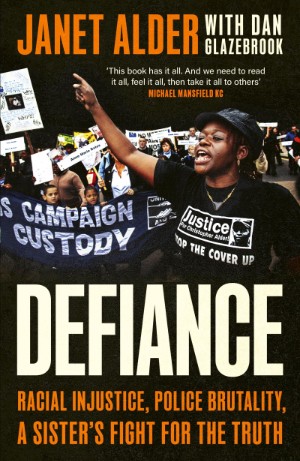
 Janet Alder, Defiance: Racial Injustice, Police Brutality, A Sister's Fight for the Truth (Dialogue Books 2025), 464pp.
Janet Alder’s account of her fight for justice for Christopher Alder exposes the ruling system’s determination to deny and cover up its crimes, finds Tayo Aluko
Defiance by Janet Alder (with Dan Glazebrook) chronicles the death in police custody of Janet’s brother, Christopher, and her long fight for the truth. I read it in the period leading up to Chancellor Rachel Reeves’s Spring 2025 statement, amid warnings of inevitable cuts to public services. Then, toward the end of the book came this passage:
‘I obtained, by means of a simple phone call to the funeral directors, the documentation surrounding Christopher’s body …. I found it hard to believe that South Yorkshire Police, who spent £500,000 of public money in their investigation, including a return trip to Australia to interview a former mortuary worker, did not think to phone the funeral directors and ask for their documentation’ (p.414).
Published 26 years after Christopher Alder died in police custody in Hull on 1 April 1998, the book reveals with unquestionable clarity how his death came after racist police officers physically (and probably sexually) assaulted him in a police van en route to Hull police station (pp. 117, 136). At the station, they then laughed and racially mocked him as he lay unconscious, handcuffed, face down on the floor, his trousers and underwear around his ankles, choking on his vomit until he breathed his last.
Days later, an officer appeared at Janet’s door in Burnley, saying he’d been sent to tell her that Christopher had collapsed and died while in a police station. That would be the first in an endless stream of lies she would be told over the next twenty-something years, by a state which, it turns out, had been abusing her family from even before she was born.
Alder recounts how she and her four siblings were taken into the care of Hull City Council after the wrongful deportation of their postnatally-depressed mother. Their father then had half of any wages taken as a contribution to their care, during which they endured much abuse.
Christopher fell into the embrace of the British Army as soon as he left school at sixteen, ending up in the elite 3-Para regiment. Deployed to Northern Ireland during the Troubles, he quit the forces as soon as that tour ended.
Janet never got to discuss with him the irony of this son of Nigerian parents ending up in the service of British Imperialism against the Irish, for the family lost contact with each other after they left care. She does however recount much of their story in separate flash-back chapters, interspersed with the accounts of her dogged struggles against the police, the Crown Prosecution Service, the judiciary and medical experts, as the cover-up of the facts surrounding Christopher’s death continued. It was as though she realised that the multiple incidences of abuse – physical, sexual and emotional – that she had endured at the hands of all kinds of men as she grew up, had prepared her for dealing with what she describes as a narcissistic state: not as a victim, but as a survivor who had had enough.
Fighting the system
Propelled by an anger which reached a peak when she first watched the harrowing footage of her brother’s final moments, Alder fought to assemble sufficient evidence to prove foul play. Despite the CPS putting seven barristers up against her and her sole barrister, Leslie Thomas QC, a gruelling four-week inquest would see the jury return a verdict of unlawful killing. Christopher, Jane and her family then decided that Christopher’s funeral could now proceed, two years after his death.
By now spearheading a national ‘Justice for Christopher Alder’ campaign, Ms Alder would then fight off an appeal by the police against the verdict, but then fail, over the next eight years, to persuade the courts to uphold charges against the individual police officers who caused Christopher’s death, or against the CPS for racial discrimination against her, for the way they sabotaged her case against the police.
Then came, in November 2011, the unbelievable news that Christopher had not actually been buried! Family, friends and supporters had unknowingly buried a Nigerian woman who had died with no family in the country. The ‘body swap’ only came to light when the woman’s family, finally granted visas twelve years after her death, insisted on seeing her body. Christopher’s body, meanwhile, had remained in the mortuary and been used routinely in police training. Yorkshire Police, who had been involved in the cover-up of Humberside Police’s criminality, investigated this new scandal, at the cost of the £500,000 quoted earlier.
Janet had also discovered that during the inquest in 2000, both she and her barrister had been put under surveillance by the police, using no fewer than eighty officers. This saga, involving just one family fighting for justice for one man killed by state operatives, is likely replicated by most other families in the United Families and Friends Campaign, practically all of whom would presumably share Alder’s observation that: ‘Those charged with upholding accountability have instead upheld impunity, whether under Labour or Conservative governments’ (p.421).
Justice for victims and families aside therefore, the amounts of money being wasted on actively and wilfully suppressing the truth is absolutely staggering. If the Chancellor wishes to save money, she need look no further than the criminals in uniforms and suits in the so-called justice system.
As we watch that same system being aggressively deployed against those calling for justice for Palestine and the planet, it is clear that citizens are in one hell of a fight against the state. This book forensically exposes its ugly underbelly, and introduces us to the kind of tireless, fearless warrior we need in our ranks.
Tayo Aluko is a playwright, actor, singer and activist based in Liverpool.
Before you go
The ongoing genocide in Gaza, Starmer’s austerity and the danger of a resurgent far right demonstrate the urgent need for socialist organisation and ideas. Counterfire has been central to the Palestine revolt and we are committed to building mass, united movements of resistance. Become a member today and join the fightback.
