
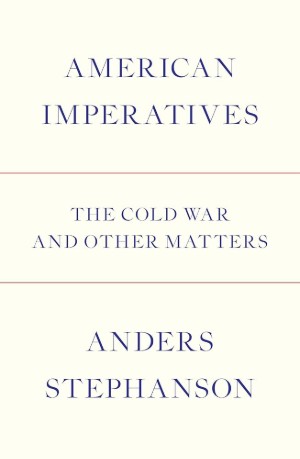
 Anders Stephanson, American Imperatives: The Cold War and Other Matters (Verso 2025), 384pp.
A new history of the Cold War provides fresh perspective on the pattern of American imperialism, and much to debate, finds Chris Bambery
This is an important book for understanding the US and the post-1945 ‘American Century’. The post-Second World War cold war still casts a long shadow, and still has a major influence on US foreign policy. It’s not an easy book because it often deals with figures in US diplomacy and academia who are unfamiliar today, and of whom few know much about, but it is well worth reading.
One such unfamiliar figure today is George Kennan. Kennan was a US diplomat who in 1947 became director of the State Department’s policy-planning staff. Kennan’s views on containment were set out in an influential article in Foreign Affairs magazine in July 1947, which challenged any attempt by the US to co-operate in any way with the USSR on the grounds that Stalin was set on global domination. In effect, he rejected the policy of the wartime president, Franklin D Roosevelt, a Democrat. Harry Truman, who became president on Roosevelt’s death in 1945, was determined to appear strong to ward of Republican opposition.
Kennan advocated not just that the USSR had to be contained but that the USA should apply pressure wherever it could. Kennan believed this would force Moscow either to bend to Washington’s position globally or that sufficient pressure would lead to the USSR’s collapse. Pressure meant military pressure and the construction of military alliances, particularly Nato, which would include all sorts of unsavoury regimes; General Franco’s fascist dictatorship in Spain for example.
‘One need not embrace the Soviet position to see that the cold war as embodied in the American stance was utterly against Stalin’s interests, that he would have liked precisely what he said he wanted: negotiations, deals and reductions in tension, coupled with relative isolation, and above all, recognition as an equal. Instead the USSR became a pariah’ (p.45). Within a short time, Kennan would discover ‘that it was the Soviet Union that was behaving like a traditional great power while the United States was being unorthodox’ (p.44).
Kennan would now advocate a ‘realistic diplomatic approach to the Soviet Union, above all on the problem of Germany.’ By then, of course, he was out in the cold, ousted from the Truman administration, which had taken up his original position with fervency (p.14).
Truman now claimed to represent the ‘free world’. Under Roosevelt, that was a term used to describe the anti-fascist states (another was the ‘United Nations’). Now it was necessary to conflate fascism and communism as totalitarianism. In truth, this was a vague term to be applied to any state that did not bend to American interests.
The US and the rest
What the Cold War provided the US was ‘a solid theoretical foundation for US globalism.’ In other words, its global domination militarily, economically and financially (p.83).
What Anders Stephanson does is locate the need for the US to define itself against an ‘other’ within an older tradition of America’s ‘Manifest Destiny’ employed at the turn of the nineteenth century as a justification for the 1898 Spanish-American war and the subsequent creation of US colonies in the Philippines, Hawaii, Guam and Puerto Rico, and an informal empire including Cuba and much of Central America.
This was justified as a Christian project for the good of the natives. The ‘other’ were the non-white inhabitants of Asia in particular. Since 9/11, the ‘other’ has been Islamic terrorism but that is much more difficult to locate and contain than was the case with the USSR. Today China is held up as the ‘other’.
Stephanson’s argument was that the Cold War effectively ended In 1962 with President John F Kennedy and Soviet leader Nikita Khruschev entering into talks after the near Armageddon of the Cuban Missile Crisis, culminating a year later in the Test Ban Treaty.
After that US-Soviet relations generally tended to follow the pattern established after the defeat of Napoleon when the Great powers gathered together to resolve points of contention. This was even more so after President Nixon’s surprise visit to Beijing in 1972 which, effectively, allied the US and China against Russia.
There is much that is contentious here but it is well argued and well supported. What I do feel is that Stephanson rather underplays what is often called the Second Cold War in the 1980s, under President Ronald Reagan. This renewed arms race was designed to bankrupt the ailing Soviet economy, and it worked.
Stephanson is, however, excellent on showing that Washington continued to see the new Russia through the lens of the Cold War. The policy was to see it parcelled up into weak, rival states, Ukraine being one.
One of the advocates of this was Zbigniew Brzezinski, President Jimmy Carter’s National Security Advisor from 1977 to 1981. Subsequently, while pursuing an academic career, he a Washington insider.
Brzezinski would be one of the neo-con advocates of regime change for any state perceived as hostile to the US (and Israel). Regarding Russia, Brzezinski was confident that Washington could succeed because Moscow could never ally itself with Beijing. Obama, Trump and Biden’s policies have ensured the occurrence of that very thing!
As the US now faces China, a new cold war seems well underway. The military build-up by the US and its allies in the South China Sea is very dangerous. However, if there is a new cold war, it will be different from that of the 1950s. While many of the ‘hot’ clashes between the two blocs were in Asia – the Korean and Indochinese wars – the focus was Europe, Germany in particular. Europe is of much less strategic importance for the US today, though there are deep splits in the US military and intelligence regarding this.
Anders Stephanson helps us understand a key chapter in our recent past but also where the USA stands today.
Before you go
The ongoing genocide in Gaza, Starmer’s austerity and the danger of a resurgent far right demonstrate the urgent need for socialist organisation and ideas. Counterfire has been central to the Palestine revolt and we are committed to building mass, united movements of resistance. Become a member today and join the fightback.

Chris Bambery
Chris Bambery is an author, political activist and commentator, and a supporter of Rise, the radical left wing coalition in Scotland. His books include A People's History of Scotland and The Second World War: A Marxist Analysis.