
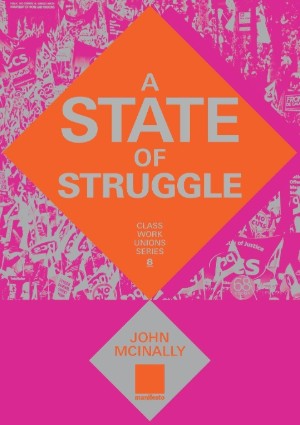
 John McInally, A State of Struggle (Manifesto Press 2025), 332pp.
This history of the civil-service union PCS is important reading for union activists, and shows the importance the union has had in the fight against austerity, finds Graham Kirkwood
We have become accustomed to the PCS, the Public and Commercial Services Union, being at the forefront of struggles against austerity and war. It has over the past fifteen-plus years been the main union calling for unity and coordinated action across the union movement. It hasn’t always been like this. Until Mark Serwotka’s election in 2000, the union was controlled by ‘the most right-wing leaders in the whole trade union movement, with direct links and backing from the state’ (p.14). Support for the misleadingly named ‘moderate’ leadership came from the most right-wing elements of the gutter press. During union elections, right-wing electoral slates were printed in full in tabloid newspapers (p.14). Woodrow Wyatt, ‘The Voice of Reason’, with his column in the disgraced and defunct News of the World, regularly spewed out warnings on how reds and Trots were taking over the union on the way to a Soviet-style dictatorship in the UK (p.101). One-time vice president Tony Rouse is quoted as saying ‘these Trotskyists should be taken from this room, tied to a lamp post and whipped until the skin is flayed from their backs’ (p.103).
History of civil-service unions
John McInally has written this biography of the PCS and its forerunner civil-service unions. McInally is a long-standing PCS and previously CPSA activist whose union branches have always had a high level of member participation and delivered on national industrial action (p.12).
The book contains a wealth of detail on the development of the civil-service unions and their place in the wider struggles in UK society particularly over the past fifty years. It will be essential reading for PCS activists but also for activists in other unions and deserves to be on the bookshelves of union branches.
It starts with a history of the civil service and the unions representing staff within it. The civil service is a key component of the British state (p.19). In the 1850s, there was a drive to create a civil service that was integrated and efficient. In the 1870s, the government began employing boys and women in the civil service, which changed workforce composition. Rather than simply being cheap, as expected by the management, both these groups became rapidly organised and among the workforce’s most radical elements (p.28). In 1871, a strike of telegraphists was ruthlessly suppressed (p.26).
Civil-service employees have always had a peculiar relationship with the state. Any industrial action was viewed early on as a direct challenge to the state (p.27). Towards the end of World War I, an inquiry reported under the leadership of Sir John Whitley, a Liberal peer, advocating joint work councils to settle grievances (p.33). The system of ‘negotiated compromise’ (p.34) was a system almost deliberately designed to produce a lay bureaucracy (p.36) where shop stewards and other elected union representatives become more and more integrated into the union/management negotiation machine to the exclusion of the ordinary members (p.35). Such lay bureaucrats could also be useful in policing and managing workplace anger and silencing socialist or communist activists (p.35).
Another major shift took place geographically, with 72.5% of civil-service workers based in London in 1931 shrinking to only 26% by 1977 (p.44). The end of the 1970s saw a huge upswing in industrial action by public-sector workers, known as the winter of discontent. Civil servants were among the public-sector workers taking part in strikes for the first time (p.45). The first strike action taken by the Civil and Public Services Association (CPSA) as a union was in 1973 against the Conservative government’s pay freeze (p.50).
The right-wing leadership and the rank and file
Much of the development of a hard right wing inside the CPSA (or CSCA as it was at the time) coincided with the development of the cold war between Russia and the USA (p.42). Investigations uncovered links between the moderates and at least two CIA-associated organisations and an attempt at infiltration by MI5 (p.51). The moderate leadership were key advisors to Norman Tebbit, Thatcher’s right-hand man, as he drew up anti-union legislation (p.52).
The moderates held office, almost exclusively, in the CPSA from the late 1970s to 1998 (p.54). In 1986, CPSA members elected leading left winger, committed Marxist (p.70) and Militant supporter (p.67) John Macreadie to the position of general secretary. The moderates refused to accept the result, and with the support of the courts and legal establishment along with a ‘strident press campaign’ (p.73), managed effectively to undermine Macreadie and force a rerun which the left lost.
The moderates presided over a ‘bonfire of agreements’ including a surrender of national pay bargaining (p.105). They aided in cuts, privatisation, decentralisation and marketisation (p.54). Things began to shift in 1969 when the CPSA adopted a strike policy for the first time (p.45). It would be two decades, however, before the right inside the union was finally defeated (p.46).
A huge dispute broke out in 1981. Inflation was running at 15%, but the government imposed a 6% pay rise on civil servants. The first wave of national one-day strikes took place in March 1981 and caused major disruption to central government operations as well as to airports and ports. They were solidly supported in the large workplaces like Longbenton and Washington in the north east (p.60). Local strike committees coordinated protests and unofficial walkouts (p.61).
The right wing managed, however, to whittle down the action and ultimately it was defeated. The 26-week dispute was the longest since the 1920s and mobilised significant numbers of civil-service workers for the first time. It was a major milestone in the developments of the CPSA as a union (p.63).
There were a number of important local disputes in the 1980s and 1990s including the Easterhouse unemployment benefit-office dispute which included an all-Glasgow one-day strike (p.107). In 1983, a dispute broke out among pension and child-benefit staff against pay cuts being imposed at the huge Newcastle and Washington sites which had over 5,000 CPSA members (p.79). Following this dispute, a campaign began against the branch leadership, expelling them from the union. The Newcastle eight had this overturned at the conference in 1990. Another significant dispute was at the Bedminster job centre in April 1993, where members took solidarity action with print workers at J.W. Arrowsmith (p.88).
All change
Mark Serwotka won the general secretary election in December 2000 with 40,740 votes against the right candidate Hugh Lanning who polled 33,942, on a 30% turnout, decent for these type of elections (p.115). Serwotka was well known in the union among activists. His branch had a high level of member participation and had always delivered on national industrial action (p.12). Serwotka led and won a six-month dispute in Caerphilly in 1987 (p.107).
Predictably, Barry Reamsbottom, the moderate leader, challenged the result in the courts, calculating that Serwotka and also Janice Godrich, who had been elected president, would not be able to afford to challenge him. Serwotka and Godrich put their homes up as security to fight Barry Reamsbottom in the courts (p.119). They won.
Fighting Austerity
Serwotka and Godrich’s elections were the result of deep disquiet among rank-and-file PCS members over the lack of resistance to the Conservative and Liberal Democrat coalition government’s austerity agenda. A political fund had been established in November 2005 following a membership ballot (p.132). The PCS would become one of the most important and influential unions politically over the coming years.
The PCS became of vital importance to the wider movement against austerity, setting out the union’s position in a short document, ‘There is an alternative: The case against cuts in public spending’, known as ‘The Alternative’, in September 2010 (p.174). The TUC and the larger public-sector unions such as Unison had rolled over and largely accepted the cuts to public services. Tory prime minister David Cameron met the TUC in December 2010 at Downing Street, the first such meeting for a quarter of a century: 25% budget cuts followed (pp.171-2).
The 2010 Spending Review laid out a further £7 billion in cuts: 700,000 public-sector jobs would go, including 100,000 civil servants (p.180). The effect of these cuts are still being felt today; courts for example lost 14,000 jobs. We now have people waiting two years in jail before they can receive a trial while Starmer and Mahmood want to do away with jury trials (p.180).
The government then attacked pensions in October 2010 (p.182). In March 2011, the head of the CBI spelt out that public-sector pensions had to be attacked, as they remained the biggest barrier to privatisation (p.183).
The TUC eventually organised a march on 26 March 2011 which was huge, attracting 750,000 through London (p.185). The TUC insisted on dealing with the pensions issue in isolation from the rest of the austerity agenda (p.186). A one-day strike was called for 30 June 2011 by PCS, UCU, NUT and ATL. Three quarters of a million workers came out on what became known as J30 (p.186). A further one-day strike, effectively a public-sector general strike, was called for 30 November (p.187). This time, between two and three million union members came out on strike, the biggest strike in UK history (p.188).
From this, the TUC went into negotiations and came out with a terrible deal, agreeing to sectoral bargaining (p.189). The cross-union solidarity that PCS had been instrumental in forging was broken. Unions then either agreed the deal or withdrew from the action; the PCS itself called off the action on 12 March (p.191).
A further one-day strike was called for 10 May 2012 but by this time the fight was over. The TUC had fulfilled its historic role in defusing and scuppering a class fightback which could have seen off this vicious Tory government, which instead lasted another twelve years in various guises.
The future
McInally finishes the book with a word of caution about the future of PCS. In recent years, the left inside the union has become split over preferences towards particular party candidates and also, damagingly, over identity politics. Such manoeuvres leave a space for the right inside the union to reorganise. A resurgent right wing inside the PCS would be a disaster not only for PCS members but also for those of us in the wider anti-austerity and anti-war movements where the union has played such an important role.
Before you go
The ongoing genocide in Gaza, Starmer’s austerity and the danger of a resurgent far right demonstrate the urgent need for socialist organisation and ideas. Counterfire has been central to the Palestine revolt and we are committed to building mass, united movements of resistance. Become a member today and join the fightback.
