
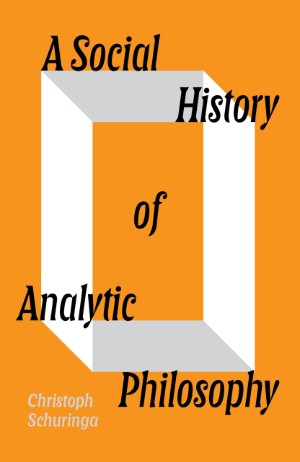
 Christoph Schuringa, A Social History of Analytic Philosophy: How Politics Has Shaped an Apolitical Philosophy (London: Verso 2025), 336pp.
Christoph Schuringa’s analysis of the dominant tradition in Anglosphere philosophy provides valuable insights, finds Sean Ledwith
The most famous remarks ever made about philosophy within the Marxist canon are contained in the founder’s ‘Theses on Feuerbach’ where he observes, ‘The philosophers have only interpreted the world in various ways, the point is to change it.’ The subsequent history of the subject in the modern era, especially within the English-speaking world, however, has been dominated by an implicit assumption of the reverse: the point is emphatically not to change the world. The premise of most academic practitioners of philosophy is that the subject resides pristinely in some form of transcendent realm, unsullied by historical or political considerations.
Anybody who has enrolled on a philosophy course at an English university in the last fifty years or so has quite feasibly experienced a rapid disillusionment concerning the apparent relish with which some lecturers underline how, in their view, the subject has no relevance to the everyday world in which most people live. Many teenagers are probably drawn to the subject as they approach adulthood as it appears to offer an ideal opportunity to question the beliefs and preconceptions they have grown up with in their families and communities.
Regrettably, this pubescent excitement at the prospect of discovering new horizons of intellectual endeavour is often doused in cold water from day one as undergraduates find themselves in seminars wading through seemingly pedantic and trivial discussions about terminology, rather than considering ways to change the world, as Marx would recommend.
The main reason for this possible abatement of expectations is that philosophy in our part of the world has been dominated by what is known as the ‘analytic’ tradition for the last hundred years or so. Christoph Schuringa, in this highly original account from an explicitly Marxist perspective of the rise of this tradition, also notes this contrast between what many new students in higher education might anticipate and what they might receive from the subject in some UK/US departments:
‘Usually, their initial interest in philosophy was prompted by existential questioning of the kind that analytic philosophy discourages. Once they see that what is instead on offer is the regimen of analytic philosophy, they either find it uncongenial enough to leave or quickly learn to internalise its demands’ (p.12).
It has been a convention in histories of philosophy to highlight the contrast between the way the subject has evolved in the English-speaking world, with the analytic tradition as the natural successor to the empiricist school that developed in the wake of the English Revolution in the seventeenth century, as elucidated by thinkers such as Locke, Hume and Mill; and the continental brand of philosophy which evolved in parallel, predominantly in France and Germany in the same period, and included figures such as Descartes, Kant and Hegel.
Origins of analytic philosophy
Schuringa cites the remarks of the influential English Marxist, Perry Anderson, that this duality has often provided the pretext for ignorance and close-mindedness on the part of the former about the concerns of the latter. English philosophy, Anderson observed is, ‘far from being a symposium of truth and independent of time and place … in the pristine sense of the word, a class ideology. Anderson further noted that during his study of the subject at Oxford in the 1960s, the ideas of European thinkers such as Hegel and Sartre were “greeted with roars of laughter from the cavalry-twilled canaille who make up the bulk of the audience”,’ (quoted on p.12).
Schuringa does not really address the origins of this intriguing phenomenon but an exploration of it can usefully precede his specific focus on how it played out in the twentieth century. Historical materialism would propose that these contrasted trajectories as not accidental. The English bourgeoisie was in the vanguard of political revolution in the early modern period, as marked by its toppling of the feudal elite in the revolution spearheaded by Oliver Cromwell in 1649. Consequently, it did not require the construction of a sophisticated theoretical edifice to justify the takeover of the state.
In France, however, it would take over another century to mobilise the material and intellectual forces required to unseat the Bourbon monarchy and its aristocratic hangers-on. The political fragmentation of Germany meant that the bourgeois revolution was imposed from above even later. The latter two countries, therefore ironically benefitted from their slower political evolution, compared to England, in the sense that a greater degree of intellectual ferment was stimulated in the push to facilitate the transition from feudalism to capitalism. The willingness of European thinkers in the seventeenth century such as Descartes and Spinoza to engage in a more conceptual and speculative version of philosophy than their often complacent English counterparts would ultimately lead to the dialectical insights of Hegel and Marx in the nineteenth which provide the essential foundations of the revolutionary socialist movement today.
Most standard histories of the analytic tradition situate it predominantly in the context of the philosophical debates that swirled around in the late nineteenth and early twentieth centuries on the nature of language and logic. Schuringa provides accounts of these debates that are accessible to a non-specialist but also adds illuminating social and political analyses, as alluded to in the title. In the process of doing so, he aspires to undermine the prevailing orthodoxy within philosophy that the subject exists in a noumenal realm of pure thought, uncontaminated by the vicissitudes of class struggle or revolutions that characterise modern history. He explicitly sets out to understand analytic philosophy as an intellectual response to the great upheavals of the last two centuries by some of the most articulate and sophisticated members of the Western elite, without reducing their ideas to crude expressions of privileged self-interest. In Schuringa’s words:
‘Once it is recognised that analytic philosophy, like its cousins behaviourism and neoclassical economics, serves to perpetuate a picture that is central to bourgeois liberal ideology – that of an inert realm of fact, simply given to the subject to be passively received, against which realm that subject stands as supposedly autonomous and spontaneous – it is seen that no passage in its history escapes ideology-critical treatment’ (p.4).
Analytical philosophy and US hegemony
Schuringa traces the origins of this school of philosophy to the convergence of three strands of inquiry at the start of the last century. At Cambridge in the first decade of the twentieth century, Bertrand Russel and GE Moore pioneered the notion that most philosophical problems could be expressed in the form of mathematical equations or in logical notation. This methodology was enthusiastically adopted in Vienna in the inter-war period by the school of ‘logical positivism’ who similarly identified science as the ultimate arbiter of truth and falsehood. Any statement that could not withstand scrutiny by the scientific process should be cast aside as literally meaningless. After World War II, JL Austin and Gilbert Ryle at Oxford, provided the third strand of the analytic tradition by arguing that philosophy should consist primarily of the micro-analysis of ‘ordinary language’ and avoid any discussion of grand conceptual notions such as truth, justice or freedom.
Just as there was no classical programme of analysis before this act of fusion, neither did the fusion result in such a programme. Instead, what resulted was an unstable amalgam that began to decay almost as soon as it was formed. However, analytic philosophy had asserted itself as the dominant form in the American academy and in the American sphere of influence beyond. It may have been in a state of internal disintegration, but its stability as a social structure ensured its continuing survival (p.9).
The salient point that Schuringa is making here, which is conspicuously omitted in most accounts of the same topic, is that this school of analytic philosophy came to dominate English-speaking philosophy during a historical era which witnessed the rise of the US to superpower status, with the UK as its de facto vassal state dutifully providing diplomatic and sometimes military cover for the Washington-based hegemon. Schuringa is not so reductionist as to argue that is all we need to know about analytic philosophy, but it is striking that it takes a writer equipped with a Marxist lens to highlight this intriguing correlation. The author further observes:
‘An adequate explanation of the rise of analytic philosophy in the postwar US must consider the highly specific political and social conditions which obtained, and how they shaped the activities of those subject to them. A successful reconstruction of these conditions presupposes a significant effort of deliberate defamiliarization since the world that the US created after 1945 as the dominant Western power emerging from the war, is the world in which we live’ (p.121).
Schuringa is pre-empting here the pushback that his version of history will inevitably encounter from the philosophical establishment in the US and UK because the analytic elision of social and economic factors from the subject has been so thoroughly embedded in the minds of most of its practitioners over the decades since 1945. That is not to say that his discussion of this entwined intellectual and political milieu is entirely satisfying. It would have been interesting to read a more thorough exegesis in suitably philosophical terms by the author of the precise ways in which the analytic mode of thinking underpins the hegemony of the Atlanticist capitalist order.
Game theory and opposition
One startling way in which he does underline this connection between the philosophical and the political is the number of prominent US philosophers who had explicit links to that country’s military-industrial complex, which of course grew to enormous size and influence in the Cold War era. One of the institutional platforms of this nefarious network operating within American intellectual life was the Rand Corporation (the title being an abbreviation of Research and Development). As well as funding a broad range of academic activity, this organisation became particularly famous for the creation of ‘game theory;’ a mode of thinking which focused on the ability to outwit and defeat a hypothetical adversary through the application of logic. That sounds harmless enough, but its real-world applications included the consideration of how to ‘win’ a nuclear war with the USSR or how to thwart the alleged Communist menace within the US. A remarkable number of high-profile American philosophers with global reputations, such as John Rawls, Donald Davidson and WVO Quine had direct connections to Rand at one time or another in their careers. Hans Reichenbach, for example, was one of the logical positivists from Vienna who found an academic refuge in the US and also produced research papers for Rand, with ominous titles such as ‘General Form of the Probability of War’ and ‘Rational Reconstruction of the Decision for War’ (p.135). Schuringa reflects on this dubious relationship:
‘Much of the intense research activity that was needed in order to shore up the position of the US in the face of the perceived threat of Soviet aggression, as well as to reinforce liberal capitalism domestically, was carried out under the auspices of the RAND Corporation. It provided a congenial home for analytic philosophers, who worked together with economists and others within its basic research paradigm of Operations Research’ (p.122).
Within the UK, one of the most interesting consequences of the hegemony of the analytic school was the reaction against it from philosophy students who were stimulated by the global wave of rebellions around 1969. In 1972, a group of graduates at various British universities established the Radical Philosophy Group, whose founding statement included a direct attack on the restricted ambitions of the subject as practised in the US and UK up to that point. They were also keen to explicitly re-connect with the Continental tradition which had produced the intellectual brilliance of Hegel, Marx and other radical thinkers who understood there is a liberatory impulse at the heart of philosophy which explains why it consistently appeals to many young people. Schuringa cites the words of the founding declaration of this attempt to re-connect with the spirit of Marx’s ‘Theses on Feuerbach’:
‘Contemporary British philosophy is at a dead end. Its academic practitioners have all but abandoned the attempt to understand the world, let alone to change it. They have made philosophy into a narrow and specialised academic subject of little relevance or interest to anyone outside the small circle of Professional Philosophers’ (quoted on p.166).
The RPG has impressively managed to survive the neoliberal onslaught of the 1980s and after which followed the radicalism of the 1970s, and still provides a far more relevant engagement for the subject in a twenty-first-century world wracked by climate change, racism and war, than anything that emerged from the analytic tradition.
Before you go
The ongoing genocide in Gaza, Starmer’s austerity and the danger of a resurgent far right demonstrate the urgent need for socialist organisation and ideas. Counterfire has been central to the Palestine revolt and we are committed to building mass, united movements of resistance. Become a member today and join the fightback.

Sean Ledwith
Sean Ledwith is a Counterfire member and Lecturer in History at York College, where he is also UCU branch negotiator. Sean is also a regular contributor to Marx and Philosophy Review of Books and Culture Matters