
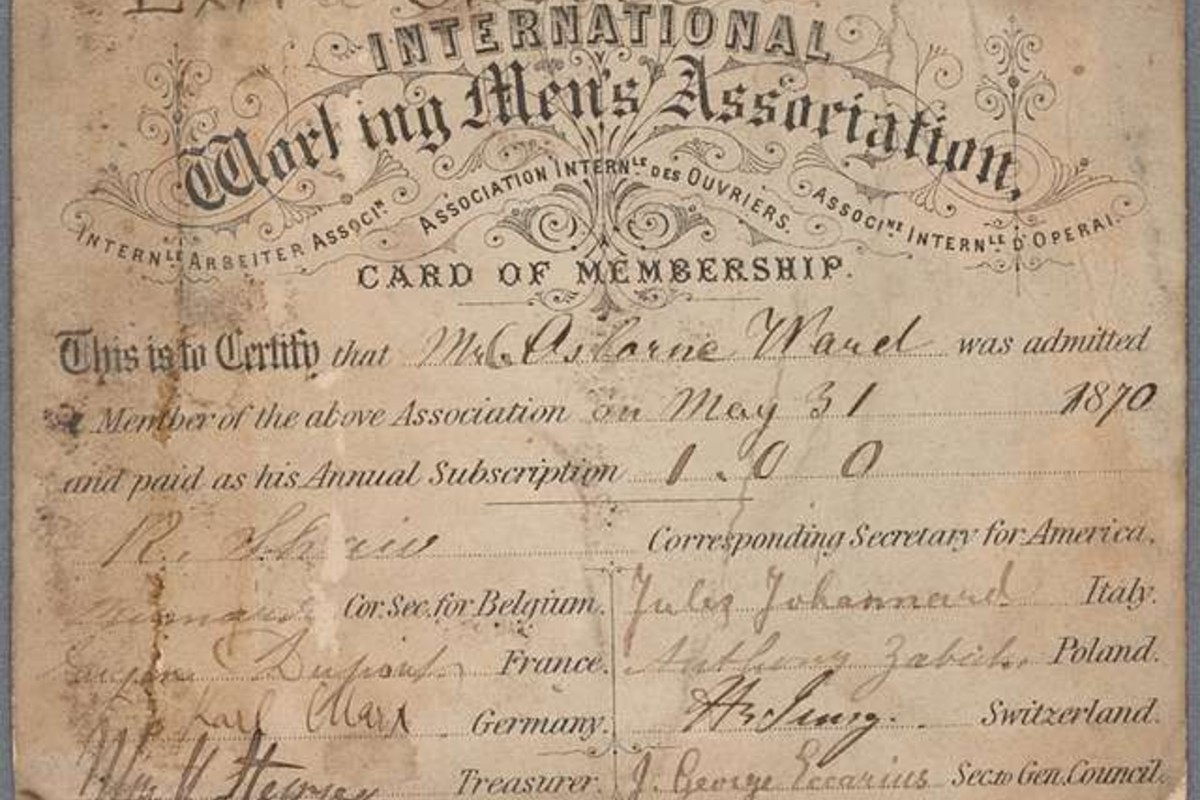
 International Working Men's Association card of membership 1870. Photo: New York Public Library / CC0 1.0 Universal Public Domain
The method of historical materialism has always been an anathema to the apologists of capitalism. Tayfun Er refutes its bourgeois distortions to uncover the revolutionary core at the heart of Marxism
Bourgeois critics of Marxism have a favourite target. They rarely begin with Marx’s critique of capital, the commodity, exploitation, class power or the state. They prefer to begin with ‘dialectical materialism,’ and, more specifically, with Engels’s unfinished notes later published as Dialectics of Nature.
The attraction of this move is obvious. If Marxism can be reduced to a speculative philosophy of nature, then it becomes easier to dismiss it as a nineteenth-century metaphysics: a system of universal laws imposed on physics, chemistry, biology and history alike. From there, the attack proceeds quickly. Engels is treated as the representative of Marxism, Dialectics of Nature as its philosophical foundation, and the whole revolutionary critique of capitalism is made to stand or fall with Engels’s most vulnerable formulations.
This is a mistake. More precisely, it is a politically useful mistake. Marx himself did not call his method ‘dialectical materialism’. Although the phrase had appeared before, it became a central Marxist category only after Marx, above all through Plekhanov’s systematising work from the 1890s onward and, subsequently, through orthodox Marxism in the Second International and the Soviet tradition. Marx’s central theoretical achievement was not the construction of a general philosophy of the universe. It was the critique of political economy: the discovery that capitalist society is not a natural order, but a historically specific form of social production organised around value, wage labour, capital accumulation and class domination.
Historical materialism
Marx’s materialism is historical and social before it is cosmological. It starts not from ‘matter in general’, but from real human beings producing and reproducing their lives under definite social relations. In Marx, the key question is not whether nature obeys three dialectical laws. The key question is how human labour, property, production and class power are organised in a given mode of production.
The distinction is not pedantic. It does not mean that Marx was indifferent to nature, science or the material world. On the contrary, Marx’s critique of capitalism is impossible without labour as a metabolic relation between humanity and nature. But the method of Capital is not a set of abstract laws mechanically applied to every domain. Marx’s dialectic is immanent. It follows the contradictory movement of a definite social form from within.
That is why Marx’s dialectic remains so dangerous. In the afterword to the second German edition of Capital, Marx praised Hegel for grasping the general form of dialectical movement, but insisted that Hegel’s dialectic had to be turned right side up. In its rational form, Marx wrote, dialectics is “critical and revolutionary” because it grasps every historically developed form as transient, as a form in motion, as something that contains the possibility of its own negation.
This is the Marx bourgeois philosophy wants to avoid. It is far safer to argue against a caricature of “dialectical materialism” than to confront Marx’s analysis of capital as a social relation that necessarily produces crisis, exploitation and class struggle.
Collaboration
Engels cannot simply be pushed aside here. No serious Marxist should treat Engels as a disposable appendix to Marx. Engels was Marx’s closest collaborator, a foundational socialist thinker, and the person without whom much of Marx’s later work would never have reached the world. His writings on class, the family, the state and political strategy remain indispensable.
The Dialectics of Nature
Engels’s Dialectics of Nature is a different kind of text. It was not a finished book prepared for publication. It was a collection of notes and fragments, written in the context of nineteenth-century science, and published long after both Marx and Engels were dead. To treat it as the final philosophical constitution of Marxism is therefore already a distortion.
The difficulty lies elsewhere. Engels tried to think nature historically, and that was a legitimate and often fruitful impulse. Nature is not a dead mechanism. Evolution, geology, thermodynamics and ecology all undermined static views of the natural world. Engels saw, earlier than many bourgeois thinkers, that nature itself has history, movement and transformation.
The trouble starts when suggestive insights are hardened into a universal doctrine. The transformation of quantity into quality, the interpenetration of opposites, the negation of the negation: these may illuminate certain processes, but they cannot replace concrete investigation. Once they are turned into ready-made keys for every science, dialectics becomes the opposite of Marx’s method. It ceases to be critical and becomes scholastic.
This is precisely where later orthodoxy did damage. After Marx’s death, ‘dialectical materialism’ was increasingly presented as the general worldview of Marxism. In Plekhanov, this took the form of philosophical systematisation. In Lenin’s Materialism and Empirio-Criticism, it became a militant defence of materialism against idealist and positivist currents. Under Stalin, it was condensed into an official doctrine of “dialectical and historical materialism”. The result was a reversal: historical materialism was often made to appear as one application of a broader philosophy of nature.
That reversal gave bourgeois critics an easy target. They no longer had to deal with value, surplus value, commodity fetishism, primitive accumulation, imperialism or the class character of the state. They could mock ‘laws of dialectics’, point to outdated scientific examples, and declare Marxism refuted. But refuting a later philosophical codification is not the same as refuting Marx.
Marx’s materialism
A serious Marxist response should therefore avoid two errors. The first is to surrender Engels entirely to bourgeois criticism, as if the Marx-Engels collaboration were an embarrassment. The second is to defend every line of Engels’ natural-philosophical speculation as if Marxism required infallible scriptures.
Marxism needs no such scripture. Its strength lies in its method: the analysis of concrete social relations, rooted in class struggle and historical development. Marx’s materialism does not ask us to repeat formulas. It asks us to uncover the real relations behind appearances.
In capitalist society, appearances are powerful. Wages appear as payment for labour, not as the purchase of labour-power. Profit appears as the reward for capital, not as a form of unpaid labour. The market appears as freedom, while workers are compelled to sell their capacity to work in order to live. The state appears as neutral, while it secures the general conditions of capital accumulation.
This is where Marx’s dialectic operates with full force. It does not float above society as a metaphysical law. It enters the commodity, the wage, money, capital, crisis and class struggle, and shows how each contains contradictions that bourgeois thought cannot resolve.
Philosophical confusion
That is why this kind of attack on ‘dialectical materialism’ is often an evasion. Bourgeois philosophy of science may expose weaknesses in Engels’s unfinished notes. It may correctly reject crude applications of dialectical laws to nature. But it has not thereby touched this core of Marx’s critique of capitalism.
The point is not to choose Marx against Engels in a shallow way. The point is to distinguish Marx’s critical method from later doctrinal closure. Engels should be read historically, not canonically. Marx should be read as a critic of capitalist social forms, not as the founder of a cosmic system.
There is an apocryphal story that Hegel once said only one man had understood him, and that even he had misunderstood him. Whether or not Hegel ever said it, the joke captures a real danger in the history of Marxism. To understand Marx is not to convert him into a philosophy of everything. It is to use his method against the society that still rules us.
There is, however, a grain of truth in the criticism. A frozen, formulaic ‘dialectical materialism’ can become bad philosophy. But bourgeois critics are wrong about the conclusion. That is not the refutation of Marxism. It is a reason to return to Marx’s revolutionary critique of capital.
Tayfun Er is a writer and civil engineer based in Turkey. He is the author of two widely discussed books on oligarchy in Turkey, as well as numerous articles and research essays. His work focuses on Marxist political economy, class power, migration and the contradictions of capitalist development. Website: www.tayfuner.com
Before you go
The ongoing genocide in Gaza, Starmer’s austerity and the danger of a resurgent far right demonstrate the urgent need for socialist organisation and ideas. Counterfire has been central to the Palestine revolt and we are committed to building mass, united movements of resistance. Become a member today and join the fightback.
