
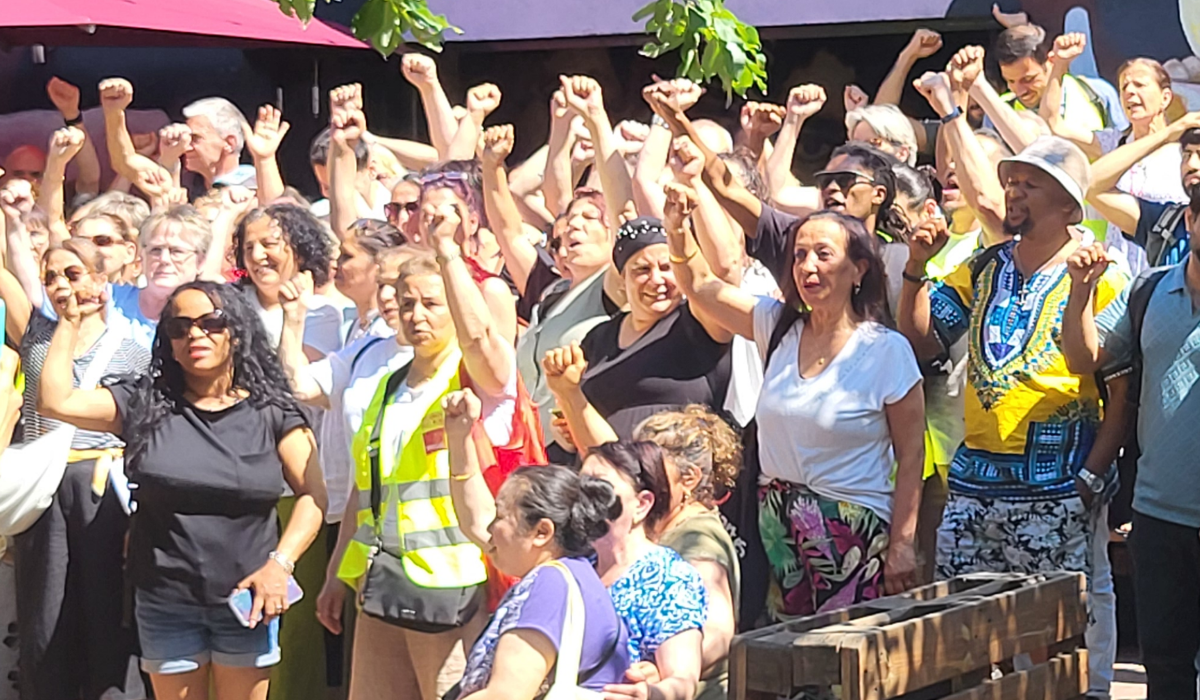
 Striking hospital ancillaries celebrate victory, Berlin, 23 June 2026. Photo: Ray Ferris
Ancillary workers in Berlin hospitals have won a significant strike victory, reports Robert Dale
After 64 consecutive days of strike action, hospital workers in Berlin have won a significant victory. They wanted pay parity with the national public sector agreement, and that’s what they got.
The group concerned is the ancillary workers who provide the non-medical services at the city’s municipally owned general hospitals (cleaning, food preparation, sterilisation, transport, etc.). Their jobs were outsourced in 2002 and their pay had fallen well below the national public sector contract. Their colleagues at the city’s teaching hospitals won a similar dispute last year. (It is worth noting that the outsourcing was the first act of the very first state minister appointed by the Left Party’s predecessor, the PDS. So much for electoral politics.)
Notably, this was a minority strike. Altogether about two thousand workers are affected, spread across eight main sites and many smaller ones. An organiser told me that more than half are members of the union, Verdi, and up to three or four hundred were on strike on any one day, often more like two hundred.
The union organisers placed great emphasis on participation. As well as daily picket lines, strikers demonstrated at their employers’ head offices and at a string of political meetings and events. Strike pay was disbursed on the picket line each day, and local activists collected €50,000 in donations to top it up. There was generally understanding for colleagues who felt they could not afford to strike (although, as an organiser told me, attitudes were ‘a matter of personality’).
The health system here operates an internal market, so it made sense to target the big money-spinner, which is operations. That placed a premium on the operating theatre cleaners and sterilisation services. Theatre nurses at several of the hospitals staged a couple of days of solidarity strikes, despite the very tight restrictions German law places on such action.
The employers’ side made their concessions piecemeal, with the strikers rejecting these ‘offers’ one after another by show of hands at mass meetings. Only after 64 days, and a last-minute clarification to restrict the bosses’ ability to terminate the agreement at a later date, did they feel they had won enough to settle.
So what is the deal? Essentially, pay will be increased in stages, reaching 100 per cent of the national public sector agreement by 2031. Although they will not strictly be part of the national agreement, they did also win the right to strike with their in-house colleagues whenever it comes up for renewal.
While the mass meeting on 23 June declared victory and called the strike off, the agreement still had to be put to a formal vote (via workplace ballot boxes). The result is now through, and shows a good majority to accept – with a significant minority who felt they could have achieved more. While the outcome raises the hospital workers’ pay to the level of the national agreement, they remain outsourced. That is being discussed as one to fight for in future.
At the final mass meeting, rank-and-file members announced that they would continue to organise going forward, with monthly meetings bringing together activists from all the sites. And the union is holding a conference in early September to discuss the lessons of the dispute. Under German labour law, union members can apply for ‘study leave’ to attend on full pay. The relevant forms were handed out at the mass meeting.
I found it thoroughly refreshing – and I could say startling – to be seeing proper old-fashioned trade union methods applied, and applied successfully: well-attended picket lines, solidarity strikes, decision-making by show of hands at mass meetings. To a significant extent this approach was driven by the team of young organisers brought in by the union. Workers also spoke of drawing inspiration from a successful strike by nurses and ancillaries at the same hospitals in 2021, in the midst of Covid.
Robert Dale lives in the Berlin region, where he has been active in socialist politics since the 1980s.
Before you go
The ongoing genocide in Gaza, Starmer’s austerity and the danger of a resurgent far right demonstrate the urgent need for socialist organisation and ideas. Counterfire has been central to the Palestine revolt and we are committed to building mass, united movements of resistance. Become a member today and join the fightback.
