
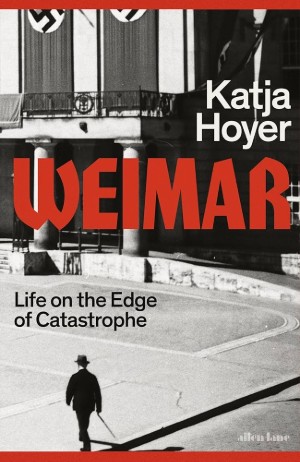
 Katja Hoyer, Weimar: Life on the Edge of Catastrophe (London: Allen Lane 2026), 496pp.
A history tracing the inter-war experiences of people in the city of Weimar during the rise of the Nazis fascinates, but its refusal to consider class limits it, finds Ian Goodyer
Anyone familiar with modern European history will know something about Weimar Germany, but they will almost certainly have a much vaguer mental image of the town that lent its name to this brief and troubled interregnum between war and dictatorship. The Weimar Republic, which spanned the gap between the collapse of the Hohenzollern monarchy at the end of World War I and the establishment of the Nazi regime in 1933, was a turbulent and contradictory affair. It was born in revolution and ended in violent counterrevolution, and along the way it combined daring experiments in avant-garde culture and politics with some of the most dispiriting and reactionary episodes of the interwar period. The scope and scale of developments in Germany, and their ultimate international repercussions, have tended to overshadow the town of Weimar itself, so Katja Hoyer’s recent book, her third on the subject of German history, is both welcome and illuminating and has received favourable reviews in the British press.
The Council of People’s Deputies which assumed power following the First World War declared that elections would be held to a temporary National Assembly, empowered to draw up a new constitution for the fledgling German Republic. Weimar was chosen to host this assembly for a number of reasons: the town was centrally located, it was relatively compact and had plentiful amenities, and it was a place in which key figures of German high culture – principally Goethe, Schiller and Nietzsche – had lived and built their reputations. It was therefore a town that metaphorically, as well as literally, sat at the heart of Germany. If Weimar could lay claim to a number of positive associations with Germany’s cultural heritage, it also benefited from the fact that it was not so closely bound as the capital, Berlin, to the Prussian militarism that had been so discredited in Germany’s recent defeat and humiliation.
For the ‘moderate’ social democrats who dominated the provisional government, it was also vitally important to insulate the National Assembly from the revolutionary events and ideas that were still coursing through Germany’s major cities, especially Berlin. As Hoyer makes clear, however, Weimar proved to be particularly receptive to the chauvinism and antisemitism that were key components of Nazism and the town became an important venue in Hitler’s ascent to power. It was the site, in 1926, of the Nazi Party’s first rally since it was relaunched the previous year. Although many Weimarer were shocked by the violence and intimidation that accompanied this event, by 1929, the Nazis had secured 24% of the vote in the town, more than double the 11% registered across the state of Thuringia as a whole.
Witnesses
Hoyer’s study revolves around the firsthand accounts of native Weimarer and others who became closely associated with the town. These witnesses speak to us through their diaries, letters, published works, memoirs, conversations, official documents and so on. This gives the book a particularly intimate character and it allows us to glimpse the thoughts and to infer the motives of people trying to negotiate an extraordinarily challenging and confusing set of circumstances. Hoyer maintains an almost entirely non-judgemental attitude towards her subjects, so it falls to the reader to draw their own conclusions about the people at the centre of her account.
Over the course of the book, we witness their behaviour and are sometimes privy to their private thoughts. Reading this a hundred years or more after the event, we do so in the knowledge that the most terrible cruelty and violence will consume many of the lives being recounted. In the course of their stories, we can see how destinies are shaped by strings of small decisions: minor betrayals or acts of compassion; hypocrisies and epiphanies; moral queasiness lapsing into unchallenging conformity; the myriad ways in which Weimarer either made implicit bargains to find a safe niche in this increasingly intolerant society or were ground down by it.
In her introduction, Hoyer describes how she views the people whose words fill her book: ‘Though they represent different age groups, genders, social classes and responses to the tumultuous era they lived through, they should not be seen as types. Each individual was a real human being with their own complex circumstances, motives and room to manoeuvre. While their stories combine into what many may regard as a cautionary tale, it is difficult and often unhelpful to judge people’s behaviour from our vantage point a century later’ (p.xxiv).
Culpability
The question of personal responsibility for the rise of Nazism suffuses Hoyer’s narrative. It informs the life of Carl Weirich, a keen diarist whose story provides a thread throughout the book. The opening pages recount Weirich’s participation in a hike to the Buchenwald con-centration camp, forced upon a large group of Weimarer by occupying American troops. The camp was built a few kilometres from the town, and here Weirich was confronted with its remaining inmates and the murderous apparatus that had been built to contain them. Weirich’s horror is evident, but as Hoyer makes plain later in the book, Buchenwald had been constructed and maintained with the direct connivance of many of Weirich’s fellow townsfolk.
The broader context of Weirich’s life, through the war years of 1914-18 and beyond, is provided by plentiful extracts from his journals. Although Weirich never joined the Nazi Party, he did, for a while, contribute to a fund supporting the SS and when his business faced multiple challenges at the end of 1932, he wrote in his diary about the hopes he was placing in the hands of ‘the Führer of the National Socialist Party A. Hitler’ (p.261). Weirich experienced personal tragedies and he sometimes struggled to keep his business afloat. His financial fortunes followed the ebbs and flows of Germany’s national economy, but it is clear that he benefited from the extra custom brought to Weimar during the Nazi Party’s post-1925 re-foundation, as Hitler made the town a site for major events. Given the tumultuous period he was living through, Weirich’s journal entries offer little in the way of imagination or critical reflection, and however much we may sympathise with him as he deals with personal tragedies and misfortunes, he rarely raises his eyes to see much beyond domestic and business concerns.
Despite having experienced more than a decade of Nazi dictatorship and an appalling war, Weirich still seems genuinely nonplussed when he finally passes through the gates of a concentration camp that was built on his doorstep and which embodied the barbarism of a regime that had cut a bloody swathe through Weimar society and which was so obviously rooted in dehumanising violence. In light of his narrow priorities and unwillingness to confront honestly the realities of Nazism, it is hard not to see Weirich as conforming to the archetype of the traditional petit-bourgeois who, in Trotsky’s words ‘prefers order so long as business is going well and so long as he hopes that tomorrow it will go better.’i
Selective narratives
Weirich’s story, compelling as it is, is emblematic of a faultline that runs throughout the book: any research project that is so dependent on personal testimony left by individuals will inevitably privilege the views of those people who tended to leave behind direct literary traces, or who were the subjects of other people’s writing. Hoyer’s methodology acts as a kind of social filter, which allows relatively privileged individuals to pass through, but holds back the majority of Weimarer, especially workers. This implicit bias might have been ameliorated by a historian more sensitive to the role played by class and status in fascist politics, but as we saw above, Hoyer is determined to see her subjects as ‘individuals’ rather than ‘types’. This may be an attempt to avoid crude reductionism, but carried to the extent Hoyer takes it, it strips away crucial elements of social context that would help us explain people’s actions.
Given Hoyer’s approach, it is scarcely surprising that the bulk of her attention is focused on figures such as business people, academics, government functionaries, politicians, and others whose social position can best be described as petit-bourgeois, bourgeois or aristocratic. Not a single working-class voice is heard in the book (although there is a partial exception insofar as the handful of Social Democratic Party (SPD) politicians and bureaucrats mentioned tended to come from working-class backgrounds).
Almost all of Hoyer’s cast of characters espouse conservative political opinions and even those social democrats who receive detailed attention came from the moderate wing of the movement. This would be a minor problem in a study that aims simply to document the development of fascism among those social strata most open to its appeal, but Hoyer sets herself a more ambitious aim. At the end of her book, she expresses the hope that: ‘Studying [the] behaviour’ of her protagonists ‘both as individuals and as members of society can get us closer to understanding how Nazism took hold and how it was able to spread its pernicious influence far beyond its fanatical core. It is in these dynamics that we may find lessons to safeguard democracy and freedom in our own time’ (p.419).
Hoyer’s reference to her subjects’ behaviour ‘both as individuals and as members of society’ suggests that she isn’t blind to the pressures and constraints under which people act, but her perspective doesn’t allow her to develop her concept of the ‘social’ beyond a liberal model of society as a community of atomised individual agents. She recognises that the Weimar Republic is a messy, contested network of relationships, but it is drained of its class content; as a result, she has a narrow conception of democracy which doesn’t have room for variant forms.
Consequently, Hoyer makes it seem like the Republic is not so much ‘a’ democracy as ‘the’ democracy and that any challenge to it is therefore inherently anti-democratic. This becomes clear in Hoyer’s dismissive attitude towards the left-wing alternatives that were posed at the height of the revolution that broke out at the end of the Great War. She summarises the January 1919 revolt in these words: ‘The so-called Spartacist Uprising had been raging for three days. Interim Chancellor Friedrich Ebert of the SPD deployed soldiers and Freikorps, groups of veterans who hadn’t disbanded. Largely right-wing and well-armed monarchists were hunting down badly organized far-left workers in order to protect the seeds of a democracy neither of them wanted’ (p.41).
Fault lines
As a summary of the situation, this is profoundly misleading on at least two counts. Firstly, while the proto-fascists of the Freikorps clearly loathed democracy, this cannot be said of the workers and soldiers aligned with the Independent Social Democrats and Spartacus League. The revolutionary left may have been antagonistic towards the bourgeois democracy being mooted by Ebert and the SPD, but this is because they were fighting for a different form of democracy based on organs of working-class power.
Secondly, Hoyer fails to acknowledge that it was revolutionaries such as Rosa Luxemburg and Karl Liebknecht, and the forces that rallied alongside them, who represented the most consistent and potentially effective antidote to incipient Nazism. Friedrich Ebert and other so-called ‘moderate’ social democrats (such as his execrable Defence Minister Gustav Noske) ensured that the road to the Weimar Republic was driven across the corpses of democracy’s most principled champions and with the support of reactionary forces that would later form part of the paramilitary backbone of Nazism. The communist and socialist challenge to the republic being shaped under the aegis of Ebert et al was far from being anti-democratic. Its defeat, and the manner in which it was defeated, laid the foundations for what was to follow.
Hoyer’s equation of the far right and the far left, and her refusal to countenance the idea that an effective anti-fascist politics must be cognisant of class relations, leads her into a dead end, and it undercuts her ambition to ‘find lessons to safeguard democracy and freedom in our own time.’ Poring over the literary output of people who, in most cases, made their (sometimes uneasy) peace with Hitler’s regime may be helpful in tracking the spread of the Nazi contagion and its precursors, but rather than providing source material for a progressive alternative in the way Hoyer implies, it ironically tends to support analyses of fascism that stress its class character. Katja Hoyer has therefore written a valuable book, but not necessarily for the reasons she thinks she has.
There is a complacent myopia that characterises many of the people Hoyer highlights and which readers may find infuriating, but this does provide insights into the mentality of individuals for whom democracy was tolerable as long as it didn’t interfere with their own privileges and social status. We thus meet a middle-class woman, Catharina Lehmann, who agonises over her vote in the first national election in the new republic, and becomes enthused at the thought of women being empowered through the constitution, only to vote for the antisemitic and nationalist DNVP (German National People’s Party) in solidarity with the deposed Kaiser and against the ‘threat’ of the SPD.
Then there is Elisabeth Förster-Nietzsche, sister of the late philosopher Friedrich Nietzsche, and a lifelong monarchist and antisemite. She quails at the uncouthness of the Nazis (she much preferred Mussolini to Hitler), but nevertheless consents to their ideologues exploiting her brother’s work in exchange for the money and resources to build a permanent home for Nietzsche’s archive.
Even Harry Graf Kessler, a friend to Elisabeth Forster-Nietzsche and described by Hoyer as a ‘liberal’, couches his anti-fascism in anti-democratic patrician terms when he declares to his friend: ‘Mussolini fundamentally embodies the most dangerous tendency of democracy because he leans on his rule by … majority (however this may have been achieved) to cut off the existence of individual free people by law. What is slowly developing in the United States as the worst side of democracy, the rule of the stupid will of the masses over the will of the individual, fascist Italy enshrines in its fascist constitution. Mussolini is basically the most sublime embodiment of democratic herdthink … the thing your brother fought against most vigorously’ (p.196).
Despite her bias towards sources drawn from various elites, Hoyer reveals a wellspring of genuine courage and anti-Nazi fortitude in her account of the underground resistance networks sustained by social democrats such as Kurt Nehrling. Readers will share her high regard for the men and women who, in the aftermath of defeat and facing brutal repression, maintained small groups dealing mainly in reading and propaganda, and small-scale acts of dissent.
Flames of hope
This needs to be contrasted with Hoyer’s cavalier dismissal of left-wing social democracy at a time when it could still call upon the support of armed militias and powerful blocs of organised labour in its struggle against a wave of antisemitism and reaction. There is nothing wrong in principle with applauding the extraordinary bravery of those heroic souls who refused to turn inwards in the face of Nazi tyranny and kept alive small flames of hope and optimism, but it is a peculiar kind of anti-fascism that valorises resistance only when it has been effectively rendered impotent.
An atmosphere of fatalism hangs over Hoyer’s book, which cuts against her avowed intention to draw from history lessons to inform us in the fight against contemporary tyranny. Despite my serious criticisms, however, I found the book both informative and engaging; if nothing else, it evokes the mentality of the Nazis and their enablers with horrible precision. At its best, Weimar captures at an almost molecular level some of the myriad steps taken by a society as it descended into the filth and barbarism of fascism.
Hoyer has written a book that, in my view, offers some powerful testimony and fascinating commentary, but it fails to live up to the author’s hope that it will provide ‘lessons to safeguard democracy and freedom in our own time.’ Her reluctance to grant any explanatory power to class in explaining the rise of Nazism, means Hoyer will fail to appreciate the pertinence of this observation from Walter Laqueur in his own cultural history of the Weimar Republic: ‘If the middle classes in their majority did not welcome the Republic, it was partly because life under the Kaiser had by no means been intolerable, and on the other hand because, having to choose between order and freedom, they would almost certainly opt for the former.’ii
In summary, I would urge anyone curious about Hoyer’s book to read it critically and to supplement it with additional material about Weimar Germany. For those wishing to arm themselves for anti-fascist struggle, Trotsky’s numerous writings on Germany are invaluable, and Chris Harman’s The Lost Revolution: Germany 1918 to 1923 is a brilliant study of the struggles that marked the formative years of the republic.
i Leon Trotsky, Fascism: What it is and How to Fight it, (Atlanta: Pathfinder Press, 1969), p. 19.
ii Walter Laqueur, Weimar: A Cultural History 1918–1933, (Salisbury: Phoenix Press, 2000), p.4.
Before you go
The ongoing genocide in Gaza, Starmer’s austerity and the danger of a resurgent far right demonstrate the urgent need for socialist organisation and ideas. Counterfire has been central to the Palestine revolt and we are committed to building mass, united movements of resistance. Become a member today and join the fightback.
