
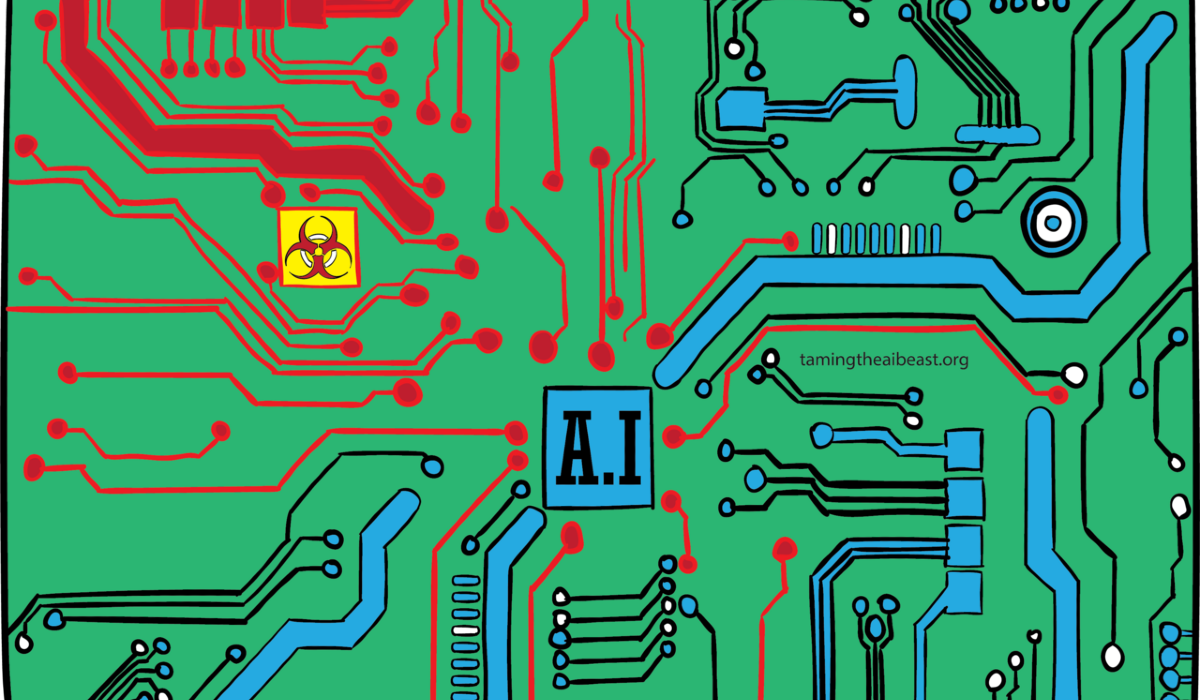
 AI 'End Scenario' Cartoon/ CC BY-SA 4.0
 Kevin Crane takes on some common questions about Artificial Intelligence
Is AI Going to take my job?
Statistically… no, but you’re not supposed to know that.
The capacity for AI to eliminate jobs has been greatly overhyped by tech company elites and largely accepted uncritically by both politicians and the media establishment, but there’s really no evidence for it. In fact, there is growing evidence that AI technologies are consistently failing at this.
The promise (or threat) of AI boosters has been that generative tools such as large language models (LLMs) are so prolific at creating output that it renders human labour obsolete. It has failed on several levels. The most basic of these is that generative systems do have any actual understanding of the things they produce: they are number machines that are simply scan an input, run a calculation on it, and then return and output based on estimate of the most likely response that a human would give based on analyses of actual things created by humans. With enough accumulated data and processing power, the calculations can often be very sophisticated and produce results that appear convincing, provided that they are never analysed for actual content. There is not a lot of use for these projects, however, if they are never going to subject to actual scrutiny, and this is where the limitations come in.
Attempting to use LLMs to do the jobs of clerical, administrative or professional staff frequently produces utterly absurd results. Asking an LLM to write a legal paper to dispense with a lawyer, for instance, will produce a document that appears to be written in appropriate language but that will riddled with incorrect references and fictional details. This is because the LLM does not know the difference between relaying truths and writing lies – words are all just sequence of data points to them. A person using a LLM to produce official documentation therefore has to filter through it’s output to root out the so-called “hallucinations” (which are better described as errors) thus slashing or reducing any productivity gain that system was supposedly providing in the first place. The result has been that AI has delivered conspicuously unimpressive impacts on corporate productivity, making it difficult to see how corporations can use them to cut jobs long-term.
In the culture and entertainment sector, things are scarcely any better for employers. AI-derived content is frequently very obvious to the consuming public, who react to it extremely poorly. Market research consistently shows that audiences are rejecting films, books, shows and video games that have been produced using generative AI. In fact, even a rumour that AI was used in the production of media is a huge turn-off to potential consumers, such is the public’s hatred of ‘slop’. The hope that companies had a couple of years ago that they would be able to churn out profitable products without the need for workers has proved to be a complete illusion.
What AI technologies have been primarily used for at work in practice has been to force workers to increase their personal output, with the ‘job apocalypse’ being much more of a spectre to intimidate employees into submission than any actual reality.
Is AI of any value to humanity?
This question is made tricky to answer by the fact that there is, in fact, no specific technology or product that actually is ‘AI’. AI is marketing term used to bundle together a range of data-driven systems, which include such things as search engines, recommendation algorithms, speech recognition systems, autonomous robots, generative tools and game-play intelligence. These things actually have very little to do with each other, apart from that businesses have been marketing them all as ‘AI’.
Could any of these things benefit humanity? Yes, a reasonably imaginative person can find practical uses for all them which could be of genuine benefit to society and our natural world. Even generative systems like LLMs, which do not deliver what capitalists have claimed them to (see above), actually do have thoroughly useful applications when applied to big-data research and analysis. They just aren’t at all good at what they’ve been marketed for.
Technology is fundamentally social: the impact that it has is determined by who is using it and what their intent is. The problems we are currently having with technology derive from the fact that it is in the control of overly-powerful corporations run by the billionaire class.
Can AI develop its own consciousness?
No. Next question?
Oh, OK, I suppose this does need to be answered, since it is often pushed as a concept. Conscious, or “general” intelligence is a widely theorised, but completely unevidenced, idea that stems from the theory that software-based decision-making systems might be similar, in some very minor or elementary way, to the way that the human mind works. Our grasp of how brains function is still so partial that there would be no real way to confirm this even if were true, but we do know how computers work and they are really very, very unlike brains.
Even if we make the argument that an artificial intelligence is so sophisticated that it acts somewhat like a consciousness, to say that this would ever be equal to, or even comparable to the consciousness of a human being is a notion that only get sillier the more we look at it. The consciousness of human being is something more than a simple response to stimuli. Human intelligence is a creative and, so far as we know, unique phenomenon that deduce and induce original ideas. As the prolific tech critic Emily Bender famously put it, AI does not actually do anything original and is better described as a “stochastic parrot”, reproducing noises it has heard humans make based on a simple mathematical calculation in the same as a real parrot will make human-sounding noises without the faintest idea what they mean.
The persistence of the notion that advanced computer systems are becoming conscious is really driven by two things. One of these is old-fashioned wish fulfilment: the designers of AI systems have picked up the notion of self-aware machines from popular culture, and are therefore somewhat unknowingly driven to design the systems they are working on as if they were conscious, effectively building an illusion based of their preconceptions into what they are working on. This is really what drives the interface on so many AI platforms to act as if it is “chatting” to you, when it would certainly be more efficient to make the interface much more direct and obviously machine-like.
The other factor, however, is propaganda. The tech industry has weaponised popular anxieties about what AI might be capable of or might do at some point in the future to completely obliterate discussions about what it does now. Elon Musk and Sam Altman find it much more useful for their business plans to divert discussions about AI projects onto the science-fiction dangers of Terminator-style conscious machines, than to allow us to have open and serious discussions about the economic and environmental damage their sprawling data centre complexes do in real life right now.
Can AI be regulated?
All the technologies associated with AI could be regulated, but this a political fight and one that our side is currently losing.
The tech industry is using its vast concentrations of wealth and deep connections to establishment politicians to prevent governments from governing it. Indeed, at the moment governments are cheerfully handing over key functions of the state to the tech companies in an extreme act of privatisation.
Here in Britain, we have has a particularly egregious example of this just recently. Mayor of London Sadiq Khan attempted to prevent the deeply unpleasant tech company Palantir from being given a major contract with the Metropolitan Police. Whatever Khan’s other shortcomings might be, his motivation for this was dead right: Palantir is a company with deep ties the American military-industrial complex, run by a group of notorious racist and authoritarian bosses headed by the infamously unpleasant weirdo Peter Thiel.
The full force of political, media and establishment pressure was exerted on Khan, and he buckled and allowed Palantir to get the contract, giving the sinister corporation to snoop and scrutinise millions of Londoners. We urgently need a political movement to fight back against the ever-extending reach of these companies into our institutions.
Will the AI boom bust?
It is pretty widely recognised that the AI sector is a classic capitalist bubble, which is almost certain to burst sooner or later. Capitalism has been producing bubbles for centuries now, and most of them have pretty similar features: certain commodities become over-valued by capitalist traders until a point gets reached in which the cash being spent on them couldn’t possibly be realised in terms of actual, countable profits.
The AI sector has, however, some particular features which make its vulnerability to a market crash particularly acute. One of these is it’s environmental unsustainability: the demand that the tech companies have for constantly expanding in order to attract further investment is running up against the physical limits of reality. The Big Six corporations unveiled plans for new compute capacity last year that were so vast that not enough electricity was being generated in the entire world to supply them!
Relatedly to that first problem, the second is that AI’s constant desire to increase in scale is negatively affected by one thing that most previous industries can do that it can’t: it delivers no economies of scale. Almost any other type of product becomes cheaper by the unit the more if you produce, because the outlay and marginal costs of production become less and less significant relative to your other costs. This is very obvious is you are making physical products – if you’ve created a machine for making paper-clips, the investment looks a lot cheaper if you use to make one hundred thousand paper-clips rather than one hundred – and it normally applies to software products too. Microsoft don’t need to re-develop Windows for every individual computer it is installed on, so every license they sell for it is just making them more money for almost no additional investment.
In contrast, the cost of output for an AI product remains stubbornly proportional to the amount of output created. Every time someone makes an AI request, even if many or most of them are making the very same request, the system has to run be in full, consuming energy and placing demand on hardware, to the same extent and with the same intensity every time. This means that as the sector attempts to grow infinitely, it’s costs just rise to meet that increase in size. This brings the looming point of total unsustainability even closer than it would have been with previous overheated sectors, including the “dot-com” and property bubbles of the 2000s.
So, no the tech companies cannot possibly carry on as they have been, indeed the big companies have already begun quietly scaling back some of their most extravagant products, such as OpenAI’s much-hyped “Sora 2” video generation app, switched off after only six months because each and every extremely stupid video the public were making with it was a direct cost to the company.
Businesses like OpenAI may not be much longer for this world, with their massive debts and non-existent profit margins. The threat is that the capitalists involved will use the power that they’ve grabbed in state, government and other institutions to continue to do harm to our planet and society.
Before you go
The ongoing genocide in Gaza, Starmer’s austerity and the danger of a resurgent far right demonstrate the urgent need for socialist organisation and ideas. Counterfire has been central to the Palestine revolt and we are committed to building mass, united movements of resistance. Become a member today and join the fightback.
