
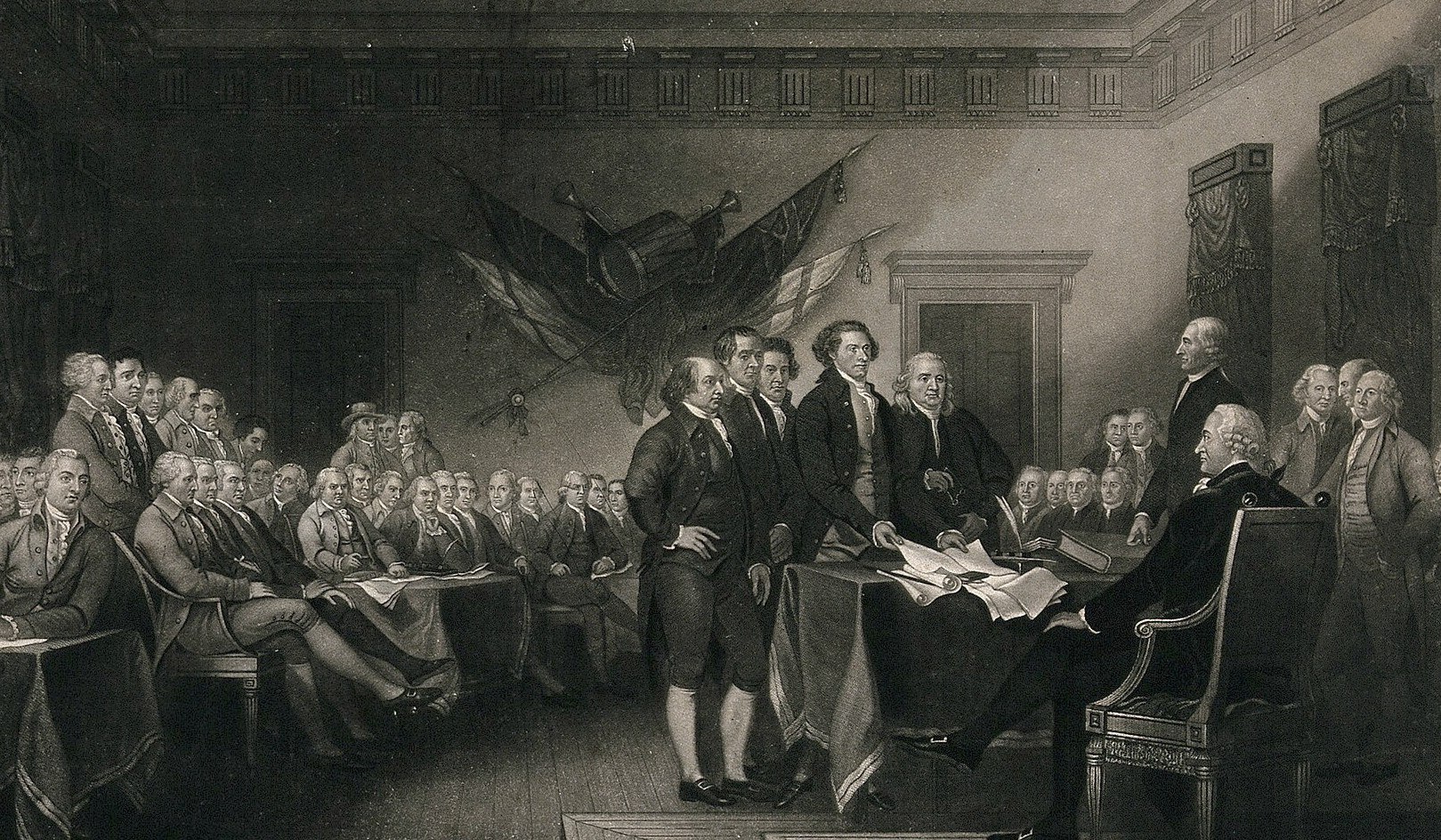
 The Declaration of Independence of the United States of America, Philadelphia, July 4th, 1776. Image: Wikimedia Commons CC BY 2.0
This year marks the 250th anniversary of the Declaration of Independence and will be celebrated throughout the US. Ironically, as Dominic Alexander explains, the American Revolution was an anti-imperialist struggle against the then superpower – Britain
The American Revolution (1775-83), sometimes just the War of Independence, is not always considered among the ranks of the Great Revolutions, but it was nevertheless a bridge between the English Revolution of the seventeenth century and the French Revolution of 1789. Influenced by the former, and influencing the latter. In some respects, the American Revolution was a halfway house; it removed structures of colonial power and so arrested tendencies towards aristocratic rule in the colonies, but did little to trouble the underlying structures of class power. Indeed, while it led to the end of slavery in the northern states, the slave system and attendant class structures were consolidated in the south. It would take another revolutionary-like event, the Civil War of the 1860s, to dismantle any of that. Even so, the American Revolution was a genuine revolution, and contained social struggles that, while ultimately contained, pointed to the potential for a more radical revolutionary rupture to have happened.
The legacy of the English Revolution was a two-edged sword. On the one hand, there was a radical plebeian tradition emphasising equality and liberty, and on the other was the more conservative one concerned with protecting the interests of property against both a tyrannical state and the danger of rebellion from below. The two traditions clearly could overlap, and the contradictions between them would only necessarily break out under conditions of severe crisis.
Unity of classes against tyranny from overseas was the dominant ethic of the American Revolution, and to a large extent, this prevented the same extent of radical efflorescence occurring compared to the English Revolution, or after it, the French. All the same, the American Revolution could not have been accomplished without major mass mobilisations from below. Such mobilisation was brought about, however, under conditions which tended to emphasise the common struggle against English imperial domination.
The proximate cause of the conflict which led to Revolution was a series of measures, including the 1764 Sugar Act and the 1765 Stamp Act, imposing greater Crown control over, and extracting more revenue from, Britain’s colonies. The Stamp And Sugar Acts were passed partly in an effort of the British government to pay off the debts incurred during the Seven Years War (1756-63), during which the French holdings in North America were eliminated, and Britain’s dominance over India ensured. The taxation of the American colonies coincided with the development of the ‘long-term subordination’ of the economies of Ireland and India.’ Indeed, Britain’s textile-based industrial revolution was made possible by the ruin of India’s artisanal textile industry. However, the American colonies were ‘only partly tied into the network of imperial control’, and saw alternatives to domination from overseas.
The response to the Stamp Act was not only boycotts of British goods by the merchants, but major plebeian demonstrations. In Boston, the demonstrators ‘hanged the stamp distributor in effigy’, invaded customs houses and burnt records relating to trade legislation. Similar events occurred in New York, Newport and Charleston. The Lieutenant Governor Thomas Hutchinson of Massachusetts complained that ‘the real authority of the government is at an end, some of the principal ringleaders in the late riots walk the streets with impunity no officers dare attack them; no attorney-general prosecute them and no judges sit upon them.’ The riots and demonstrations rapidly made the Stamp Act unenforceable, and it was repealed a year later in 1766. It was replaced in 1767 with another tranche of colonial duties.
Plebeians and patriots
These sparked further popular mobilisations. Already a loose association of plebeian radicals known as the ‘Sons of Liberty’ had emerged. Although groups appeared in all the main towns and cities, the organisations were local rather than there being any formal inter-colonial co-ordination. They nevertheless acted as a crucial link between the more radically inclined revolutionary organisers, like Sam Adams in Boston, and the mass of urban artisans and shopkeepers. Sam Adams was also instrumental in developing the alliance between the urban plebeian movement and the rural common people, first in Massachusetts and then New England more generally.
The plebeian actions also led directly to the Massachusetts House of Representatives successfully calling for an intercolonial conference over the Stamp Act, where representatives from nine of the colonies met in New York and petitioned the British parliament over colonial grievances. This congress was an important precursor to the Continental Congress that met in Philadelphia in 1776 and which made the Declaration of Independence.
The plebeian masses of New England were perhaps ready for revolution, clashing with British troops in 1770 in New York. Two months later on 5 March, troops fired on a crowd, killing five, and then occupied the city. At this stage, the wealthy merchants were not prepared to push matters further, and in 1770, they abandoned the boycott, while the British Parliament also repealed more of the disputed duties. In the face of soldiers prepared to kill, the popular movement subsided for a time, although the Sons of Liberty continued issuing leaflets and organising demonstrations.
Already in 1767, however, there were right versus left divisions in the Sons of Liberty, with the more conservative wishing to curb the ‘leveling tendencies’ of the plebeian crowd. That this conflict emerged so early points to how conscious the colonial ruling class was about the danger of mass radicalism to their control of the movement against British rule. There was a delicate balancing act that the elites needed to perform to both muster popular support against Britain while remaining in control. Even a radical like Sam Adams did his best to put limits around the activities of his ‘Liberty Boys’, and generally succeeded. The legacy of the English Revolution can be seen in the calculations being made here, both in the awareness that revolution was possible, and the consequences if the plebeian crowd gained too much traction in a crisis.
In rural areas, class divisions were at least as problematic. There had been tenants’ risings in different northern states from the 1740s to the 1760s, while ‘regulators’ in North Carolina organised to protect indebted farmers, obstructed the collection of taxes, and explicitly contrasted themselves as ‘poor Industrious peasants’ against the ‘rich and powerful … designing Monsters’. As much as ‘Patriots’ in the elite chafed impatiently against British rule, there were many others among the rich merchants in the north, and the planters in the south, who did not want to disturb the delicate balance of colonial society by rebellion.
The tea party
In 1773, the British government provided exactly the provocation needed to revive the movement, and push waverers into the Patriot camp. The Tea Act exempted the East India Company from British duties on tea exports, enabling them to undercut colonial merchants selling tea in America. Often described as a de facto monopoly, the Act underlined Britain’s assertion of its right to tax the colonies, causing opposition on multiple grounds. The popular movement thus returned.
The Boston Sons of Liberty dressed themselves as ‘Mohawks’, boarded the Company ships in the harbour and threw the tea overboard. This ‘Boston Tea Party’ was then imitated in other ports such as New York. Britain responded early in 1774 with the five ‘Intolerable Acts’ which deprived Massachusetts of self-government and other foundational rights. This attempt to make an example of the state sparked outrage across America and led to the first Continental Congress in September 1774, which soon endorsed the Massachusetts leaders’ declarations of resistance to British victimisation.
When the First Continental Conference had finished in October 1774, little was expected except another conference that would assess how well the association of colonies was working. However, the unexpected clash between colonists and British troops at Concord and Lexington on 19 April 1775, and the fighting over the occupation of Boston, meant that the conference had to move quickly to organise an army with a base of support beyond New England. The importance of Virginia to the colonial alliance was a major reason why a landowner and slaveholder from that state, George Washington, was appointed as supreme commander.
Even in the midst of the accelerating crisis in the mid-1770s, tensions between the plebeian and elite layers were apparent. In New York, in 1774, the merchants’ Committee of Fifty-One found itself challenged by the Sons of Liberty’s Committee of Mechanics demanding ‘equal rights for the classes hitherto excluded from voting’. Demands for democratic alterations to representative assemblies, including widening suffrage, equitable reforms of taxation and price controls were being made across the colonial cities. In Philadelphia in particular, artisans, labourers and shopkeepers were pressing such demands using extra-legal measures to the point that in 1776, they ‘were in clear command’ in the city. They were even seen to be threatening the existence of wealth and ‘the right to acquire unlimited private property.’ A democratic constitution was adopted by Pennsylvania in 1776, although it wasn’t until 1780 that the state abolished slavery. A more conservative constitution replaced the original in 1790.
Despite class divisions among Americans, and the hesitations of the elites, once fighting had begun, British authority rapidly evaporated. Throughout the country, popular committees formed, even in rural areas, that challenged the authority of officials, to the point that dual power existed in many areas, particularly Massachusetts. This moment of revolution meant that a significant proportion of the old elite turned to Loyalism, but although the ruling class lost control to democratic forces in some places, Philadelphia for example, in others places where radicals were temporarily strong, like Maryland and New York, the elites regained the upper hand fairly swiftly, and were able to avoid having to accept democratic constitutions such as the one in Pennsylvania.
A new republic
The Declaration of Independence came after over a full year of fighting, begging the question why it took so long. The colonists’ thinking had developed from the traditional complaint that bad ministers around King George III were the problem, through blaming parliament, to accusing the king himself, and only then deciding that the fault lay in imperial rule altogether. The long path to this conclusion was at least partly due to the position of the ruling class of wealthy merchants and planters, who were slow to accept that the existing system no longer worked in in their interests.
A breakthrough in general thinking was facilitated by Tom Paine’s pamphlet Common Sense, published in January 1776. Paine’s writing was expertly directed to a popular audience, and put an unapologetic case for an independent republic, castigating the whole institution of the monarchy. William the Conqueror was a ‘French bastard landing with an armed banditti, and establishing himself king of England against the consent of the natives.’ The monarchy was ‘in plain terms a very paltry rascally original. – It certainly hath no divinity in it.’
Unlike more conservative Enlightenment thinkers, Paine did not praise Britain’s ‘mixed constitution’, but in a lively canter through English history, ridiculed the idea that a monarchy was compatible with people’s freedom and security: ‘For it is the republican and not the monarchical part of the constitution of England which Englishmen glory in, viz. the liberty of choosing an house of commons from out of their own body.’
On the idea that monarchy has any divine approval: ‘if the setting up and putting down of kings and governments is God’s peculiar prerogative, he most certainly will not be robbed thereof by us; wherefore the principle itself lead you to approve of every thing, which ever happened, or may happen to kings as being his work, OLIVER CROMWELL thanks you. – CHARLES, then, died not by the hands of man’. There is more than a whiff of the radical tradition of the English Revolution in Tom Paine. Nor was he alone in this: calls for action against officials acting for the British were signed by ‘Joyce, Jr’, clearly recalling Cornet Joyce and his arrest of Charles I in 1647, while Cromwell was frequently invoked in radical quarters.
A contemporary went so far as to claim that ‘the Great American cause owed as much to the pen of Paine as to the sword of Washington.’ Paine gave an ideological shape to the struggle, which was particularly important in the army, yet by 1787, he had become a pariah in America, as the radical tide was repressed and a new order stabilised.
Democracy contained
The war of independence acted to contain class divisions, but even so a Committee of Privates urged voters in a 1776 constitutional convention in Pennsylvania against the ‘great and overgrown rich men’ and drew up a Bill of Rights. Although New England militia men frightened the southern planters ‘because they spread leveling doctrines’, radicalism in the army did not develop into an independent force that could challenge elite control of the revolution. There was potential; in 1781 there were mutinies, but Washington made sure he had well-paid and provisioned troops to disarm the mutineers. The American general did not make the political mistakes the Presbyterian leaders in England had in 1647.
The class conflicts underlying radical sentiment on the Patriot side were serious enough that it wasn’t in fact always easy to create enthusiasm for the fight against the British. Thus, the army had to be allowed to become an avenue for social advancement for the poor. Even so, up to a third of the population was opposed to the war, and many more were indifferent. Conscription had to be introduced, including impressment into the navy by 1779, reminiscent of the hated British practice. This was particularly so in the south, where there were stark divides between the planter elite and smallholders. With there being few urban centres, the ‘lower classes resisted being mobilized for the revolution. They saw themselves under the rule of a political elite, win or lose against the British.’ The planters feared the poor whites, who were at this point in history often hostile to slavery, and, of course, that the unsettled conditions would lead to slave uprisings.
Washington initially refused to allow black volunteers into the army for fear of encouraging hopes that slavery would be ended. The British in fact promised freedom to Virginia slaves who joined their forces. On the colonial side in the south particularly, there was great concern that the ‘malicious and imprudent speeches of some among the lower classes of whites’ had stirred black hopes for a British victory which would lead to emancipation. The British lost, of course, and treated the black soldiers who fought for them shabbily to say the least, so whatever hopes had been harboured in a Loyalist spirit were in vain.
A more positive gamble lay on the other side. There were eventually thousands of black soldiers on the Revolutionary side, but this was significantly connected to the regions where more plebeian forces affected how the war was fought. Vermont was carved out of New York by its own militia of smallholders in the course of the revolutionary years, and adopted a bill of rights in 1777 which ended slavery in its first article. Vermont was not admitted to the United States until 1791, being an independent republic during the interim.
The revolutionary period in general marked a significant crack in the system of slavery. During the war, thousands of slaves escaped captivity, but by 1830, the system in the south had stabilised, even though it had mostly been abolished in New England. The American Revolution could have had much deeper social consequences than it did, but the regional pockets where plebeian democracy became a force did not, in the end, come to drive the trajectory of the whole process.
There is a general comparison to be made with the English Revolution in this. In both revolutions, the rural poor in particular sat out events as much as they could. The ‘middling sort’, as they were called in England in the 1640s, formed in each the mass revolutionary social force. The difference is that in England, the Levellers and the agitators of the New Model Army pushed the revolutionary landowners’ faction into a more radical course than they would have preferred. However, the same dynamic did not fully take hold in the American colonies.
There were several reasons for this. One was the nature of the war as one for national independence, which tended to force out class issues in favour of national unity. Within American society, Loyalism was a weak force, and much of the ruling class only needed some persuasion to act against British rule. Bourgeois revolutionaries did not need the same scale of popular mobilisation to gain their designs as did the English parliamentary gentry in the 1640s, and so popular forces did not acquire the same leverage and room to develop their own politics and organisational forms. Moreover, a society where a certain unity in violence was required to maintain slavery and the dispossession and destruction of the original inhabitants militated against the formation of a popular democratic force that could crystalise into a co-ordinated movement.
Once the war was won, a constitution needed to be agreed, but whether this would preserve the loose union of the war era or create a stronger federal union was a major issue, dividing northern capitalists from southern planters. However, the need a strong federalist structure from the point of view of the wealthy interests was underlined in 1786 by Shays’ Rebellion in Massachusetts. Here a rebellion by plebeian elements was caused by a combination of anger among unpaid soldiers, debt distress among small farmers, and an attempt to restrict the franchise. Authority broke down and the unrest spread to Rhode Island and New Hampshire.
By September, a war veteran called Daniel Shays, a labourer by origin, had emerged as the major figure in the revolt, and attempted to lead a force into Boston, but was driven back by weather. Now winter, the rebellion was under pressure, and Boston merchants raised money to bring in an army, which duly crushed the rebels. So soon after acting ‘illegally’ themselves, the elites responded with determined repression, suspending Habeas Corpus and executing many of the leaders, although Shays and others escaped to Vermont.
Underlining the political limits of the erstwhile radical leadership, Sam Adams declared that in ‘monarchy the crime of treason may admit of being pardoned or lightly punished, but the man who dares rebel against the laws of a republic ought to suffer death.’ The rebellion of these smallholders, whose society had not yet been fully transformed by market relations, was crushed, and there was to be no further brake on the development of capitalism in the United States.
The men of property largely rallied around the federalist position in response to Shays’ Rebellion, wanting a strong central government that could repress such outbreaks of social conflict. The resultant compromise within the factions of the ruling class, with some democratic pressure affecting the balance, was a constitution which ‘serves the interests of a wealthy elite, but also does enough for small property owners, for middle-income mechanics and farmers, to build a broad base of support.’ The middling people in this coalition acted as ‘buffers against the blacks, the Indians, the very poor whites’ and enabled ‘the elite to keep control with a minimum of coercion, a maximum of law – all made palatable by the fanfare of patriotism and unity.’
The War of Independence was a bourgeois revolution which enabled the rapid expansion and development of capitalism in the United States in the century which followed. Although Britain was a capitalist nation, if its imperial rule over the colonies had continued, that would not have been possible. Apart from subjugation to another economy limiting the possibilities of development, there had in fact been tendencies towards aristocratic landowning power consolidating in the late colonial era. The confiscation of Tory Loyalist estates, and their transfer to smallholders or capitalist speculators closed off that possible trajectory. On the other side, the suppression of smallholders’ revolts, and the removal of the British Crown’s limit to Westward expansion removed limitations to the deepening of capitalist social relations on the continent.
Before you go
The ongoing genocide in Gaza, Starmer’s austerity and the danger of a resurgent far right demonstrate the urgent need for socialist organisation and ideas. Counterfire has been central to the Palestine revolt and we are committed to building mass, united movements of resistance. Become a member today and join the fightback.

Dominic Alexander
Dominic Alexander is a member of Counterfire, for which he is the book review editor. He is a longstanding activist in north London. He is a historian whose work includes the book Saints and Animals in the Middle Ages (2008), a social history of medieval wonder tales, and articles on London’s first revolutionary, William Longbeard, and the revolt of 1196, in Viator 48:3 (2017), and Science and Society 84:3 (July 2020). He is also the author of the Counterfire books, The Limits of Keynesianism (2018) and Trotsky in the Bronze Age (2020).