
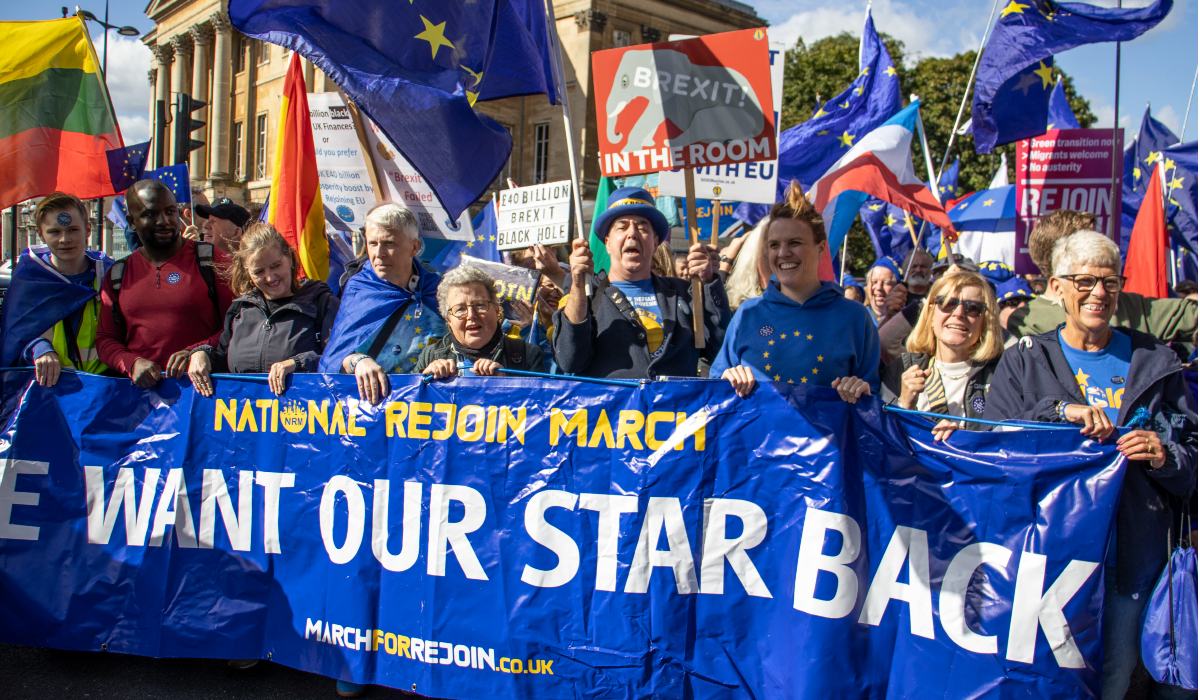
 National Rejoin the EU march, 2024. Photo: Steve Eason / CC BY-NC 2.0
Kevin Crane looks back at how the Brexit referendum happened and analyses the failings of the left in understanding what the EU represents and the politics behind it
The Brexit referendum of 2016 was undeniably a weird event, that happened for weird reasons. The Tories, under the leadership of David Cameron, called the referendum after doing substantially better than expected in the general election the year before. This should have, in theory, been massive cause for celebration for them, but what it actually did was expose contradictions that the party had been struggling to contain.
Cameron’s government had spent the previous five years governing in coalition with the Lib Dems and had assumed that the situation was likely to continue. When the Lib Dems absolutely collapsed in support in 2015, accompanied by an unexpectedly poor result for Labour, the Conservative Party found itself in possession of a parliamentary majority and a mandate for the full implementation of their electoral manifesto. Uncomfortably for the very pro-EU leadership of the party, this had included a referendum on EU membership, which they had conceded to their very anti-Europe party membership on the understanding that they would not actually need to do anything about it.
Winning big in Westminster suddenly meant that Cameron was faced with having to campaign in a contentious referendum for which no real preparation had been made. The rest of the story, from the point of right-wing politics, is basically a set of miscalculations by him and subsequent Tory leaders that saw them get outmanoeuvred by events and public opinion over and over again. Cameron called the referendum as soon as he practically could in the mistaken belief that a short campaign would benefit Remainers, only to discover that pro-EU groups and institutions had all mutually failed to prepare themselves to put persuasive arguments to the public. The Leave side was, as was predicted, fractious and disorganised, but it was able to make simple arguments and appeal to large groups of people who were discontented by Britain’s increasingly unequal and dysfunctional economy and society, not least because they had been honing arguments and propaganda for their side for the previous twenty years.
So, when the day itself came, the result was a shock, but it was not incomprehensible. The largest faction of the British ruling class was horrified, but what it was witnessing was the breakdown of its favoured political party’s strategy for corralling its social base. The Tories had used a critique of the EU, which was not sincerely believed, to maintain the enthusiasm and loyalty of voters who were experiencing net-negative effects from the actual policies of the Tory Party. Then a sharp change in the political landscape suddenly meant that they had to act on that critique, leading to years of absolutely genuine confusion about how to deal with issues like trade, immigration and Ireland.
None of this was entirely surprising, since the Tories talking out of both sides of their mouths on Europe had been causing organisational problems for the party since the 1990s. What was more disturbing, and more important, was how an internal conflict emanating from within the political right managed to become toxic to the political left, and how it looks like it might continue to be.
With friends like David Cameron, who needed enemies?
The declaration of the Brexit referendum suddenly forced everyone even vaguely left-of-centre to talk about the EU to a much greater extent than they ever had previously. It was, in hindsight, somewhat ridiculous that so little thought was given by the left to such a dominant institution in setting so much policy, standards and law.
Part of the reason the British left hadn’t discussed Europe much was that successive governments had both pushed EU integration through without that much in the way of debate. Brits did not get to vote on EU-driven constitutional changes, as had happened in France and Ireland, which had given the left openings to express specifically anti-capitalist critiques of the aggressively free-trade bloc, and thus also forced the left to engage with debates about what positions to take on the union.
British governments had also, however, steered Britain out of some more radical aspects of federalism, such as not joining the Euro currency, which also had the effect of supressing serious discussion and analysis. It all meant that when 2016 came around, you had few solid arguments and an absolute mountain of received wisdom about the EU on the left in the country. With very exceptions, the view was that if the Tory right doesn’t like the EU, then the left quite simply should.
All left-of-centre mainstream parties, most media and civil-society groups, and most trade unions instantly and enthusiastically joined the official pro-Remain front, Stronger Together, despite this basically being a popular front with Cameron’s Tory cabinet. The minority of the radical left that attempted to give a more critical analysis had, frankly, left it far too late to make the arguments and were overwhelmingly sidelined and ridiculed. Much-loved members of past generations of socialist leaders who remembered that Europe had originally been a Tory policy that the left opposed, such as the politician Tony Benn or the union leader Bob Crow, had passed away and weren’t there to offer an alternative lead.
Cameron eagerly made use of the left and the Labour movement to try and bolster his ineffectual campaign, but the truth is these forces were no more sophisticated or effective at advocating for EU membership than his own were. Worse still was the appallingly misleading nature of ‘leftwing’ pro-EU propaganda, such as an astonishing Trades Union Congress leaflet that circulated claiming that workers’ rights had been handed down from on-high by the benevolence of Brussels, rather than having been fought for by workers themselves. This was despite the EU having done absolutely nothing to stop the Thatcherite anti-union laws being passed and enforced in Britain. Desperate to try and motivate votes for Remain, many ‘progressives’ were basically reduced to projecting onto the EU the features they wanted it to have.
Trading socialist politics for EU membership, and getting neither
The generally accepted silence the liberal left had regarding the EU before 2016 was more than made up for by the almighty racket they would make about it after losing the referendum. Even people who had themselves voted Remain would start to become tired with ‘remoaners’ who would steer pretty much any discussion about anything back to why all the world’s problems revolved around whether or not Britain was signed up to a capitalist trading bloc.
The continuity Remain movement that emerged in the last years of the 2010s would go on to have a huge impact on British politics, just not one that had anything to do with their stated goals. Labour was at the time lead by the socialist Jeremy Corbyn, and powerful people were looking for a force with which to undermine him. Various things were tried, such as smearing Corbyn as sexist, which was dropped early on as it was just a bit silly. More serious bids to defeat him over his opposition to war and imperialism failed because his messaging on this was actually popular with millions of people. Antisemitism smears proved stickier, but it was the deployment of pro-Europeanism that would really derail the Corbyn project.
An oft-repeated false history of the Corbyn period is that the man himself, a left Eurosceptic like his mentor Tony Benn, damaged his popularity through lack of support for Remain. This myth is easy to disprove: Corbyn’s Labour peaked in popularity in the 2017 general election, when it made totally unexpected gains by focusing on its opposition to war and austerity. At this time, it was broadly accepting of the Brexit referendum result the previous year, and Corbyn had instructed MPs to vote for the Brexit process in parliament mere months beforehand.
It was after that general election that a serious operation was begun to shift leftwing Labour members and supporters in an actively Remain direction, and this coincided with the decline in support that Labour experienced in the run up to the disaster of the 2019 general election. Claims that Remainer figures inside Labour and the trade unions made that becoming anti-Brexit would increase the party’s popularity were repeatedly proved wrong, even as the party became more and more focused on reversing Brexit as a policy.
The central figure to this was, of course, one Sir Keir Starmer, very mistakenly given the Shadow Brexit Secretary job by Corbyn himself. We now know, thanks to the work of journalists like Oliver Eagleton and Paul Golden that, that Starmer used this position to box Corbyn into a position of supporting Remain. He would arbitrarily announce his own policies, and engage in dishonest auto-sabotaged negotiations with the government, in order to ensure that his own leader had no scope to present any kind of ‘soft Brexit’ – similar to the arrangements that non-EU countries in Europe like Norway and Switzerland have – so that the only imaginable way forward was either to stay in the EU or have the ‘hard Brexit’ favoured by the Tory right.
Remain supporters believed that this was a good thing, because they thought that the prospect of hard Brexit would present a squeeze effect on voters that would encourage them to vote for a pro-EU Labour Party (even if they weren’t keen on Corbyn’s leftwing policies). They believed this because they quite simply had no grasp of how most of the public viewed the Brexit question three years on from the referendum. As we know, Labour got absolutely trounced, and the returned Tory government proceeded to implement the hardest version of Brexit it knew how to deliver.
From the point of view of wealthy backers who’d lavishly funded the various Remain campaigns – from the deeply dishonest ‘People’s Vote’ to the downright cringey “Our Future Our Choice” – this was a splendid result as they had kept a leftwing and anti-war government from coming to office. From the point of view of the people who had been the foot soldiers of this thing, however, it was an utter disaster from which they had come away with nothing.
There has been, so far as I can tell, essentially no serious reflection from left Remain as to how they lost the entire shooting match, indeed what we’ve mostly seen is pretty much rhetorical consistency from them for the past decade. As the ten-year anniversary of the referendum goes by, various liberal left pundits are trumpeting surveys that show that a majority of voters would vote to rejoin the EU in a hypothetical referendum to do so. They don’t seem to be put off by the fact that they had surveys saying that a majority of voters were going to vote that way before the referendum, and then again in 2018 and 2019 before Brexit was the issue that decisively won the election for the Tories, and really most years since. They constantly get excited by deeply flawed evidence that says what they want it to say because of ideology, specifically the ideology of radical liberalism. Appealing to this is, arguably, one of the key functions of the EU, along with its role in shaping and directing capitalist trade and markets.
The alternative to anti-capitalism
Radical liberalism has, to a large extent, displaced social democracy as the main type of reformism left thinking, not just in Britain but in most of Europe and much of the rest of the world. It is oppositional to neoliberalism and to the reactionary right, but it comes with some very heavy restrictions on what alternatives it is willing to put to those.
It is heavily individualist and influenced by a lot of ideas that come out of postmodern thinking that doesn’t place faith in systemic analysis. Radical liberals can be critical of capitalism, because of the negative things that it does, but they don’t really have a theoretical picture of why it does these things or what alternative order would lead to better outcomes. Bad people are quite simply in charge, and their ‘socialism’ (if they even use the term) is limited to finding ways to have nicer people act as administrators. It is made even weaker by their superficial grasp of class, which is primarily focused on poverty or restricted access to opportunity: relation to consumption, in other words, rather than relation to production.
Failing to understand that the exploitation of the working class as the source of ruling class wealth is really the start point for radical liberalism’s self-defeating attitudes towards political, economic and state power. If you accept the globalisation-era claim that the EU is, in fact, the source of wealth via its superior organisation of trade, you fundamentally break with the idea that the strategic orientation of the left is through the organisation of the working class. The strategic focus shifts instead to appealing to the ‘progressive’ potential of the state and transnational institutions. It also leads one to defend those institutions from criticisms, and this produces an utterly false of logic of the enemy-of-my-enemy when those criticisms come from people to whom liberals have other criticisms.
A lot of what radical liberals think they support about the EU is based on a false logic which say’s ‘The right-wing nationalists dislike the EU, and disagree with me about X, so the EU is good for X.”’ This is what leads ignorant TUC bureaucrats to issuing dim-witted leaflets claiming the EU invented workers’ rights. It is what leads some British leftists to incorrectly claim that we cannot resist neoliberalism outside the EU, despite the structures of the EU having been specifically to crush the Syriza government for resisting neoliberalism. Many other people to claim that the EU is the solution to climate change, or political repression, or high cost of living, but – most commonly of all – the solution to racism.
The idea that the EU can magically weave some sort of anti-racist magic that will make people more friendly to workers and refugees from other countries was already fairly silly a decade ago, but it is frankly a sick joke today, as the bloc continues to militarise its external borders, moves away from allowing free movement across its internal ones and begins to set up refugee gulags that are exactly the same as the failed Rwanda plan our previous Tory government tried to implement. While Brits might reasonably, if wrongly. have felt like continental Europe was more cosmopolitan that their home country (which was often labelled ‘rainy fascism island’ in online discussion by radlibs), it is just plain ignorant not to notice that most European countries have moved to significantly to the right on race and immigration at least as much as Britain has since Brexit, if not more in some instances.
Things that are going wrong in our country are overwhelmingly doing so in similar ways for those states still in the EU: the drive to war and militarism at the expense of welfare and environmental action, the surrender to Trump’s extractive trade wars, the curtailing of civil liberties and free speech. Left Remainers claimed that Britain leaving the EU would lead it down a uniquely and specifically reactionary path, the truth is that Britain has largely converged with the same reactionary path as the EU. As with their failures at home, the radical liberals have no real analysis of why their proposed solution so obviously does not work abroad.
These bad radical liberal takes are themselves in no way a uniquely British problem. The whole reason why the aforementioned Syriza government in Greece was able to have an extremely strong anti-austerity mandate – which they won at an election and a referendum – destroyed was because that government was addled by a lot of the same bad ideological thinking. In many other European countries, Italy being an extreme case and France a more moderate one, Europeanism has caused previously strong radical left movements to be near destroyed. Yiannis Varoufakis, a prolific left academic and the original minister for finance in the Greek Syriza government, has written powerfully about how an insidious Europeanist dream has been used to displace more consistently anti-capitalist class-based left politics throughout the continent.
There’s a definitely a deep irony in the way that the ten year anniversary of the Brexit referendum has coincided with a sharp drop in the fortunes of two of the politicians who had previously used the issue to their advantage so successfully. One of them is Nigel Farage, the nationalist reactionary who acted as the outrider for Brexit, who is now in a massive mess over his inability to parlay his past campaigning successes into building a viable party of government. The other, though, is Keir Starmer, whose pathetic self-pitying resignation speech was hilariously interrupted by a ranting remoaner, who he was claiming to speak on behalf of just seven years ago. Starmer’s overdue passing has, amongst many other reactions, lead to a resurgence in activity by the pro-EU movement, as witnessed by a (fairly small) demonstration in Whitehall on Saturday and a large volume of speculative articles in the liberal press. The left in Britain cannot afford to allow itself to cede initiative to this nonsense again: we need to take the initiative and argue for a genuine socialist response to society’s crises, not give the ground to radical liberal arguments that identify real problems but present utterly useless solutions.
Before you go
The ongoing genocide in Gaza, Starmer’s austerity and the danger of a resurgent far right demonstrate the urgent need for socialist organisation and ideas. Counterfire has been central to the Palestine revolt and we are committed to building mass, united movements of resistance. Become a member today and join the fightback.
