
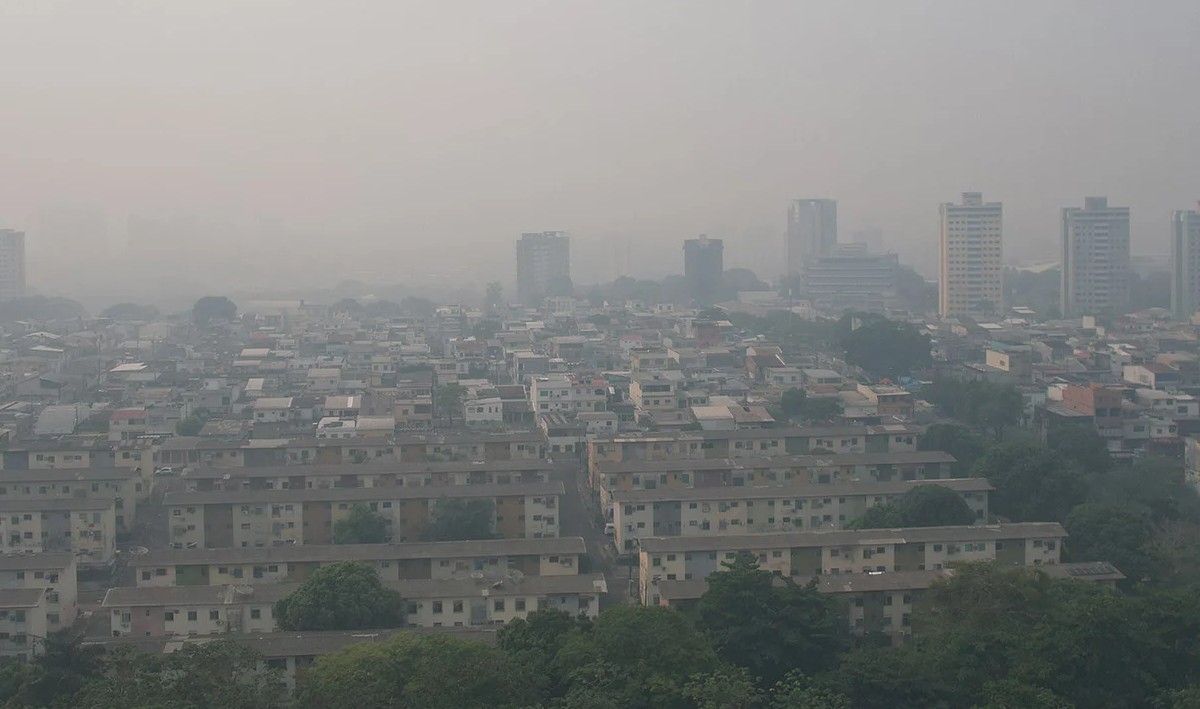
 Smoke covers Manaus, record of worst air quality levels worldwide as a result of El Nino.
Photo: Alberto Cesar Araujo / Amazonia Real / CC BY-NC-ND
Smoke covers Manaus, record of worst air quality levels worldwide as a result of El Nino.
Photo: Alberto Cesar Araujo / Amazonia Real / CC BY-NC-ND
With record-breaking temperatures disrupting much of western Europe, John Clarke examines the global existential impact of the El Niño and capitalism’s inability to combat it
The El Niño climate phenomenon is likely to have a serious global impact this year, with populations facing harsh weather conditions and increased levels of food insecurity. This effect, however, as threatening as it is in its own right, must be viewed in terms of its interconnection with the intensifying process of climate change and a series of other factors arising from the imbalances and instability of global capitalism at this point in time.
On 19 May, The Conversation reported that ‘Climate scientists, agricultural experts and policymakers warn that a super El Niño could tip vulnerable populations towards famine.’ It went on to explain that such a rare ‘super El Niño’ event could be expected to disrupt ‘global weather, increasing the risk of extreme heat, droughts and flooding.’
An article in The Guardian, on 21 June, also exploring the acute risks posed by El Niño this year, explained that the phenomenon ‘was named by fishers in the Pacific in the 1800s, but it was not until the 1970s that scientists understood its global nature and began to piece together the historical impact of the natural weather pattern characterised by hot years and brutal extremes.’
This year, there is great concern over ‘the expected size of the temperature anomaly, which will push global heat higher at a time when extreme weather events such as Europe’s recent heatwaves and slew of storms are pushing the boundaries of what societies can handle.’
Multiple stressors
Sonali McDermid, a climate scientist at New York University, makes the vital observation that ‘My worry is not for the El Niño alone. I’m worried about the confluence of multiple stressors happening at the same time.’ Sadly, the factors she alludes to are very easy to identify and they all relate to global capitalism and its massively disruptive impacts on the natural world.
The article points out that ‘this month, the Famine Early Warning Systems Network projected 115-125 million people would need urgent food assistance by December, with risks of famine in Sudan, South Sudan and Somalia.’ This shocking development unfolds, moreover, in a context where ‘about half of the world’s 68 poorest countries are experiencing debt distress or at high risk of it…and the Iran war has since led to high energy prices and restricted fertiliser supplies that have weakened buffers against weather shocks.’
We also must add to this the dreadful effects of a major shift away from ‘foreign aid’ by the Western powers, as part of a strategy of increased domination and exploitation. We are told that ‘the gutting of US overseas aid and the shrinking of European development budgets means less support may come when crises hit.’
The impacts ‘are also set to be felt in the rich world as El Niño brings stronger heatwaves and wider spread of some vector-borne diseases.’ Additionally, of course, the disruption of agriculture can only further the inflationary pressure on food supplies even in those countries where populations will be spared from the worst effects.
Destabilisation
The onset of El Niño this year also ‘provides a taste of the cascading horrors that climate scientists warn will destabilise societies as the planet heats up.’ This is an absolutely critical consideration that points to the connection between the periodic El Niño effect and the ongoing process of global heating.
A publication issued in 2023 by Imperial College London provides some clarity on this question. It explains that ‘El Niño and La Niña are two phases of the naturally occurring climate phenomenon’ that respectively produce warmer and cooler temperatures. Unquestionably, this variation ‘leads to the most dramatic year-to-year variation of Earth’s climate.’
When it comes to the link to climate change, ‘recent studies suggest that global heating may be leading to stronger El Niño events.’ One of these ‘found that current sea surface temperature extremes driven by El Niño have intensified by around 10% compared to pre-1960 levels. This builds on previous studies which predicted that the frequency of extreme El Niño events could double over the next century due to faster surface warming of the eastern Pacific Ocean brought on by global temperature rises.’
So it is that ‘global average temperatures have already reached record-breaking levels in 2023 and with a strong El Niño phase, it is likely the world will experience climatic instability equal to or greater to 2016, with widespread floods and droughts predicted to cause vast economic damage and food insecurity.’
As I suggest previously, the proliferation of extreme weather and climate instability has a dramatic impact on hard pressed populations. If we view the El Niño effect as one that plays out within a broader process of global heating, this can be seen in the starkest terms.
In 2024, the World Food Program USA showed that ‘over 1.7 billion people have been affected by climate-related disasters over the past decade. These disasters are happening more often with increasingly devastating effects. Droughts are lasting longer. Hurricanes and cyclones are more common and more destructive. Floods and wildfires are affecting more parts of the globe.’
Impact compounded
The article went on the explain that ‘as climate change increases the frequency of these disasters, vulnerable communities don’t have enough time to recover and rebuild their livelihoods before the next one hits. They’re caught in a cycle of destruction, poverty and hunger.’
Very clearly, the El Niño phenomenon exerts a powerful influence that is greatly compounded by the intensification of global heating. Not only does it appear that El Niño is itself intensified by climate change but it is also now playing out in a world that is heating rapidly due the fossil fuel emissions.
A rational and just society would appreciate the enormous threats that are posed by such a situation. It would work diligently to ensure that the emissions that were compounding the problem would be curtailed as rapidly as possible. It would also be developing and implementing a bold plan of action to ensure that the inevitable impacts of global heating would be responded to as effectively as possible. Every effort would be made to protect populations and to ensure that the maximum capacity to adapt to and recover from harsh climate impacts would be in place.
Global capitalism in 2026 displays a complete lack of such a rational response. Indeed, fossil fuel interests and their political servants are bound and determined to continue along their destructive path for as long as possible.
In 1876, Friedrich Engels wrote in the Dialectics of Nature ‘Let us not, however, flatter ourselves overmuch on account of our human conquest over nature. For each such conquest takes its revenge on us…Thus at every step we are reminded that we by no means rule over nature like a conqueror over a foreign people, like someone standing outside nature – but that we, with flesh, blood, and brain, belong to nature, and exist in its midst.’
This warning was set out when the impacts of fossil fuel capitalism were considerably less advanced and not as clearly understood as they are today but it still rings true. In an interview with Counterfire last year, Ian Angus brought the far greater seriousness of the situation that has developed since Engels’ time sharply into focus when he suggested that ‘at least a dozen global metabolic cycles are now breaking down because capitalism’s short-term pursuit of profit undermines the Earth’s natural metabolic processes…capitalism is a truly global system and its destruction of metabolic cycles is planet-wide, so global changes are happening hundreds of times faster than ever before.’
The destructive attempt by capitalism to ‘stand outside of nature’ is clearly in evidence as the fluctuations underlying the El Niño effect play out in the context of a process of global heating that is spinning disastrously out of control. It is also a further demonstration of the fact that the struggle for climate justice requires a firm and clear socialist perspective if it is to offer a viable way forward.
Before you go
The ongoing genocide in Gaza, Starmer’s austerity and the danger of a resurgent far right demonstrate the urgent need for socialist organisation and ideas. Counterfire has been central to the Palestine revolt and we are committed to building mass, united movements of resistance. Become a member today and join the fightback.

John Clarke
John Clarke became an organiser with the Ontario Coalition Against Poverty when it was formed in 1990 and has been involved in mobilising poor communities under attack ever since.