
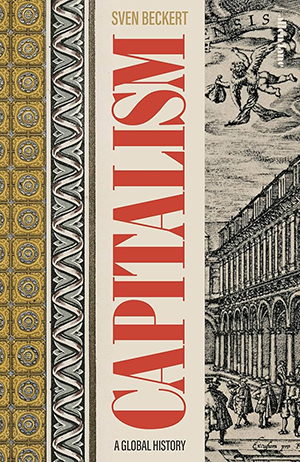
 Sven Beckert, Capitalism: A Global History (Allen Lane 2025), xiii, 1325pp.
This enormous history of capitalism provides much fascinating detail, but its flawed conceptualisation of the system’s history undermines it, argues Dominic Alexander
This is a monumental book for a monumental subject. Beckert’s history takes us from even before capitalism can be said to have existed with ‘islands’ or ‘nodes’, as he terms them, through its burgeoning as a world system, to the Industrial Revolution and its ensuing crises, all the way to the crisis of the present day. Beckert offers a series of important interpretations of capitalism’s patterns and dynamics, but notes at the outset that he rejects the idea that capitalism has ‘laws’ as either Adam Smith or Marx conceived them (p.22). Acknowledging the differences between the two, he nonetheless detects a commonality: where Smith naturalised the commodity, Marx’s critique of the commodity meant that ‘he naturalised class conflict’. These two positions are not actually the mirror image that Beckert presents them to be, but as far as explicit engagement with Marx’s system goes, this is all that’s offered.
It is not that Beckert eschews advancing a theory of capitalism in favour of an empirical agglomerations of data, but the analysis does threaten to sink beneath the weight of description at points along the way. Theoretical inspiration comes from the Austro-Hungarian reformist socialist Karl Polanyi’s critique of orthodox liberal economics, which can be both useful and limiting. Beckert begins with the observation, drawn from Polanyi, that the history of capitalism has seen us ‘move from a society in which markets were embedded in social relations to one in which social relations are embedded in markets’ (p.3).
Beckert correctly notes that markets are not themselves capitalism, long predating its emergence as a total system, or mode of production in Marxist terms, but he does perceive there to be an inherent, and autonomous logic to markets as such, thus making them ‘seeds’ of capitalism. This is a problem, because while on the surface, it sounds like common sense, the equation in fact accepts the assumptions that bourgeois economics makes about ‘markets’. Viewing ‘markets’ as a singular phenomenon with their own rules separate from the social relations which create them effectively de-historicises them. This means that while Beckert rightly insists that capitalism has to be viewed as a totality and a world system (p.12), the sense of it emerging from the contradictions of pre-capitalist society tends to be subsumed beneath the metaphor of ‘islands’ of mercantile capital inserting themselves into, and reshaping, societies.
An island of ‘capital’
Hence, Backert begins his story of capitalism in twelfth-century Aden, where, he claims, capitalists appeared as ‘sedentary merchants’ who were ‘uniquely reliant on the investment of capital for their power; they embodied its logic of ever continuing expansion’ and they ‘demonstrated that large profits could be had from controlling flexible, fungible capital. That significant resources could be captured by market-based exchanges, not just by systems of mutual obligation, taxation or violence’ (p.37). The picture Beckert paints of this ‘island’ of ‘capitalism’ as a nexus of exchange within the trade routes of the Indian Ocean is certainly fascinating. The point that the Indian Ocean economies were far in advance of the European in complexity, scale and wealth is certainly important. The claim about these merchants being capitalists, or merchants of a new kind, is however, rather questionable.
Even though Beckert does allow that earlier such ‘islands’ of capital may have existed (p.40), this remains the starting point, which leaves issues about the meaning of ‘capital’ unexamined. Any mercantile system connecting wealthy elites, the consumers, can be said to be extracting profits from market exchanges, and so it’s not clear why these merchants in Aden, as sophisticated as their operations were, should be considered a different social species from merchants in highly developed commercial systems before them, whether in the Roman Empire, for example, or indeed ancient China. Moreover, it is important to note that their profits, at this stage, derived from commercial transactions rather than production. Their profit was generated by siphoning off the surplus extracted from labour by other systems, whether of rent, tribute or taxation. That means they were not capitalists, but just merchants.
This is where Beckert’s rejection of Marx undermines the argument, as he fundamentally doesn’t see capitalism as a set of social relations, but as a parasitic autonomous logic that has been able to insert itself into pre-existing social relations. Indeed, he rejects the idea of seeking the origins of capitalism in developments within those relations: ‘Capitalism’s origins cannot be explained by finding a kernel from which it sprouted. Its history is a globally networked process that sprang from the building of islands of capital that by their very nature … were always linking to one another’ (p.39). It is notable that while rejecting the idea of ‘kernels’ of capitalism, the islands metaphor re-introduces it by the backdoor by claiming there is an inherent ‘nature’ to ‘capital’.
There are aspects to the argument that are correct, in that capitalism cannot be found by delving ever deeper into the structures of feudal estates, for example, to find capitalism in miniature, and capitalism surely does emerge relationally across different regions, at least. Nonetheless, Beckert’s model does assume a capitalist homunculus lurking in mercantile activity in a way that substitutes for an analysis of how social relations produced capitalism. As a result, there is an implicit sense that capitalism matures naturally once a certain quantitative threshold of economic development, and wealth accumulation, had been reached.
Asia’s commercial miracles
There is a strong point, however, and the source of much of the interest in the earlier parts of the book, in showing that the conditions for capitalism’s emergence lay at least as much in the economic development of Asia than of Europe: ‘capitalism’s condition of emergence was the world economy’ (p.173). There is no question how impressive all this is, from China to India and into the Muslim world. In part, there was a general increase in agricultural production throughout the Old World after 1000CE, and this increased the quantities of produce for trade, and corresponding merchant activity.
Of course, some regions responded more dynamically than others. In the Muslim world, ‘Islamic political and economic elites congregated in cities, and a network of metropolises soon dotted the landscape from North Africa to the Middle East.’ A common language and concentrations of populations in cities was a spur to activity, and states capable of the systematic taxation of merchants, while managing stable currencies, were keen to take advantage. Beckert also notes that ‘Islamic writers considered the logic and legitimacy of profit and capital’, and they were aware of a ‘passion for the accumulation of capital’ that for Beckert ‘would not be out of place to sum up Wall Street today’ (p.42).
This is all true, but broadly speaking, it could describe the ancient world as well, with the only major difference being a step change in agricultural productivity in the medieval world. So is the difference between pre-capitalism and capitalist breakthrough a merely quantitative one? It’s fairly clear that Beckert is not suggesting that it is, but his limited analytical framework leaves the question hanging. The acquisitive mindset of a ‘culture’ of capitalism, a theme to which Beckert returns periodically, is also less revealing than he appears to think, since accumulation is the hallmark of any exploitative elite, as the antiquity of the King Midas legend, for example, suggests.
This is an area where the influence of Polanyi is unproductive, since, following him, Beckert sees capitalism as essentially a parasite that feeds off its host until it takes it over entirely. Thus, he describes pre-capitalist economies as ‘embedded in … a framework of social norms’ and, quoting Polanyi, ‘organized either on the principle of reciprocity or redistribution, or householding, or some combination of the three’, with no economy controlled by the markets (p.89). This definition ignores the way societies were differently organised according to relations of exploitation, whether through state taxation, or renders to lords in kind and money, and how these relations were mediated through urban or rural elite organisation. The different articulations of these relations of production determined the place within which trade could work, and the extent to which ‘market relations’, if we take these as a proxy for potential capitalist development, could develop. Such questions are not explored here.
Instead, Beckert describes the major Muslim cities as an ‘archipelago of capital’, with Baghdad originally leading the way in wealth and power, before it declined and Cairo’s merchants, in its stead, became renowned ‘for their wealth and the reach of their commercial undertakings’, to India and south-east Asia (p.47). By the second half of the eleventh century, Egyptian merchants were involving themselves in the production of flax, which they exported in large quantities, but they also invested in sugar processing and ceramic manufacturing. The developed nature of economic activity was the background for Ibn Khaldun advancing something like a labour theory of value in the fourteenth century (p.48).
Pre-capitalist thinkers were capable of penetrating insights into economics more often than is generally realised, however, so this is not as revealing as Beckert believes. While all the evidence of economic vitality is certainly impressive, the metaphor of the ‘archipelago of capital’ begs the questions that need to be asked about the place of such cities within the wider relations of production in which they existed, and why capitalism did not spring from this context of economic development.
The size of cities and the sophistication of merchant activity in the Islamic world was, of course, at least rivalled by that in the Chinese Empire, where both Indian and Arab merchants were active too. Chinese merchants began investing in textile and porcelain production in the eleventh century, and industry increased to the extent that some have seen this as the ‘sprouts of capitalism’. Beckert allows that it is possible not to accept this interpretation of the Chinese economy at this point, although its technological advances are undeniable, and its experiment with paper money fascinating (p.57). However, it all did depend on the labour of the peasantry, which Beckert seems to forget when he argues that the Song Emperors of China in the twelfth century were able to use the taxation of trade as a way to fund the army without an extra burden on the peasants (p.93). This could only be true if Chinese merchants were systematically able to reap their profits indirectly from the labours of peasants outside China through consistently favourable terms of trade.
Trade itself only redistributes surplus rather than creating it. Unless China was effectively draining India and elsewhere of surplus, for which Beckert provides no evidence, then the surplus from Chinese peasants necessarily footed the bill in the end. It appears that Beckert is only fitfully aware of the role of labour in the creation of surplus, sometimes appearing to assume that mercantile exchange produces profit all by itself. Once again, eschewing Marx means that Beckert falls back into the bourgeois economist’s discredited assumptions despite his avowed wish to critique them.
European and Asian trajectories
Despite all the evidence of economic development, Beckert concludes that capitalism ‘had not yet emerged’ from these islands or archipelagos of capital, but ‘the growing reservoir of global capital … presaged the fundamental conditions necessary to the emergence of capitalism. Its global reach and society-altering power remained embryonic’ (p.71). Beckert doesn’t note this but the Chinese economy did fall back from its medieval high point, as ultimately it depended upon the state and its economic mobilising power. When that went into reverse, so did commercial activity. Similarly, the Islamic world’s commercial development rested precariously upon concentrated urban consumption, as had also been the case in the ancient world. If problems developed in the extraction of surplus from rural areas, then the cities would stagnate. This did indeed happen in the Islamic world after the fourteenth century, although Beckert barely acknowledges it.
Europe was certainly in many ways a backwater during the medieval period and beyond. While its own commercial ‘revolution’ in the thirteenth century has been mined for the origins of capitalism, Beckert shows that the vaunted achievements, from bills of credit to double-entry bookkeeping (pp.83-4), either originated elsewhere, or were matched often at earlier dates. Even so, Europe was catching up to the more advanced regions by the end of the Middle Ages; for example, in 1391, when China’s population was 90% rural, Europe’s wasn’t that far behind at 95%, although in England that was 98.8% (p.87).
Despite impressive development in some regions, and their interconnections, capitalism had not broken through by the early modern period. Beckert outlines various constraints on capital’s progress in making ‘deeper inroads into economic life’. Ultimately, low levels of productivity in a subsistence economy meant that ‘the frontiers of commodification lacked sufficient volume or force to push into new spaces or social realms’ (p.95). Resistance to capitalist impulses is given some role here as ‘rural cultivators the world over protected as best they could the crucial resources they needed for subsistence’ so that ‘capital owners often failed to wrest control from them’. Beckert seems to attribute this to the social regulation of markets, following Polanyi again (p.96). Pre-capitalist class struggles are important, but Beckert’s notice of them is curiously one-dimensional, since the peasantry’s struggle to retain its surplus could act as a stimulus to ‘market’ activity as well as a block to capital accumulation.
Another potential block to capital accumulation that Beckert identifies is the state, which appears as a recuring theme in the book. This is an explicit critique of neoclassical notions of the free market, which see the state as an obstacle rather than the essential supporting factor for capitalism to work. Beckert is quite right to say ‘capitalism without the state was impossible, indeed unimaginable’ (p.97 and see p.344). The state did constrain capitalist impulses, in Beckert’s view, in China and Japan. It is notable that both of these stand out for the coherence and stability of their state systems.
In Europe, the Church may have haphazardly put obstacles in the place of capitalists, but no European state had the reach, capability or even interest in playing similar roles to those in east Asia. Was Europe’s fractured and comparatively feeble state system, and its attendant wars, a component part of its ‘advantages of backwardness’ (p.126) which enabled capitalist breakthrough there (p.152)? Beckert points to increasing taxation and commercialisation in sixteenth-century Europe as a dynamic that spurred on capitalism, but insofar as this might be true, the fact alone explains little. Firstly, waves of militarised competition had happened before without showing any signs of spawning capitalist development, and secondly, the parts of Europe that were most affected by the war regime of the early modern period were precisely those that stagnated rather than grew. Surplus sucked into warfare actually deprived the base of the economy of the capital required to develop capitalist relations of production.
In considering the rise of capitalism in Europe, there is an overemphasis here on the role of the bullion looted from the Americas which Beckert seems to hold singularly responsible for Europe’s ability to increase its level of trade with Asia (p.133). In fact, all that coin brought problems, not least inflation, and not just to the Iberian economies. Most of it was squandered in warfare which did much to devastate and depress the European economy in the sixteenth and seventeenth centuries. Increasing trade with Asia should, at best, have drained Europe of the bullion it had seized from the Americas, without doing anything to fuel European development; any profits should have been consumed unproductively. This argument also leaves unexplained why it was north-east Europe (the Dutch and the English) who benefited from Iberian gold and silver. There is a missing piece of the puzzle here. This is similarly the case elsewhere in this section, for example in the lack of an explanation for why Europe was able to bounce back from the Black Death, while other parts of the world didn’t (p.170). Attention to the different kinds of social relation at work in different types of societies would have helped fill the gaps.
Plantation slavery to the maturity of capitalism
More convincing is Beckert’s argument around the use of islands such as Cape Verde by the Portuguese to develop slave plantations. This experiment created the model that would be used in the Caribbean, which was able to unleash capitalist accumulation from the bonds of previously existing social constraints (p.131). The unprecedented levels of exploitation enabled by this context, and the freedom to commit genocide in pursuit of profit, certainly provided a new engine for the emerging capitalist social relations of particularly north-eastern Europe. Unlike merchant commerce, this exploitation did bring huge quantities of surplus into play, and convincingly did enable capitalism to enter a new phase from its embryonic stage in north-east Europe.
Beckert also shows how far even into eastern Europe the slave trade and its associated industries was able to penetrate. Once again, however, Beckert fails to explain why a particular corner of Europe should have been in the position to launch this world-altering spree of plunder and mayhem. He also doesn’t offer a hypothesis for why elite merchants from elsewhere didn’t engage in similar experiments, given their apparently capitalist nature. The extended metaphor of the ‘archipelagos of capital’ ends by doing a lot of work in stitching together the mass of material, but as fluent as it appears on the surface, it does little to explain the forces working underneath.
The focus on merchants as the main social force behind capitalism, despite the claim that ‘varying social forces’ were involved (p.134), leaves out of consideration how peasants and artisans contributed to the formation of capitalism as a social system, rather than simply acting as a brake upon its potential. In part, this seems to be in line with the major thrust of the argument against neoclassical theories of capitalism, where markets are always a potential waiting to be unleashed. However, in emphasising the role of merchants and a kind of early-modern state-military-industrial complex, where capitalism parasitically intrudes into society, the account becomes one-sided. It is surely in the dialectical interaction of forces from above and from below that enabled capitalism to emerge as a total system. A more complex, Marxist, analysis would also help to explain why wealthy and advanced societies like China’s were not the ones to make the breakthrough. That distinction is still the case however often Beckert insists that capitalism was a ‘co-production’ across the world (p.300).
Such an approach would also address another lacuna in this very long book, which is the absence of revolutions in its picture of capitalism. There is no accounting for how and why certain states acted differently in regard to capital after 1649 in England, or 1789 in France. For Beckert, all states are essentially the same, unaccountably either advancing or holding back capital. The revolutions that matter to Beckert are those in Europe in 1848 which Beckert sees as the moment when capitalists finally begin to challenge the old regime, drawing on Enlightenment ideas and nationalism (pp.538-40), but this is surely too narrow a view of bourgeois ascendency, oddly leaving out its triumph in England and the US much earlier. Beckert determinedly decouples political struggles from changes in economic regime.
Thus, Beckert sees an ‘old-regime’ capitalism as distinct from a new kind emerging after the 1873 crash (p.559). This distinction obscures more than it reveals, and there is no convincing analysis of the nature of the capitalist crises that start to unfold. Marx’s laws of capitalism would have been useful at this point, but instead we are given some ill-informed barbs directed his way, such as the notion that he and Engels were at the forefront of separating ‘respectable’ workers from the ‘lumpenproletariat’, based entirely on a misunderstanding of Engles’ critique of Ferdinand Lassalle (p.668). The analysis of industrial workers’ revolt against capitalism in the nineteenth and twentieth centuries remains superficial, and certainly avoids seeing the working class as the gravedigger of capitalism.
There are also a few passages that raise alarm, as when he refers to a ‘Workers Party of Britain (WPB), which first entered Parliament in 1894 … joining a wartime [World War I] coalition of Catholics and Liberals’ (p.674). Errors will creep into any book, particularly one as long as this, but this is bizarrely wrong on several points, and it’s hard to see how it happened. Mistakes such as these, and the various ill-considered attacks on Marx, raise the question how far other less familiar elements are accurate enough to support Beckert’s claims. The interrelation of chronology and causation when discussing crisis, neoliberal response and the rise of China also appears somewhat awry in the closing stage of the book, and this is certainly the weakest section.
If the argument loses momentum after it reaches the industrial revolution, nonetheless, Beckert’s analysis of the role of colonialism has much to recommend it as a narrative account. Despite his notional neutrality towards capitalism as a system, the horrors of the plantation system and the extremes of brutality with which colonial empires, in the Americas, Asia and Africa, were carved out, are allowed their full due. Beckert is convincing that the plantations were central to the unfolding of capitalism, if not quite its origins, as a world system, and as fuel for the industrial revolution. The theme of coercion as a constant driver of the system as opposed to ‘self-propelling markets’ (p.714) is a useful aspect of the book, if not a particularly novel one.
The emphasis on Asian economic development, and its necessity as a condition for the emergence of capitalism is also valuable. Considerable space is given to social struggles against exploitation and capitalist intrusion, but Beckert’s unwillingness to see class struggle as a central engine in the development of capitalism as a social system, and the demotion of the great revolutions as key watersheds, also leads to a certain aimlessness in the discussion of the last two centuries. Finally, along many others, Beckert assumes that any transition out of capitalism will recapitulate its own pattern of development, through a development of something new in metaphorical ‘islands’ of novelty connecting with each other (p.1085). However, just as capitalism was arguably without precedent as a new form of society and economy, so the transition out of it will likely take a very different course.
Before you go
The ongoing genocide in Gaza, Starmer’s austerity and the danger of a resurgent far right demonstrate the urgent need for socialist organisation and ideas. Counterfire has been central to the Palestine revolt and we are committed to building mass, united movements of resistance. Become a member today and join the fightback.

Dominic Alexander
Dominic Alexander is a member of Counterfire, for which he is the book review editor. He is a longstanding activist in north London. He is a historian whose work includes the book Saints and Animals in the Middle Ages (2008), a social history of medieval wonder tales, and articles on London’s first revolutionary, William Longbeard, and the revolt of 1196, in Viator 48:3 (2017), and Science and Society 84:3 (July 2020). He is also the author of the Counterfire books, The Limits of Keynesianism (2018) and Trotsky in the Bronze Age (2020).