
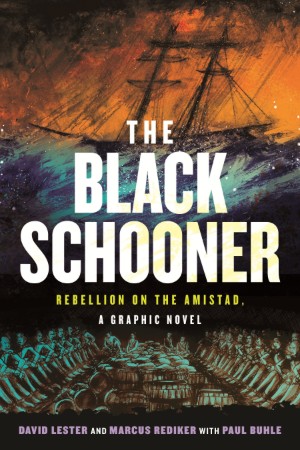
 David Lester and Marcus Rediker, The Black Schooner: Rebellion on the Amistad, A Graphic Novel, ed. Paul Buhle (Boston: Beacon Press 2026), 130pp.
The Black Schooner is an informative and vivid telling of the famous story of a successful revolt on a slave ship in 1839, and will inspire readers to discover more, finds Graham Kirkwood
The way that slavery and its abolition were taught when I went to school in Scotland back in the 1970s was all about the great reformers like William Wilberforce. No mention was made of the struggles of the actual slaves themselves. One break in this was a TV series in the 1970s which everyone watched on Saturday night prime-time TV called Roots, based on the books of Alex Haley (who helped Malcolm X write his autobiography). It told the history from the perspective of an enslaved African called Kunta Kinte. Other than that, very little was made available in the mainstream about the true history of slavery and the rebellions against it by the enslaved.
This graphic novel The Black Schooner is important therefore in that it continues the tradition, as it says in the afterword, of ‘history from below’ pioneered by W.E.B. Du Bois and C.L.R. James, who as ‘preeminent scholar-activists converged on a central conclusion: Black people had, contrary to previous histories and popular expectations, fought for their freedom’ (p.117).
The book tells the true story of 53 West Africans (49 men and four children) who rose up and took over the slave ship Amistad in August 1839. They wanted to sail home to southern Sierra Leone but were betrayed by the remaining crew members, who sailed the ship north. They were captured by the US navy and taken on shore to stand trial for murder and piracy in a court in Connecticut; the captives had killed the captain of the ship in self-defence during the rebellion.
While on trial, they were befriended by abolitionists active in the movement against slavery who with the Africans built a campaign which ultimately led to their exoneration and freedom. They returned home.
Key individuals highlighted by the book include Cinqué, a warrior and rice planter from Mendeland in Sierra Leone, Grabeau, a Poro people’s leader and rice planter, and Margru, a ten-year-old girl also from Mendeland. For the abolitionists, the slaves were assisted by John Quincy Adams, attorney, who had been US president between 1825 and 1829, Roger S Baldwin, another Connecticut attorney and Lydia Maria Child, a writer and feminist.
The American abolitionists are driven by honourable human instincts, a revulsion at the reality of slavery and a desire to see the practice ended and the slaves to be freed. They also, as is shown in the book, have a desire to, in their eyes, ‘civilise’ the Africans. This is a problem for the Africans, grateful for the assistance but not happy to be simply folded into the abolitionist’s religious framework. In the book’s afterword, the authors recall the writer CLR James: ‘the saga of the Atlantic slave trade described so vividly in this book had its origins in Africa where, as James suggested, the life of peoples and nations before the slave trade had been less violent than in contemporary Europe, the status of the peasants equal if not better. The trade wreaked havoc on many African societies, resulting in millions of deaths. Historians conveniently forgot that civilization had, in so many ways, actually began in Africa’ (p.117).
Written in an accessible format, the illustrations convey movement and the turbulence of the events and along with the text, carry a great deal of historical knowledge. It is a good introduction and makes you want to understand more about this period in the history of early capitalism. This easy to read and informative little book would be an excellent addition to school libraries.
Before you go
The ongoing genocide in Gaza, Starmer’s austerity and the danger of a resurgent far right demonstrate the urgent need for socialist organisation and ideas. Counterfire has been central to the Palestine revolt and we are committed to building mass, united movements of resistance. Become a member today and join the fightback.
