
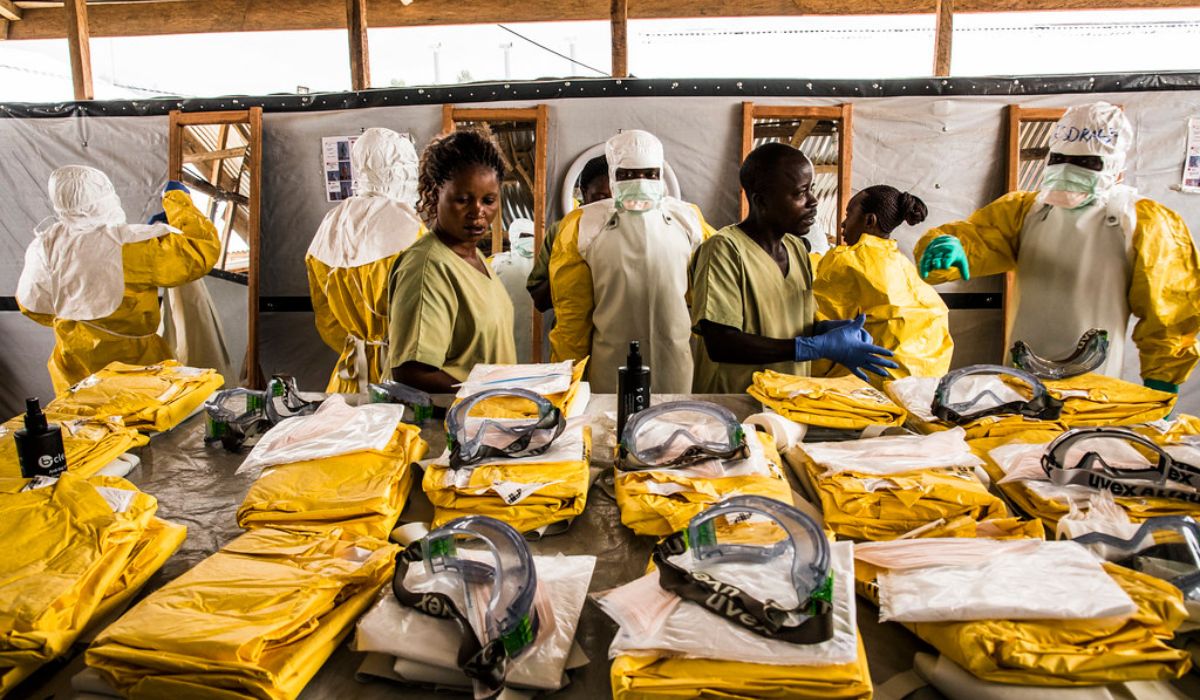
 Health workers put their Personal Protective Equipment on before entering the zone where people are quarantined. 2019 Beni, DR Congo. Source: World Bank Photo Collection - Flickr / cropped from original / CC BY-NC-ND 2.0
The outbreak of Ebola in the DRC is not merely an act of nature but a result of healthcare privatisation and a range of processes produced by imperialism, argues John Clarke
In responding to a lethal Ebola outbreak in the Democratic Republic of Congo (DRC), the World Health Organisation (WHO) and Western media outlets have stressed local factors that are impeding the work of containing the outbreak. These considerations are not irrelevant, but an understanding of the proliferation of infectious diseases in Africa and the vulnerability of populations to it requires that the legacy of colonialism and the present nature of global imperialism be properly considered.
The BBC ran an article on 27 May headlined ‘Ebola-hit DR Congo faces “catastrophic collision” of disease and conflict, WHO warns.’ It quoted the organisation’s director-general, Tedros Adhanom Ghebreyesus, as saying that it was impossible to ‘build community trust or isolate the sick while bombs are falling.’ He was pointing to the fact that the Ituri region, where the outbreak has been centred, has been under military rule since 2021 and is the site of major conflicts.
An article in the Guardian also stressed the issue of behaviour within the local population that stood in the way of effective measures. It points out that, during a visit to the DRC, Ghebreyesus stated that: ‘We can stop this Ebola and anyone who has it can also recover. But the rule … is this thing is everybody’s business and every citizen should be involved.’
The WHO director-general was referring to protests that have been taken up against public-health measures that include ‘restrictions on handling victims’ bodies [that] violate local burial rites. He also stressed that, while there is no vaccine for the ‘Bundibugyo virus, the strain behind the current outbreak,’ it is survivable if treatment is begun rapidly after symptoms develop.
There is no doubt that the present outbreak is an enormously dangerous development. The US Centers for Disease Control and Prevention (CRC) notes that there have already been 42 confirmed deaths in the DRC, with 282 confirmed and a further 220 suspected cases. Nine more cases and an additional death are also reported in neighbouring Uganda.
These lethal developments and the very real risk that the situation could get much worse are enormously concerning, but they raise questions about the emergence of the Ebola threat and why it has taken place in Sub-Saharan Africa that go well beyond the attitudes of the local population.
Vulnerability factors
The WHO issued a fact sheet last April that explained that Ebola has an average fatality rate of 50%, with ‘early intensive support care’ able to increase the prospects for survival significantly. However, it needs to be stressed that such medical intervention is, of course, much less readily available in Africa than in Western countries.
Ebola first emerged in 1976, in two separate outbreaks in what is now South Sudan and the DRC. It is now understood that the ‘virus can get into the human population when people have close contact with the blood, secretions, organs or other bodily fluids of infected animals’ but, once it has spread into a human population, it can be transferred by person-to-person contact.
Any serious examination of the vulnerability factors at work leads to a rejection of the notion that unenlightened attitudes and ‘cultural practices’ are the chief culprit when it comes to the proliferation of Ebola and the repeated outbreaks that have occurred in several African countries.
In 2021, the National Library of Medicine in the US issued a report on ‘A Snapshot of Poverty, Diseases and War – the Democratic Republic of the Congo.’ It noted that ‘DRC’s fight with the EVD (Ebola Virus Disease) was just settling when WHO declared COVID-19 to be a Public Health Emergency of International Concern (PHEIC) on March 12, 2020. DRC’s economic growth decelerated from its pre-COVID level of 4.4% in 2019 to an estimated 0.8% in 2020. This has caused concomitant setbacks in the treatment and control of major health issues like HIV, tuberculosis, measles, rift valley fever and malaria in the country.’
The report paid considerable attention to the great inadequacies of the public healthcare system in the DRC. It bemoaned a very serious lack of resources that were available for medical treatment, disease containment, preventative measures and public education on health threats. It issued a rather futile call for the strengthening and scaling up of existing public health systems, and suggested that helping countries ‘respond to public health threats quickly and effectively within their borders is critical to preventing the spread of diseases regionally, and around the world.’
In 2024, The Peoples’ Health Movement took a rather more candid look at some of these same considerations on a global scale. It noted that the WHO Constitution declares that the ‘enjoyment of the highest attainable standard of health is one of the fundamental rights of every human being without distinction of race, religion, political belief, economic or social condition.’
However, despite these noble sentiments, the report drew the conclusion that ‘the right to health is breached on a daily basis for many millions, perhaps billions, of people today.’ It backed up this assertion with a detailed exploration of eight ‘ways in which capitalism and imperialism drive health inequity.’ These include such factors as austerity, privatisation of healthcare, food systems designed to maximise corporate profits and war and conflict.
Healthcare financialisation
Given that the capacity of local healthcare systems is such a critical question in a situation like the present Ebola outbreak in the DRC, it is worth paying attention to a paper that was written in 2024 by Julia Ngozi Chukwuma, María José Romero and Elisa Van Waeyenberge that explores ‘the role of the World Bank Group in promoting public-private partnerships [PPPs] in health in Africa.’
The paper finds that the World Bank has been a ‘lead actor’ in promoting PPPs, and that these initiatives ‘act as vehicles of healthcare financialisation, posing significant threats to equitable healthcare delivery.’ Moreover, ‘PPPs (including in health) often draw on public (domestic and international) resources to support the transformation of public services into private assets … This occurs to the detriment of alternative practices and notions of strengthening public social service delivery systems framed by the imperatives of access and quality for all.’
If degraded and grossly inadequate public healthcare opens the way for infectious diseases, the organisation of global production under the imperialist system also plays a decisive role in generating them in the first place. In an effort to survive, impoverished people are pushing ever deeper into forested areas, often to produce crops that major Western companies require.
In 2014, The Conversation looked at the spread of Ebola in Africa that was occurring at that time and noted that it ‘is poverty that drives villagers to encroach further into the forest, where they become infected with the virus when hunting and butchering wildlife, or through contact with body fluids from bats.’
The article shows how ‘deep-cutting into forests for agricultural development has breached natural barriers to the evolution and spread of specific pathogens.’ It is not surprising that we find the same players at work in driving this process that are accelerating the privatisation of healthcare systems in the Global South.
With regard to the emergence of such forms of agricultural development in Guinea, we find that it is ‘identified by the World Bank as [having] the highest investment potential for industrial agriculture.’ In this situation, ‘farmers with small land holdings are faced with a choice: either sell off or scale up to meet the competition. Forests are one of the first casualties.’
To simply attribute the lethal spread of Ebola to unenlightened attitudes among the threatened population is both inaccurate and deeply offensive. It plays into longstanding and thoroughly racist assumptions that can be used to conceal the real driving forces that are at work.
The spread of disease and the threat of pandemics are being generated by a system of global capitalism that displays an unsustainable disregard for the natural world and for the human populations that live within it. The link between yet another outbreak of Ebola in the DRC and the imperialist world order under which it occurs is undeniable, and meaningful solutions are impossible without acknowledging this and acting upon it.
Before you go
The ongoing genocide in Gaza, Starmer’s austerity and the danger of a resurgent far right demonstrate the urgent need for socialist organisation and ideas. Counterfire has been central to the Palestine revolt and we are committed to building mass, united movements of resistance. Become a member today and join the fightback.

John Clarke
John Clarke became an organiser with the Ontario Coalition Against Poverty when it was formed in 1990 and has been involved in mobilising poor communities under attack ever since.