
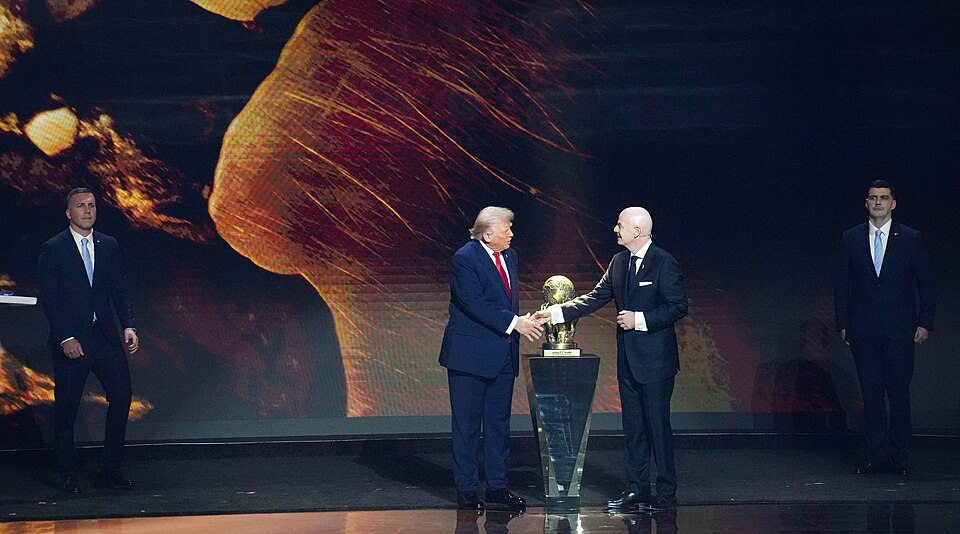
 FIFA President Gianni Infantino and U.S. President Donald Trump shake hands during the FIFA World Cup 2026 official draw at the John F. Kennedy Center for the Performing Arts in Washington, D.C., December 5, 2025. (Official State Department photo by Freddie Everett)
Mega-events like the World Cup further processes of social exclusion and physical displacement of poor people and their communities, which must be resisted, argues John Clarke
No one can blame football fans for being excited about the World Cup but the price to be paid for mega-events of this kind isn’t measured only in the cost of the tickets. Enormous public resources are diverted to prepare for them and put them on. Moreover, the process of developing the infrastructure and facilities that are demanded by the operators of this event often accelerate an agenda of upscale redevelopment and gentrification that is already at work.
Toronto, where I live, is now braced for the impact of the World Cup and the negative consequences have already made themselves felt. 230 Fightback, an organisation of which I’m a part, is campaigning for a property in the poor working-class Downtown East neighbourhood, that has sat vacant for eighteen years, to become the site of a social-housing project. The developer that owns it is waiting for market conditions to be right to create yet more luxury housing and further the gentrification of the area.
Being well aware of how the World Cup will further a process of redevelopment that threatens centrally located poor communities, we have decided to take advantage of this event to press our demand for social housing. On 13 June, we will be marching on the property with the intention of using the now fenced-in open ground to host a community showing of the World Cup match between Qatar and Switzerland. We have written to the developer, KingSett Capital, to insist that the company open up the property for this event but, curiously, we have not yet received a reply.
Displacement and dislocation
As I suggested, the impacts of the World Cup have already been felt in this city and, not surprisingly, they have played out along well-established lines of social inequality. A 27 May Facebook post from StreetVoicesTO, speaking for those who are directly affected, notes that from ‘the early closure of major respite sites to reports of unhoused people being pushed out of visible downtown spaces, many are questioning who gets prioritized when global events come to town.’ The post goes on to ask, with considerable justification: ‘Do mega-events like the World Cup help cities grow or push vulnerable communities further aside?’
An article in Yahoo News, published the day before, informed us that as ‘FIFA fever sweeps Toronto, unhoused residents and advocates say a much darker story is emerging impacting the city’s most vulnerable … The Toronto Underhoused and Homeless Union (Tuhu) alleges residents experiencing homelessness are reporting forced removals, intimidation, verbal abuse and violence.’ This, it is argued, is part of a concerted effort to ensure that ‘visibly poor and unhoused people are … pushed out ahead of FIFA-related activity in the city.’
The CBC also reported that Tuhu ‘… interviewed 45 unhoused people at Union Station in the last six weeks, asking if they had noticed an escalation in security. It says roughly 90 per cent of respondents reported either witnessing or experiencing “security violence” first-hand.’ Despite graphic accounts of intimidation and assaults, Mayor Olivia Chow predictably insists that those involved in this ugly clearing operation ‘work together as a team so that the services available to those that needed help will be seamless.’
Such a process of forcing unhoused people out, as part of the preparations for the World Cup, is hardly a novel development and it was fully expected. Last August, Yahoo News reported that advocates ‘in Vancouver’s Downtown Eastside say they fear that residents will be removed from the neighbourhood as the city prepares for the 2026 FIFA World Cup.’
Such fears were hardly unreasonable, given that this low-income neighbourhood lay inside a two-kilometre ‘beautification’ radius around the stadium that must be established under the terms of the ‘host city agreement’ with Fifa. Moreover, ‘many in the Downtown Eastside fear a repeat of what they say happened during the 2010 Olympics, when unhoused residents were pushed out of key areas in the name of safety and security.’
Over the years, World Cup events have involved enormous social costs that have included the kind of displacement that I describe above but that have also meant the permanent erasure of low-income communities and the vilest forms of exploitation of the workers involved in preparing for the events.
The Geneva International Centre for Justice found that in ‘preparation for the 2022 Fifa World Cup, Qatar has built a new airport, seven football stadiums, a metro system, multiple roads, 100 new hotels, and essentially an entirely new city around the main stadium that will host the final match … It is estimated that more than 30,000 foreign labourers were hired just to build the stadiums.’
This huge influx of workers was subjected to the brutally exploitative Kafala system, ‘that binds foreign workers to their employers and prevents them from changing jobs or even leaving the country without seeking permission from their sponsor. This system has become increasingly controversial for being a human exploitation system. Due to this practice, migrant workers face restricted movement and communications, debt bondage, forced labour, visa trading or irregular residency status.’
Inevitably, the workers who made the Qatar World Cup possible were swindled on a massive scale and subjected to sometimes lethal forms of extreme exploitation. Assurances of decent treatment by the local authorities and Fifa itself proved to be meaningless and subsequent efforts to obtain compensation have been largely fruitless.
Exclusion and displacement
The World Cup shares with other mega-events this role of a highly exploitative juggernaut that furthers processes of social exclusion and physical displacement. The Georgetown Journal of International Affairs has explored these questions with regard to the 2024 Olympics in Paris. It found that much of the ‘construction occurred in the communes that constitute the northern department of Seine-Saint-Denis, an economically disadvantaged and majority-minority banlieue.’ This area was subjected to a large-scale eviction process, in order to obtain the same kind of ‘beautification’ that I described in the case of Vancouver.
The Journal notes that this was part of a process of ‘clearing the undesirables’ that is common to such mega-projects. It points out that, in case of Paris, there was ‘an overwhelming police and military presence with omnipresent security barricades, severe restrictions on personal travel, and the introduction of AI-powered facial-recognition security cameras. While the mega-event must be secured against terrorist threats, these security practices were deployed against residents.’
It must be understood that this clearing process isn’t simply a temporary phenomenon. Showpiece mega-events exacerbate a process of upscale urban development that is already underway. With liberal fair-mindedness, the Journal concludes that ‘some consider this an overdue step towards urban improvement, but others protest the inhumanity of the actions, as affordable housing remains out of reach for many.’
Canada will host thirteen of the 104 World Cup matches to be held in North America and this will involve an outlay of over $1 billion in public resources, with the specific costs for the matches that will take place in Toronto coming in at $380 million.
This huge outlay will, however, not be the full cost of the mega-event because the social impacts will be considerable and lasting. As a ‘neoliberal city,’ Toronto has seen a sustained process of urban redevelopment under which the commitment to social housing has been utterly abandoned. Housing prices and rents have been driven up, homelessness has proliferated and systems of social provision have been massively degraded.
As this process has intensified, developers and investors have been allowed to profit from an extreme commodification of housing, and the social dislocation and tensions generated have been dealt with by a massive transfer of resources to police budgets, despite the implementation of brutal measures of austerity. The World Cup will grease the wheels of this whole ugly process and drive it forward.
There is no intention to point the finger of blame at those who will watch or attend the football matches that are about to take place but it is necessary to deplore the political decision to fund this tournament so lavishly while the basic need for housing is denied to so many people because of a supposed lack of resources.
Later this week, when 230 Fightback marches on a vacant property that should be meeting the housing needs of a hard-pressed community, it is to be hoped that the demand for ‘bread not circuses’ that it takes up will be a rallying call. The legacy of this tournament should not only be one of cruel displacement and profits for a few but of increased levels of resistance by those who are being pushed aside.
Before you go
The ongoing genocide in Gaza, Starmer’s austerity and the danger of a resurgent far right demonstrate the urgent need for socialist organisation and ideas. Counterfire has been central to the Palestine revolt and we are committed to building mass, united movements of resistance. Become a member today and join the fightback.

John Clarke
John Clarke became an organiser with the Ontario Coalition Against Poverty when it was formed in 1990 and has been involved in mobilising poor communities under attack ever since.