
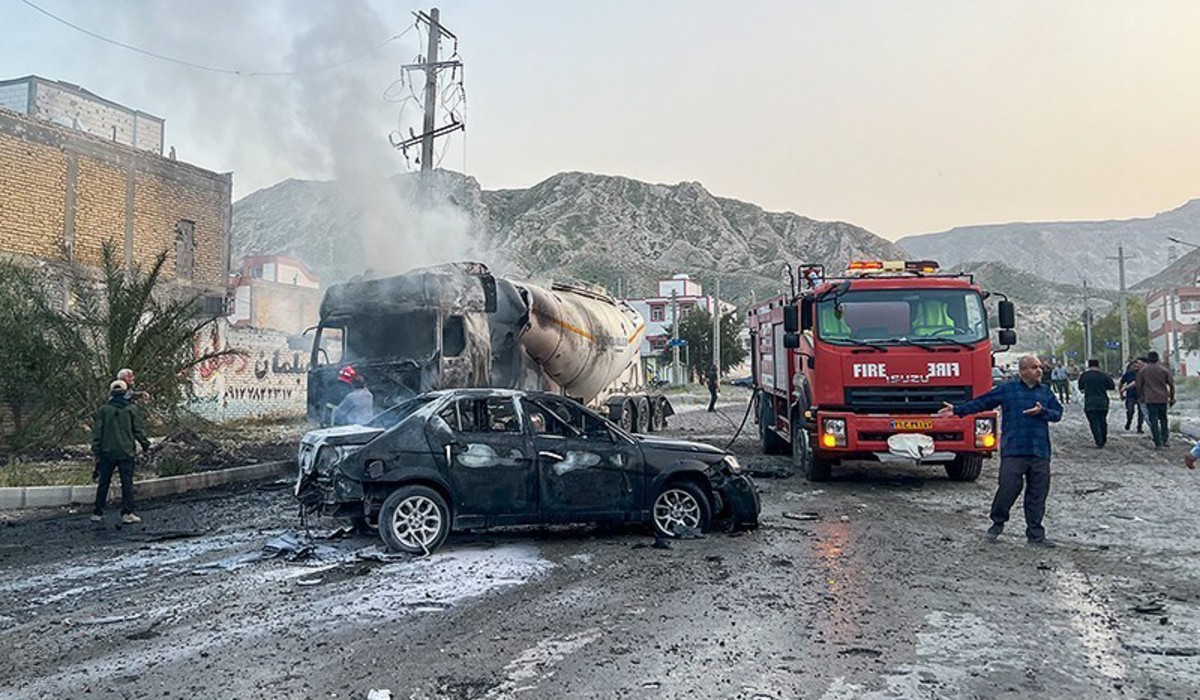
 US / Israel attack on Lamerd southern Iran 28Feb2026. Photo: Tasnim News Agency / CC BY 4.0
With the continuing face-off between the US and Iran over the Straits of Hormuz, Chris Bambery assesses Trump’s options and their likely outcomes
Iran expects the United States to resume its war on them at any time. For his part President Donald Trump is considering a plan by US Central Command (CENTCOM) for a “short and powerful” wave of strikes on Iran.
There are three options:
- airstrikes on Iran’s infrastructure
- forcing the opening of the Straits of Hormuz
- the seizure of Iran’s stock of enriched uranium.
There are serious issues with each.
The first is what the US and Israel did for two and a half months starting 28 February. It was designed to force the Iranian regime to the negotiating table but it did not work then and it does not look set to work any time soon.
The second would require ground troops and the US does not have sufficient of those in the region. They would be meeting large numbers of soldiers and Revolutionary Guards in prepared positions with plenty of missiles, drones, mortars and artillery.
There is also the issue of warships. In both the Straits themselves and, if they went through them, the Persian Gulf they would be prime targets for Iranian missiles.
Regarding the third option, Iran has some 11 tons of enriched uranium of different grades. It is unlikely to have them stored in one or two places. Rather its more likely to have been dispersed in what is a huge country making it like searching for a needle in a hay stack.
The Americans seemed to have attempted a raid on Isfahan to seize enriched uranium stored there. US special forces set up landing site for C-130 transport aircraft. This was then targeted by Iranian air defences. Washington then claimed the goal was the search and rescue of a shot down pilot of an F15.
Eventually the Americans had to evacuate with several aircraft reportedly lost, including “at least one A-10 Thunderbolt II and two Black Hawk helicopters.”
It brings back searing memories of the attempted rescue of US diplomatic hostages 46 years ago which ended disastrously and was a huge embarrassment for President Jimmy Carter.
Escalation
The biggest problem Trump faces is that it is Iran rather than he that holds the better hand of cards. If he goes up the escalatory ladder Tehran will respond. With the Houthis they could close the Red Sea, which would be a massive blow to the world economy. That would stop Saudi oil exports which use an east west pipeline to the Red Sea coast.
They could also resume strikes on the Gulf States. They are now seriously divided with Saudi Arabia and the United Emirates resuming a longstanding vendetta with the latter leaving OPEC because of Saudi’s dominance. Qatar and Oman seem prepared to co-operate with Iran allowing them to export oil, gas and much more.
All are concerned that the US failed deliver on its promise of protection during the March and April war.
Negotiations stalled
Trump is considering re-starting the war because of the impasse in negotiations. That is because Washington is not taking Iran’s ten point plan for a settlement seriously. It wants a full settlement which will ensure peace in the region. Those points include the end to sanctions, reparations, removal of US bases in the region and much more. When those have been settled, and only then, would Iran discuss its nuclear programme.
Ignoring all this Washington wants to start negotiations with the nuclear programme which is a nonstarter for Tehran.
Adding into this mix is awareness in the White House that any renewed war will be unpopular at home and Americans are feeling the pain from the economic fallout, not least from higher prices at the petrol pump.
The Republican Party is very nervous about the November mid-term elections and the fallout from all this. It’s interesting that two likely Presidential candidates, Vice President J.D. Vance and Secretary of State, Marco Rubio, are keeping mum on Iran.
Diplomatic developments
For its part Iran last week Iran’s Foreign Minister Abbas Araghchi visited Russia for talks with President Vladimir Putin. Putin praised Iran for fighting to retain its independence. Araghchi also visited Oman to discuss the full re-opening of the Straits of Hormuz and Pakistan to brief military chief, Asim Munir, Prime Minister Shehbaz Sharif and Foreign Minister Ishaq Dar.
In other words, Iran is rallying a degree of diplomatic support. Pakistan has also opened a land route between it and Iran, allowing exports and imports to enter the latter.
The impact of the blocking of the Straits of Hormuz is particularly acute in East and South Asia:
‘Import-dependent economies have borne the brunt of the shock. Pakistan, reliant on imported fuel for the overwhelming majority of its needs, faced sharp price hikes, as petrol and diesel rose by roughly 50% within weeks. Inflationary pressures intensified, cascading through food and transport sectors.
India, similarly dependent, experienced supply anxieties and market volatility despite attempts to diversify imports. Across Africa and parts of Asia, the effects have been even more severe, triggering fuel shortages, rising electricity costs and constrained industrial activity.’ For all Trump’s bluster and threats any decision to re-commence this war will be deeply unpopular at home and abroad.
Before you go
The ongoing genocide in Gaza, Starmer’s austerity and the danger of a resurgent far right demonstrate the urgent need for socialist organisation and ideas. Counterfire has been central to the Palestine revolt and we are committed to building mass, united movements of resistance. Become a member today and join the fightback.

Chris Bambery
Chris Bambery is an author, political activist and commentator, and a supporter of Rise, the radical left wing coalition in Scotland. His books include A People's History of Scotland and The Second World War: A Marxist Analysis.