
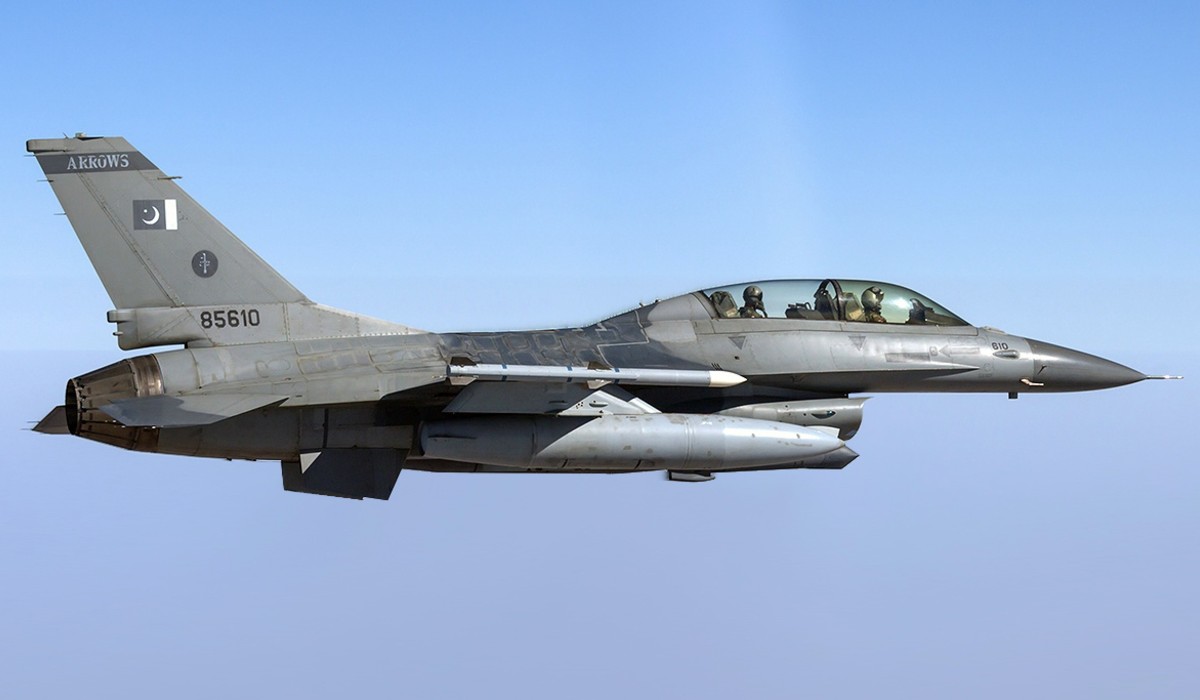
 Pakistan Air Force F-16BM Fighting Falcon. Photo: Asuspine / Wikimedia Commons / CC BY-SA 4.0
The ‘open war’ between Pakistan and Afghanistan cannot be divorced from US imperialist geostrategy, argues Dragan Plavšić
As the US built up its forces in the Gulf and attacked Iran, yet another war, though overshadowed by it, was erupting between Pakistan and Afghanistan.
Launching air strikes, Pakistan said it was acting in self-defence against attacks by the Pakistan Taliban (TTP) operating from safe havens in Afghanistan. Kabul issued denials and said Pakistan was violating Afghan sovereignty. Pakistan claimed it had targeted TTP-linked sites and militants, killing and wounding hundreds, while Afghan authorities reported multiple civilian casualties. Kabul’s own retaliatory attacks along the border led Pakistan to declare ‘open war’ on 27 February. At the time of writing, hostilities continue.
Wars don’t start on battlefields. Self-serving claims and counter-claims aside, three key interlocking factors are at work here: the Pashtun question, Pakistan’s regional rivalry with India, and most immediately of all, the war on Iran in the wider context of US geostrategic determination to curb and disturb China’s rise. Each factor adds fuel to the fire but the last is decisive for last month’s ominous escalation.
The Pashtun question
In 1893, the 1640 mile border between Afghanistan and British India (the Durand Line named after a British diplomat who ‘negotiated’ it) was drawn up and runs today between Afghanistan and Pakistan. Britain’s imperial aim was to weaken Afghanistan and create a strategic buffer against Tsarist Russia.As its priorities were geopolitical and military, ethnic territories were simply ignored.
As a result,the Durand Line sliced its way through Pashtun lands: today forty million Pashtuns live in Pakistan (the second largest ethnic group to the Punjabi majority) and 20-25 million in Afghanistan (the largest group). Nevertheless, Afghan and Pakistan Pashtuns remain close.
Afghanistan has long rejected the Line as a colonial injustice. For its part, Pakistan fears the potential threat of Pashtun nationalism, a fear sharpened by the fact that Pakistan has been bound together since its formation in 1947 by religion – above all Sunni Islam – while remaining deeply divided along ethnic lines between Punjabis, Pashtuns, Sindhis, Baloch and others.
To counter this fear, Pakistan has assiduously promoted Islamism against nationalism. In the 1980s, it provided funding and arms – as a US conduit – to Islamists fighting Russia’s occupation of Afghanistan. In the mid-1990s, during the Afghan civil war following Russia’s defeat, Pakistan backed the Taliban, pursuing what its strategists were fond of calling ‘strategic depth’ against India and a pliable regime in Kabul. It was one of only three countries (with Saudi Arabia and the United Arab Emirates) to recognise the Taliban regime when it took power in 1996.
However, in 2001, following 9/11 and the US invasion of Afghanistan, Pakistan supported the war on terror, receiving substantial economic and military assistance from Washington. At the same time, duplicitously, security elements maintained ties with the Afghan Taliban, hedging bets in the event of US failure and as leverage in any future political settlement.
The war on terror devastated Pashtun areas of Pakistan where the Afghan Taliban took refuge before recuperating and returning to the fight. US drone strikes in these areas, officially opposed but tacitly allowed by Islamabad, in addition to its own military operations, fuelled anger and resentment. Thousands were killed including many civilians amid widespread human-rights abuses, spurring Pashtun nationalism.
The already-mentioned TTP – the Pakistan Taliban – emerged in 2007. Increasingly positioning itself as the protector of the ‘Pashtun tribal nation’ against ‘Punjabi imperialism’, it has blended jihadist rhetoric with ethno-nationalist appeals to boost recruitment. It launches attacks on Pakistan’s military but also Christians and Shias. The grassroots Pashtun Tahafuz (or Protection) Movement (PTM) was also formed in 2014 demanding accountability for human-rights abuses.
Pakistan and India
Pakistan’s policy was backfiring well before the defeat and withdrawal of the US from Afghanistan and the Taliban’s return to power in 2021. Since then, the blowback has intensified and with it the Pashtun question. The Afghan Taliban provided safe havens for the TTP, causing a sharp increase in attacks and Pakistani state repression. The PTM also faced repression: though it stressed Pashtun identity, it did so first and foremost as a civil-rights movement yet was proscribed nevertheless under Pakistan’s Anti-Terrorism Act in 2024.
Local competition with India amplified this deteriorating situation. For decades, Islamabad saw influence in Afghanistan as essential to preventing strategic encirclement by New Delhi. After the Taliban’s return to power, India – historically anti-Taliban – adopted a more pragmatic approach, seeking to exploit the opportunities now offered by deteriorating Afghan-Pakistan relations, including reopening its embassy in Kabul in October 2025 and strengthening economic ties. As one commentator from the US think-tank the Wilson Center put it:
‘The fact that this treatment is coming from India – a nation that never previously had friendly relations with the Taliban, makes this all the more significant … Delhi does get a big win in its evergreen competition with Pakistan by moving closer to a critical long-time Pakistani asset that has now turned on its former patron.’
The US and China
But it is intensified US-led geostrategic competition with China and the war on Iran which has been decisive for the most recent escalation between Pakistan and Afghanistan.
During the premiership of the now-imprisoned Imran Khan, Pakistan strengthened ties with China, adopting a more independent position towards Washington. Khan’s government accelerated the development of the China-Pakistan Economic Corridor (CPEC) and its refusal to align with pressure on Russia following the outbreak of the war in Ukraine further strained relations with the US.
Khan’s removal from office in 2022 occurred formally through a parliamentary vote of no confidence but the process was strongly influenced by Pakistan’s powerful military which continues to play a decisive role in the country’s political life.
The resulting foreign policy tilt, with the installation of a military-backed government under Shehbaz Sharif and Chief of the Army Asim Munir, has meant renewed alignment with Washington. In January, Pakistan accepted Trump’s invitation to join his so-called Board of Peace on Gaza, despite criticism over betraying the Palestinian cause. This isn’t a break with China – CPEC is too economically important – but an attempt to evade over-dependence on it.
For its part, the US State Department issued a statement supporting ‘Pakistan’s right to defend itself against Taliban attacks.’ When asked about the Pakistan-Afghanistan conflict, Trump explained with typical bombastic hyperbole that he got on ‘very, very well’ with Pakistan, extolling ‘a great prime minister, a great general there … two people I really respect a lot’ and adding that Pakistan was ‘doing terrifically well’ in the conflict.
This US tilt emboldened Pakistan in its aggressive stance against Afghanistan just as the US was building up its forces in the Gulf against Iran. This was key for the timing of the February air strikes and the ‘open war’ declaration, reflecting confidence in US backing amid US-China rivalry and impending war on Iran. By contrast, China’s stake in regional stability for the sake of its economic interests, particularly its multi-billion dollar CPEC investments, has led it to mediate, with its special envoy holding talks in both Islamabad and Kabul.
Conclusion
Pakistan is seeking to align itself dutifully with US imperialist geostrategy as Trump unleashes murderous chaos across the globe. Casting aside all or any principles of international law, Washington’s goal is to plug every possible weakness in its geopolitical position against the potential threat of encroaching Chinese power.
This is what the US was doing in Venezuela, what it’s seeking to do in Cuba and what it’s doing most murderously of all in Iran. In this way, it aims to secure its regional power in Latin America and the Middle East in anticipation of competition from China. The lawless gangsterism of all this – with its preponderant reliance on hard military power (Washington’s competitive advantage) rather than soft economic power (China’s advantage) – reflects declining US power as well as its hastening desperation.
As a result, others are taking confidence to launch their own conflicts where local interests align with US geostrategy. Hence the Pakistan-Afghanistan war. Exceptionally dangerous and turbulent times lie ahead, making the struggle for peace the overriding order of the day for the left today.
Before you go
The ongoing genocide in Gaza, Starmer’s austerity and the danger of a resurgent far right demonstrate the urgent need for socialist organisation and ideas. Counterfire has been central to the Palestine revolt and we are committed to building mass, united movements of resistance. Become a member today and join the fightback.

Dragan Plavšić
Dragan Plavšić is a member of Counterfire in London and of Marks21 in Serbia. He jointly edited The Balkan Socialist Tradition and the Balkan Federation 1871-1915 (2003).