
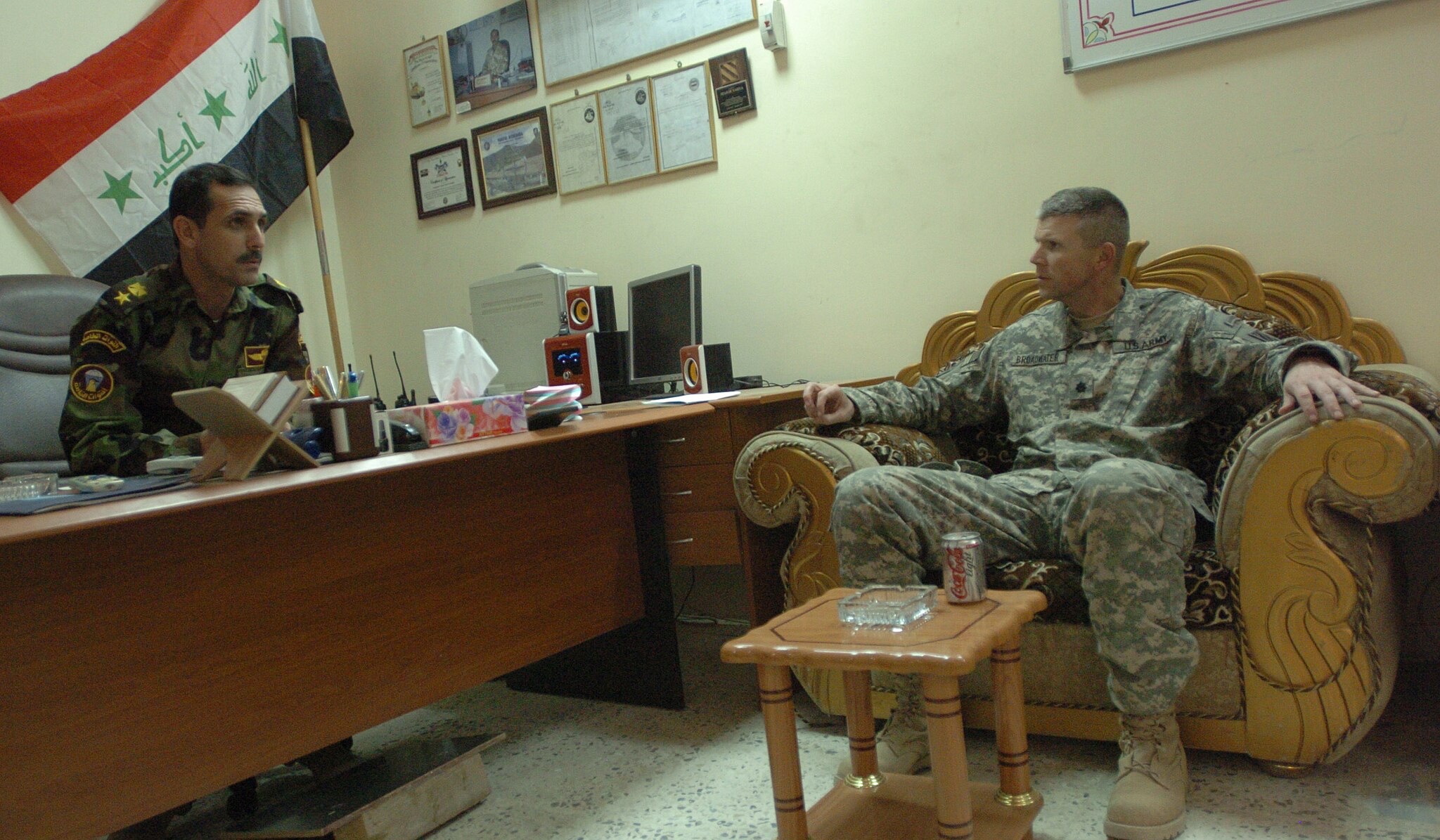
 US soldier with an Iraqi official, 2007/ Spc. Leith Edgar, Public domain, via Wikimedia Commons
Trump and Netanhayu’s ongoing war in the Gulf Region aims at regime change. Dr Mehiyar Kathem Al Sa’edi examines the dysfunctional state arrangements imposed on Iraq following the 2003 invasion
The US-devised post-2003 political system is a model that the US plans to replicate and install to manage Iran’s domestic affairs and economy. This article explores the failure of Iraq’s political system and why Iran has no choice but to resist US imperial plans.
What is persistently obscured in mainstream accounts of Iraq today is that the 2003 invasion was never simply about the removal of Saddam Hussein. The United States presided over the systematic hollowing out of the Iraqi state and the deliberate re-engineering of its political economy. Ministries were dismantled, public institutions fractured and its economic structures rewired in ways that locked Iraq into a subordinate position within the global order. In effect, the US Occupation was oriented to the domestic partition of Iraq into competing political fiefdoms and the destruction of its internal and external sovereignty. That humiliating model is the one the US plans for Iran.
From 2003 onwards, US Occupation policies entailed constructing a new political-economic trajectory where Iraq is forced into a singular function, similarly to the Arab Gulf states, to feed the world economy with cheap oil. In the process, the possibility of a self-determination informed developmental trajectory was foreclosed, replaced by a political economy geared to external markets rather than domestic social need.
Iraq was reorganised to function as an energy appendage to global capital, or more simply put, a petrol-station within one of several nodes of extraction within the region. The current catastrophe we are all witnessing in the Gulf and the war against Iran has exposed the futility of the US-imposed economic model for Iraq and the Gulf countries. If the war against Iran is successful, Iran will be forced to deindustrialise, and its economy reduced to one like an Arab Gulf state of mere oil production for world markets.
US Federal Reserve
Iraq’s oil revenues, the lifeblood of its economy, continue to flow through a US Federal Reserve–held account, ultimately subject to oversight mechanisms anchored in Washington and presided over by the office of the US President. Within this US-structured system, Iraq’s relationship to its own oil wealth is mediated and externally supervised. The effect is to circumscribe meaningful political authority over the very resource that constitutes the backbone of the Iraqi state as it has been since its founding. In this US-structured system, Iraq is forced to relinquish any political authority over its oil wealth, ending the possibility of economic sovereignty and a semblance of self-determination that had been won from decades of struggles after its independence from British colonialism.
In what has become a routine, normalised ritual of subordination, the Office of the Iraqi Prime Minister and Iraq’s Ministry of Finance must submit formal requests to US authorities to access the proceeds of Iraq’s own oil exports. These budgetary disbursements are not simply administered but subjected to scrutiny through a US-anchored financial apparatus, involving Federal Reserve officials and representatives from the office of the US President. Framed as a technocratic oversight, including the Iraqi Government, the process functions as a gatekeeping regime over sovereign income and by extension over Iraq’s future and people. This practice reflects the institutional continuation of the post-2003 occupation order, when Iraqi ministries were embedded with US advisers whose authority routinely eclipsed that of Iraqi ministers themselves.
Within this US-structured system, power over Iraq’s economy is effectively shared with Washington, concentrated through the US Embassy in Baghdad, a vast diplomatic compound whose influence is oriented to ensuring Iraq falls in lockstep with the system set up for it.
For the US, this regime of external control is entirely adequate for a country still treated as an oil prize, and one that needs to be controlled in light of US foreign policy in the region. The occupation’s strategic function was to assemble a political system designed for minimum viable state capacity: enough to protect foreign extraction, contain the possibility of domestic disruption, and guarantee uninterrupted oil exports. Iraqi elites have been folded into it as caretakers, enriching themselves through rent and patronage while policing the conditions that keep crude oil moving smoothly to international markets. There is, in effect, no Iraqi economy beyond that of those related to oil-sales. Iraq is not allowed to develop any industry or manufacturing, diktats from Iraq’s US masters.
Muhasasa
The US-structured trajectory for Iraq did not stop at external financial gatekeeping. It also installed and normalised an internal political regime for distributing oil wealth and state power: muhasasa (المحاصصة), literally “apportionment” or “shares”. Under muhasasa, ministries, agencies, and public resources are allocated through political, ethnic, and sectarian quotas, converting the state from a public institution, accountable to the people of Iraq, into a partitionable asset, controlled by Iraq’s political party elites. It is a machinery of rule that reproduces factionalism into the everyday administration of government and shapes all aspects of the state system and regulates the way the people of Iraq relate to the state itself.
Iraq, including the Kurdistan Region of Iraq, is governed through this quota system. Ministries are parcelled out to competing parties that claim ethnosectarian constituencies in parliament, and whereby office becomes the conduit to revenue. This was not an organic Iraqi settlement that merely emerged after 2003. It was formalised as a governing template under occupation authority, first through the interim Iraqi Governing Council and then entrenched through the post-2003 constitutional order. The 2005 Constitution ratified the terms under which oil wealth and state institutions would be politically distributed, thereby formalising muhasasa as the organising principle of the post-2003 state.
The outcome of muhasasa ensures that Iraq is governed without a single coherent ruling bloc capable of imposing unified direction or accepting unified responsibility. Power is dispersed across rival parties that treat ministries, budgets, and territory as divisible entitlements rather than instruments of national policy. In the Kurdistan Region of Iraq, political authority remains dominated by two competing parties that have carved out distinct geographies of control, including formal and informal oil extraction and revenue channels. Funds allocated to the KRI are therefore not simply public transfers; they are mediated through, and effectively distributed on the basis of, the two-party duopoly that structures governance in the region.
Across the rest of the country, a comparable logic prevails. Iraq is partitioned through competing Shia and Sunni parties and, in areas outside the KRI’s formal boundaries, Kurdish parties as well. Central ministries in Baghdad are allocated among Shia, Sunni, and Kurdish blocs, and muhasasa reproduces itself inside the ministries: senior posts, directorates, and key administrative positions are apportioned to rival factions, entrenching a state-within-a-state dynamic across the bureaucracy, which is oriented to serve elites, rather than the public interest. Muhasasa similarly affects all cultural and educational institutions of the state, such as the Ministry of Culture, Tourism and Antiquities (in charge of archaeology, culture and non-religious tourism), and the Ministry of Higher Education (in charge of universities). Iraq’s Embassies, their Ambassadors and staff, are similarly subject to muhasasa calculations, rendering the entire state system, its foreign diplomacy, stagnant and ineffective.
The absence of structures with which to govern Iraq is not a malfunction but emanates from the post-2003 political design the US and its allies brought into being. The system produces ineffectual administration, blocks national development programmes, and institutionalises corruption by displacing accountability. When authority is distributed as factional shareholding, responsibility is endlessly deferred, oversight becomes performative, and the public interest is structurally subordinated to inter-party bargaining and rent extraction. Corruption becomes, in this system, not only endemic but a structural feature of the allocation of power and resources to competing interests.
Sectarianism and factionalism
Muhasasa is a system grounded in a sectarian-informed liberal peacebuilding template that reduces Iraqis to managed categories of ethnosectarian identity, replacing justice and citizenry claims on the state. Installed under US occupation authority, it institutionalised fragmentation by converting governance into quota-based shareholding and by reorganising political life into party-controlled fiefdoms. This was functional to an external political economy: a state capable of administering oil extraction and maintaining export continuity yet structurally prevented from consolidating the kind of unified sovereignty that could renegotiate the terms of that order, or for that matter, pursue its own independent visions and trajectories. The implementation of seemingly simple state tasks, or inter-ministerial co-ordination, such as that between the Ministry of Defence and the Ministry of Interior, is often an outlier rather than institutional practice.
Muhasasa cultivated an environment in which armed partisan formations proliferated and acquired coercive capacity that often exceeds formal military institutions. The Iraqi Army, which collapsed in the face of the Islamic State in 2014, is evidence of this and continues to be weak, tasked with such policing tasks rather than safeguarding territorial sovereignty. Muhasasa’s institutionalised corruption, which led to the collapse of Iraq’s security forces, led to a re-occupation under the guise of liberation from the Islamic State, and the return of US forces in the country. Rather than operating as a singular national instrument of defence, the Iraqi Army continues today to be positioned as an internal security apparatus, while paramilitary actors tied to Iraq’s main political parties remain embedded within, and empowered by, the broader post-2003 system of partitioned rule.
This humiliating, oppressive and anti-human political system, or one similar to it, awaits Iran, should it fail in its defence of its territory and sovereignty.
Iraq’s nomination of Nouri al-Maliki as a possible Prime Minister was sternly rejected by the US administration, and on 7 March 2026, his application for the position was withdrawn. To understand the chokehold the US has over Iraq, it is important to look at post-2003 political-economic structures the US brought into being in its occupation of the country, which are today glaringly exposed for their ineffectiveness.
From Washington’s perspective, Iraq’s nomination of Nouri al-Maliki as prime minister threatens to disrupt the US-structured political pathway the country has been on since 2003. Al-Maliki secured two terms within the post-invasion order and, for much of that period, was supported by US policymakers, until of course he sought closer ties with Iran after the US withdrew its occupation troops in 2011. He was ultimately forced from office in 2014 amid the collapse of state control across large parts of the country following the Islamic State’s rapid territorial gains. Since then, US preferences have tended to favour more compliant intermediaries.
The US does not seek independent minded politicians, preferring administrators and caretakers, like the current Prime Minister, Mohammed Shia’ al-Sudani, who, after Trump’s comments not to support Iraq, is likely to secure a new term. Al-Maliki’s ties to Iran render his return politically unacceptable to the US administration. In this reading, Trump’s threat to withdraw US support to Iraq is less a diplomatic warning than a signal of leverage over Iraq’s fiscal lifeline: the capacity to block transfers of Iraqi oil revenues routed through the Federal Reserve account arrangements. Throttling access to these funds would not merely apply pressure to the Iraqi government; it would constrain the state’s ability to pay salaries, finance services, and destabilise the currency, thereby amplifying the risk of internal fiscal and political breakdown. Combined with Iraq’s current problems of getting its oil to the world markets, which are disrupted by the US-Israeli war against Iran, collapse of its economy and politics are increasingly a real possibility, and with that the shakeup of the post-2003 order.
A US plan of muhasasa, premised on its multiple cultural groups, is being discussed as a political system for Iran. Iran’s future, and the potential subjugation of its people to US imperialism, is at stake. Iran has to resist at all costs the imposition of those plans.
Dr Mehiyar Kathem Al Sa’edi is an Honorary Senior Research Fellow at University College London
Before you go
The ongoing genocide in Gaza, Starmer’s austerity and the danger of a resurgent far right demonstrate the urgent need for socialist organisation and ideas. Counterfire has been central to the Palestine revolt and we are committed to building mass, united movements of resistance. Become a member today and join the fightback.
