
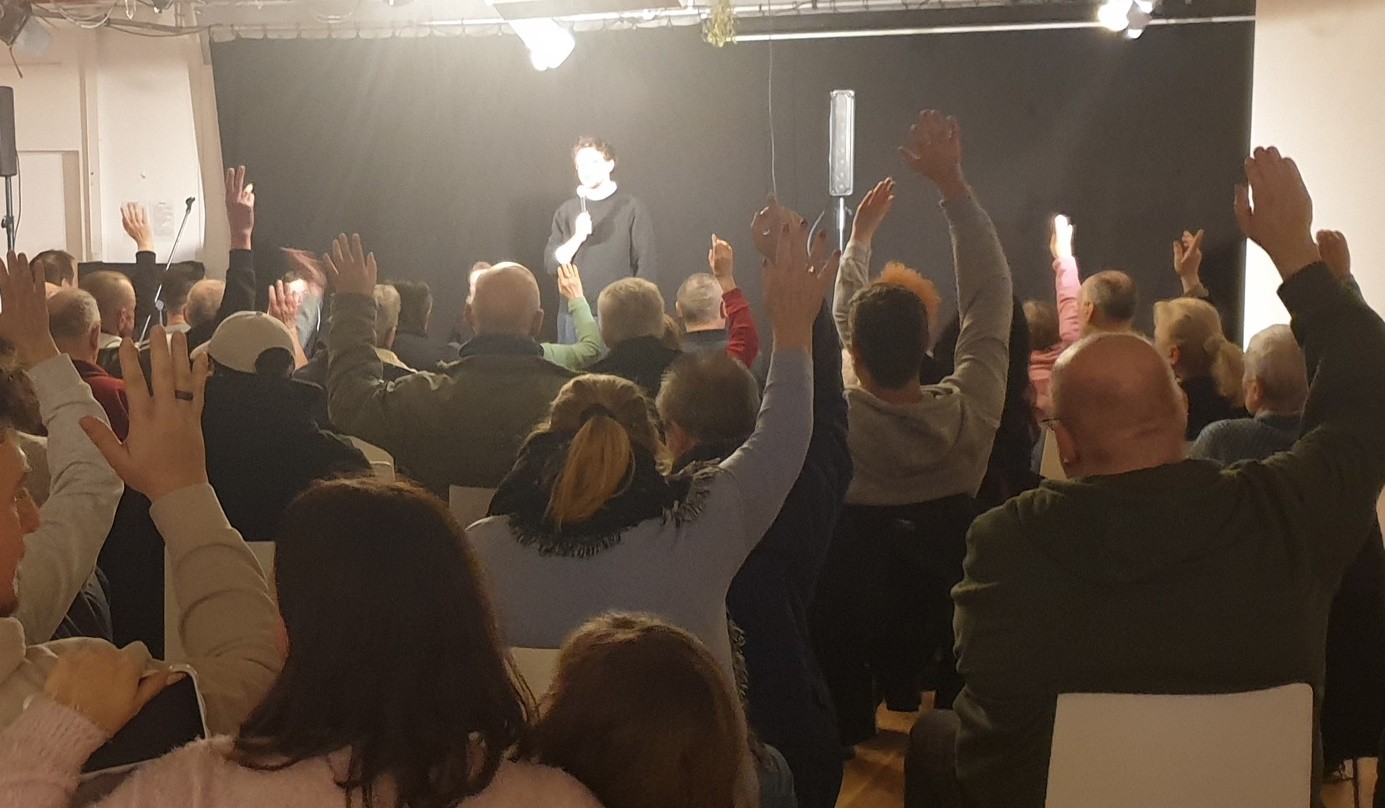
 ‘Who thinks the caretaker service got worse recently?’, tenants’ meeting, Berlin, January 2026
Photo: Robert Dale
‘Who thinks the caretaker service got worse recently?’, tenants’ meeting, Berlin, January 2026
Photo: Robert Dale
Organising tenants on a run-down Berlin housing estate, despite worries about the far right, proved to be practical and productive, in a useful lesson for activists, reports Robert Dale
The scene is a housing estate in an unfashionable corner of Berlin. High-rise, built in the 70s and 80s, and publicly owned. Older residents remember it as a splendid place to live. However, for several years now, the management organisation has been running it into the ground (extracting maximum revenue to fund a new-build programme).
The lifts are often out of order in buildings with up to 21 storeys. Simple repairs don’t get done. The caretaker service is hard to contact, and little help. Some blocks have had periods without running water. Vermin infestations have been left to fester. The stairwells are filthy, entrance buzzers not working. Unsurprisingly, residents are frustrated, angry and despairing.
Some action has been taken. Some tenants were already exercising their right to withhold part of their rent. Last autumn, a group in one block contacted the local TV station, which ran a report. That gave the housing bosses a fright and produced some improvements, but not nearly enough. And as we now know with hindsight, residents were often not aware that other blocks were suffering the same problems.
In discussions with people on and off the estate, it seemed action needed to be stepped up, but how? Some had doubts over the local vote for the far right AfD and possible tensions over immigration. The longer-established residents are mostly white, newer tenants often recent immigrants. The parties with the biggest vote on the estate are the Left Party and the far-right AfD, both with slightly over 20% (so roughly 1,000 votes for each). In the constituency as a whole, the Left Party got 35%, the AfD under 8%. A handful of supporters of fascist splinter groups are also known to live on the estate.
The process that led to a meeting being called was rather like a round of Chinese whispers. A resident had been telling her tales of misery to a relative living elsewhere. He mentioned it to a local housing lawyer. She mentioned it to her contacts in the Left Party. They saw the problem, set a date, organised a room and leafleted the estate.
About one hundred residents came to the meeting. The discussion was an outpouring of complaints and frustration. A number of tenants who had moved in when the blocks were new spoke of their shame receiving visitors these days. The housing lawyer responded at intervals, explaining practical ways to step up the pressure. The Left Party’s housing spokesperson was visibly shocked at what he was hearing. There was no discussion about party politics, and no explicit unpleasantness around immigration (although there were occasional oblique references to ‘the new tenants’ and ‘people dumping rubbish’).
On that score, I’m sure it was helpful that the meeting was arranged by the Left Party. Yet, it was certainly not a party meeting, and some of those who came had grumbled about the Left Party’s role beforehand. One resident of very long standing made a helpful early contribution, quietly reminding everyone that they were there to deal with the practical problems.
The meeting ended with a commitment by the housing lawyer to hold regular surgeries on the estate and a promise by the Left Party representatives to arrange another meeting in due course. They also suggested collecting contact details and floated the idea of establishing structures, neither of which were taken up at this point.
What I take away from this little story is twofold. Firstly, it’s sometimes easier than you’d think to unlock a door that enables people to stand up for their own rights and interests. And secondly, that a strong vote for the far right in a particular area is not necessarily an obstacle to left-leaning activist work.
Robert Dale lives in the Berlin region, where he has been active in socialist politics since the 1980s.
Before you go
The ongoing genocide in Gaza, Starmer’s austerity and the danger of a resurgent far right demonstrate the urgent need for socialist organisation and ideas. Counterfire has been central to the Palestine revolt and we are committed to building mass, united movements of resistance. Become a member today and join the fightback.
