
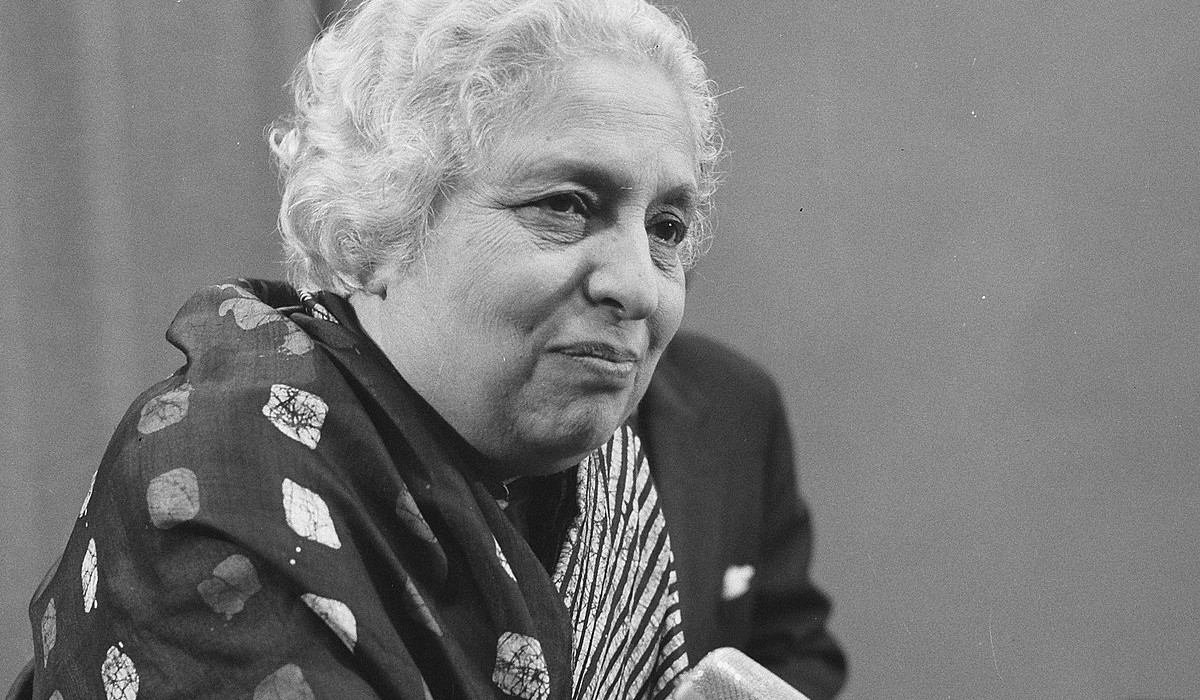
 Vijaya Lkshmi Pandit. Photo: Ron Kroon / Wikimedia Commons / CC BY-SA 3.0 NL
Wahid Shaikh, who was held in prison for almost nine years for the 7/11 Mumbai train blasts of 2006, before being found innocent, reflects on the experience of prison of a leading activist for an independent India
Vijaya Lakshmi Pandit, freedom fighter, stateswoman, and diplomat, was born in 1900. During British rule, she spent almost three years incarcerated in various prisons. Between 1931 and 1933, she was jailed for participating in the Civil Disobedience Movement. In 1940, she was imprisoned for six months. Between 1942 and 1943, during the Quit India Movement, she spent nearly ten months in jail.
In 1940, Pandit was imprisoned in Naini Central Jail in Allahabad, Uttar Pradesh. As was her husband Ranjit Sitaram Pandit. She maintained a prison diary written in English which was published in 1945. Later, in 1979, her autobiography The Scope of Happiness was published. The insights from her diary enable us to compare contemporary prison experiences to her own and examine the striking continuities between colonial-era British prisons and those in modern ‘free’ India.
Pandit wrote that her prison diary was intended for those curious about life inside prison walls. Traditionally, prison diaries functioned as guided tours of incarceration: the writer recorded daily events, personal suffering, and institutional observations. This diary was written during her third imprisonment. Composed in simple, accessible English, it chronicled day-to-day life. Sometimes in a single sentence, sometimes in a few lines, recording whatever transpired on a given date.
The diary opens with a painful scene. She describes how, one night in 1942 at two o’clock in the morning, the police arrived at her home to arrest her. Reading this, one is struck by how little has changed. Arrests still almost always take place under the cover of night. The justification offered is that nighttime arrests prevent public embarrassment. But arguably, once someone is arrested and (falsely) implicated, humiliation is inevitable sooner or later. The real reason is the same logic that drives a thief to steal at night: wrongdoing requires darkness. Another reason is strategic- night arrests prevent community resistance.
Pandit recounted a disturbing dream she had in prison. She dreamt she was alone in a small, low cell. It was raining outside, and water dripped from the ceiling onto her head, but the drops were not water, they were coins. Her head cracked open, and she felt that she was dying. Suddenly, she woke up to find herself in the prison cell, with rain still falling outside.
Dreams are a shared human experience. It is often said that dreams reflect the thoughts which dominate the waking mind. In Islam, dreams are considered a part of prophethood, with dream interpretation regarded as a serious discipline. Prophet Yusuf (‘Joseph’) is considered the greatest authority on the topic. He was himself imprisoned, and during his time behind bars interpreted the dreams of fellow prisoners as well as the King. He was eventually released and appointed as the treasurer of the state according to Islamic tradition.
During my own incarceration in Arthur Road Jail, I too had many dreams and attempted to interpret them. I recall my fellow prisoner and co-accused, Suhail Shaikh from Pune, who was known for interpreting dreams. He once dreamt of a giraffe tied in a garden, it’s neck so long that it extended far beyond the boundary, visible on the road outside. Upon waking, he interpreted the dream as a sign of prolonged imprisonment. This was in 2006. Nineteen years later, in 2025, after an extraordinarily long incarceration, Suhail Shaikh was finally released.
Pandit observed that a defining feature of prison is loneliness amid crowds. While overcrowding is a recognized problem, loneliness becomes acute when there is no intellectual or emotional companionship. One longs to speak but finds no mental alignment with others. Faces are visible, but minds remain unreadable. The eyes want to speak, but the tongue is silenced. This loneliness can be more terrifying than solitary confinement, where at least silence is expected.
On prison food and tea especially, Pandit was scathing. Prison tea, she said, was prepared from a special low-grade variety grown solely for unfortunate prisoners, so tasteless that it extinguished all desire for it. Though a lover of fine tea, even when a friend once sent her some of excellent quality, she could not enjoy it fully, separated from family and loved ones. Tea, she wrote, tastes best in companionship. It is not merely a habit but an integral part of life: it relieves fatigue, cures headaches, and sparks ideas. Without decent tea, the mind itself deteriorates.
Pandit recounted how food storage was impossible; ants infested sugar; cats drank milk. Her description of prison food: watery lentils, filthy vegetables, grit-filled bread, remains accurate. Today, authorities do not allow home-cooked food, petitioning courts to revoke such permissions. Pandit noted however that prisoners were allowed to grow tomatoes, chilies, and coriander outside their barracks, permissions that no longer exist. Vast tracts of unused prison land remain barren today, while prisoners long for fresh vegetables.
I remember Arthur Road Jail, where in wintertime the tea turned ice cold by the time it reached the Anda barrack. In summer, even if some warmth remained, the tea was so dark one wondered whether milk had ever touched it. Sugar was nominal, tea leaves absent. Prison staff never drank this concoction; they prepared their own specially. Sometimes the quantity was so little that if one dipped bread or biscuits, no tea remained to drink, but if one drank the tea, the bread remained dry.
Pandit’s love for reading and writing did not diminish in prison. She ordered books on various subjects, including World’s Great Letters, which she read carefully, annotating throughout. She even expressed a desire to write a book entitled ‘Jail and Matrons I Have Known’. Examining the role of matrons, their conduct, and how they functioned at the behest of prison authorities to harass inmates.
Prison is a place saturated with time. Authorities attempt to control not only physical freedom but intellectual freedom as well. Prison, however, is also a crucible for ideas, experiences, and books. Hence, I would urge that no restrictions be imposed on books in prison- libraries should overflow so prisoners can read freely.
Pandit noted the scarcity of trees in prison and expressed a desire to engage in gardening. During British rule, prisoners were allowed to garden. Over time, this was discontinued under the pretext that prisoners might hide weapons, drugs, money, or mobile phones. Gardening is now restricted to convicted prisoners under surveillance. A wholesome activity that once brought joy has been declared forbidden.
She wrote about a cat she saw-once a kitten during her previous imprisonment, now fully grown. It stole food but was too weak to run far when chased away. In free India, keeping cats in prison is prohibited on the suspicion that they could be trained to smuggle contraband- a reflection of institutional paranoia.
She described frogs crushed accidentally during early mornings. During my incarceration in Kolhapur Jail, there were countless snails crawling everywhere, often ending up in food. Prisoners talk to animals, insects, birds: they become companions. Umar Khalid, in a recent letter after being denied bail, wrote that prisoners feed animals and water plants, believing such acts earn divine merit and hasten release.
Pandit was allowed to sleep under the open sky: an unimaginable privilege in today’s prisons. Gazing at the stars eased her mind and softened the sense of confinement. I recall Asif Khan, a death-row prisoner in Arthur Road Jail, who would recite Iqbal’s poem “The Moon” whenever he glimpsed it from the Anda barrack. As Pandit writes, “stars do not fear prison walls”.
She criticized restrictions on writing letters limited to 500 words, calling it an attempt to imprison thought itself. Today, similar restrictions persist; we were allowed only two letters per month.
Pandit recounted the arrest of a young woman jailed merely for walking with the tricolour flag, along with her infant child. Today, those protesting constitutionally against the CAA and NRC while carrying the national flag have similarly been jailed under false charges. Leaders of these marches were denied bail and linked to the Delhi riots. Sharjeel Imam has been imprisoned for seven years and counting.
She described prison as a place that freezes in winter and becomes a furnace in summer. Falling ill in prison was the harshest punishment—no care, no concern. Quoting Geoffrey Mynshul, she wrote: “Prison is a cemetery where the living are buried; in six months of confinement, a man can learn more law than at Westminster.” This perhaps explains why many prisoners emerge as legal experts, advocate Shahid Azmi being a prime example.
She recorded the tragedy of a prisoner who missed his son’s funeral due to delayed parole. Such stories remain common today. It is of pressing importance that prison manuals change, empowering superintendents to grant immediate parole in cases of the death of close relatives. Pandit wrote about missing her child. In prison, parents often weep silently at night, hiding their faces in blankets.
She noted a rule change in 1942 that reduced evening lock-up time, cutting one hour of freedom. Prison life is not free movement – it is relentless discipline. Even today, prisoners are confined for nearly sixteen hours a day. Astonishingly, prison manuals and routines have barely changed since colonial times. She recounted Indira Gandhi’s arrest for attending a meeting, along with pregnant and underage girls, questioning the morality of such governance. ‘Governments change’, she wrote, ‘but temperament does not. The rulers remain the same, only their colour changes.’
She ends with biting satire: ‘If hell wishes to become harsher, it should consult prison authorities – they are experts in cruelty.’ Prison days feel like months, months like years. Yet a few books, moonlight, or starlight can dissolve suffering, if only for a moment.
Vijaya Lakshmi Pandit’s prison diary is extraordinary. The injustices of the past echo and merge with my own experience behind bars with disconcerting similarity. I hope that more people will reflect and raise their voices against the oppression of independent India’s prisoners.
Before you go
The ongoing genocide in Gaza, Starmer’s austerity and the danger of a resurgent far right demonstrate the urgent need for socialist organisation and ideas. Counterfire has been central to the Palestine revolt and we are committed to building mass, united movements of resistance. Become a member today and join the fightback.
