
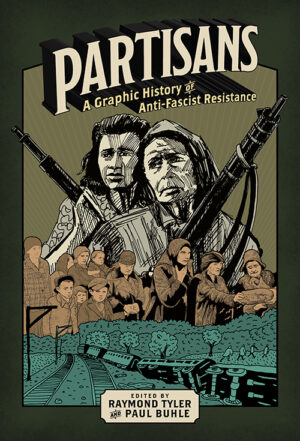
 Partisans: A Graphic History of Anti-Fascist Resistance, eds. Raymond Tyler and Paul Buhle (Toronto: Between the Lines 2025), 148pp.
A graphic history of the Partisan resistance in World War II provides a vivid, harrowing and valuable reminder of their crucial struggles, finds Eilidh Stewart
In every territory occupied by the Nazis in World War II, there were underground resistance groups heroically fighting, scheming and sabotaging, yet these stories remain relatively overlooked.
Partisans is a compilation of graphic narratives telling these often-forgotten stories of the underground resistance movement which was instrumental in defeating the Nazis. The book comprises ten visually stunning stories of resistance from Yugoslavia to Greece to Italy each in different artistic styles and from different perspectives. Some are personal accounts, for example the story titled ‘Piccola Staffeta’, written by Franca Bannerman, who delves into her own experiences as a child who rejects the brainwashing by the mandatory fascist education under Mussolini’s rule. Others are historical narrations such as the story of Tito’s partisans which briefly takes you through the period of Yugoslavia’s creation and subsequent destruction.
It particularly draws attention to the central role of women in the underground resistance movement. It emphasises the huge number of women involved in the movement with one third of volunteers in the Greek, Italian and Yugoslav Maquis (resistance groups) being women and it shares great stories such as that of Truus and Freddie Oversteegen, two young socialists who risked their lives gathering intelligence on the Nazis and scouting out traitors. It also discusses how the Partisans improved women’s rights, for example, in a Greek area dominated by resistance forces, women were granted equal political and civil rights as well as equal pay for equal work.
My favourite story was that of Josephine Baker, the famous black American dancer in Paris who took up the role of a spy for the French resistance during the war. She smuggled intelligence across borders whilst touring through sewing information into costumes or hiding it in music scores. Despite the rampant racism and sexism of the time, Baker used her platform to help defeat the Nazis with the hope that anti-colonial leaders could then demand US support for Independence and to advance the movement for civil rights. It is a profound example of political compromise in service of advancing a broader aim.
Partisans paints a picture of ordinary people going to extraordinary lengths to protect their friends, neighbours and strangers from repression, violence and destruction. They engaged in actions such as forging documents and smuggling Jewish people to safety, distributing underground newspapers, sabotage and guerilla warfare and so on. These actions were crucial to the liberation of many European cities, and even a whole country in the case of Yugoslavia, contributing enormously to the overall war effort. The fact these stories of everyday heroism, bravery and determination are not more widely known is dispiriting, but not surprising as this book highlights how many anti-fascist resistance groups were socialists. That is why this book is so important, because it shares these harrowing stories in a format that can be easily and quickly consumed.
Its usefulness is twofold: it is a great introduction to the Partisan movement but also enjoyable to those already familiar with it. For those who know little about the Partisans, it begins with a timeline of World War II in Europe and flashpoints of Partisan resistance which is useful for reference. The graphic style makes it a very easy read and packs a lot of information into a digestible format. It works as a vivid introduction to the stories and contains enough detail for further research, for example into named individuals and groups. Although it is a brief history, it’s still a good read for even the most knowledgeable as it really personifies the movement by sharing specific true accounts such as that of Franca Bannerman, which are not widely known, and brings these stories to life through the amazing artwork.
In a world where the ideological descendants of the Partisan’s opponents are resurgent and even in government in Europe, the inspiring resolve of the resistance fighters documented in this book should provide motivation to all those engaged in anti-fascist struggle today.
Before you go
The ongoing genocide in Gaza, Starmer’s austerity and the danger of a resurgent far right demonstrate the urgent need for socialist organisation and ideas. Counterfire has been central to the Palestine revolt and we are committed to building mass, united movements of resistance. Become a member today and join the fightback.
