
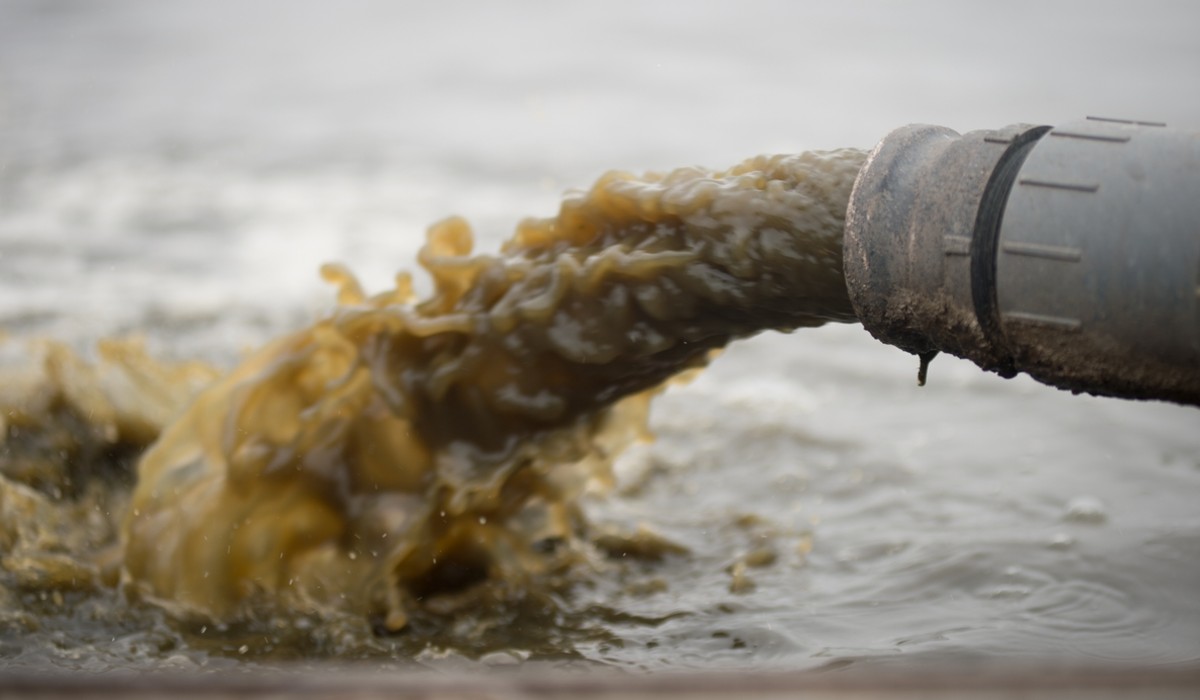
 Water pollution. Photo: Lance Cheung / USDA / Public Domain
Our Water Our Way is putting the conversation about the future management of water where it should be, in the hands of parliament and the public, explains Judy Seymour
It’s a key moment for the water industry. Sir John Cunliffe, government appointed chair of the Independent Water Commission has spoken. Many of us have scrambled to see what his ‘independent’ review of the sector says about its many crises and the remedies he proposes, not least to safeguard provision of a resource without which there can be no life.
It’s a sad reflection on the true intent of Starmer’s government that the terms of Cunliffe’s review, the first since the sector was privatised by Thatcher in 1989, precluded discussion about ownership. To do him justice, and given the numbers of people who responded to his call for evidence, he does refer to the strength of feeling that water should be taken back into public ownership. And then he moves on to the matters he’s been asked to investigate. And we are left variously commenting on the overriding conclusion that we are being recommended to apply sticking plaster to a very sick heart, when what is needed is a whole heart transplant.
As Lena Swedlow frames it in her report Our Water Our Way, ‘If water companies were regulated to the point where the water industry met benchmarks for water quality, environmental regulations and affordability, then these companies wouldn’t make profit … the business model necessitates dirty water and high bills…’
No one has expressed their angry indignation better than George Monbiot:
‘High water bills, filthy rivers – and now drought. This is England’s great artificial water crisis of 2025 … nothing undermines climate resilience in this country as much as the private ownership of our water system, and nothing reveals the drought of political ambition like the refusal to renationalise it.’
Our Water Our Way is the national campaign accompanying the Water Bill, Clive Lewis’s private member’s bill which was presented to parliament in October 2024. The campaign is led by Compass, ‘the home for everyone who wants to be part of a much more equal, democratic and sustainable future’. The Our Water Our Way report recommends that government reinstates high standards of water quality, and requires binding affordability targets, lays out a clear plan and timeline to reform our failing regulators Ofwat and the Environment Agency and commits to exploring the different models of ownership and governance outside of privatisation.
In his introduction to the report, Clive Lewis pushes the boundaries of the conversation to make the connection between government’s custodianship of our water system and the health of our democracy. In 1986, a year after Thatcher proposed privatisation, 71% of the public opposed it and only 21% were in favour. A poll a year ago revealed that 8% of people thought it should be run by the private sector and 82% wanted to see it renationalised. Two months later, the government ruled this out. Leading you might think, to a sense that 82% of the population have little value in the eyes of the labour leadership. Reform will be jubilant no doubt.
Nationalisation is affordable
The reasoning appears to be that it would cost too much. It may be – given how aware the public is of the scale of debt incurred by Thames Water – that this explanation seems plausible. Until you know that the £99 billion cost quoted by DEFRA and that confines the options, is based on a report written in 2018 by the Social Market Foundation and commissioned by four water companies. It is grounded, in the words of many economists, in ‘economic illiteracy’.
To counter this, there has been a significant response from credible experts in the financing of utilities that evidences the financial benefits of restoring water to the public sector. For example: the University of Greenwich has crunched the numbers and come up with three scenarios. Under any of these scenarios, public ownership provides a better deal for taxpayers and households. Even the most expensive scenario for nationalisation is still better for households in England and Wales.
It is cheaper to finance investment in the public sector. Taking Thames Water as an example, the Treasury has calculated that 40% of its debt would be cancelled if it was brought into special administration. JP Morgan suggests 55%. The debt would be roughly halved and then refinanced at the lower interest rate applied to the public sector.
Moody’s estimate the book value of fifteen English water companies’ shareholder equity at £14.5bn whereas the estimate calculated by the Social Market Foundation indicated a cost of £44bn to compensate shareholders based on market value, ‘rising to a total expense of £90bn if the companies’ debt was included’.
Turning to our bills, research from the University of Greenwich finds that an average of 35% of customer bills in 2023-2024 was paid to cover the interest on the companies’ debt and to pay dividends to shareholders. Unison finds that water company bosses have received over £25 million in bonuses and incentives since 2019 – despite discharging sewage into rivers close to their own headquarters for more than 56,000 hours, and 464,000 times in 2023. As We Own It puts it, ‘you are paying a privatisation tax for the dividends and debts of these companies.’ Does the government operate in the interest of the people or of private capital? asks Monbiot.
By way of contrast, ‘How will we ensure that future generations have clean water and healthy river ecosystems?’ was the question asked of the Shrewsbury People’s Assembly on Water in 2024. One of the conclusions was that a stewardship rather than an ownership model of water-resource management is needed to promote the commonwealth of the river and ensure ecology comes before profit. While change is urgent, action needs to be thoughtful and the longer-term and future generations kept in mind. Solutions should be the result of bringing all stakeholders together to understand the problem and design a plan to rectify it that has legal status. ‘There needs to be an independent citizen democratization process established throughout the regulatory system with clear links to our rivers so that regulators can be held to account. An open dialogue between stakeholders and citizens (e.g. NFU, EA councils and water companies) is needed to develop the process.’
A particular role is ascribed to engaging people in understanding and respecting the water system using art, singing and festivals to challenge norms and remind us of our responsibility to care for our water as it must be cared for if we are to sustain life against the threats of climate and environmental crises. What an opportunity to expand citizen-scientist groups in monitoring water quality, to de-commodify nature and make it part of our collectively owned commons.
Here in the north east as members of North East Compass and XR North, we are joining the Our Water Our Way campaign. On 30 August, we plan an action to encourage people to talk about their views on Northumbrian Water’s track record and to publicise a webinar taking place on 22 September. The webinar will be an opportunity to hear from Lena Swedlow, author of the Our Water Our Way report, Nick Morphet, researcher into water quality in the north Tyne area and Prof. Becky Malby from the People’s Commission on Water. There will be time to share our responses to their presentations and to sketch ideas for further action. Please join us we are pretty confident you can be sure of a lively conversation. Know that you will be very welcome!
Before you go
The ongoing genocide in Gaza, Starmer’s austerity and the danger of a resurgent far right demonstrate the urgent need for socialist organisation and ideas. Counterfire has been central to the Palestine revolt and we are committed to building mass, united movements of resistance. Become a member today and join the fightback.
