
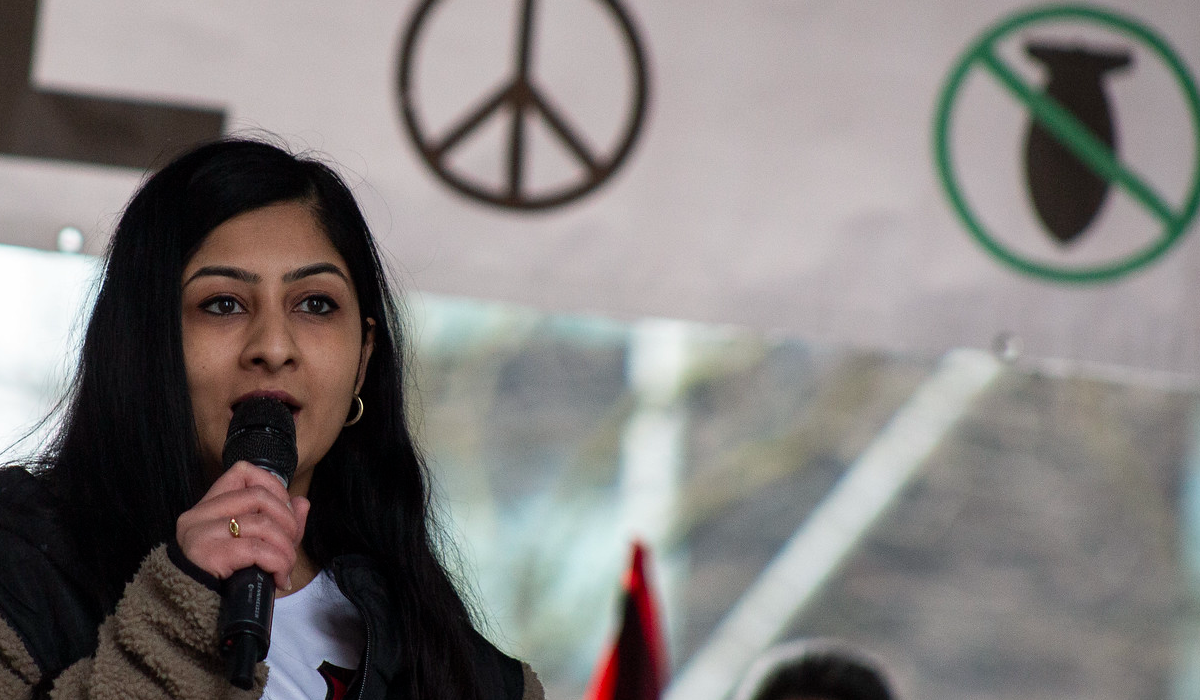
 Zarah Sultana MP addressing a national march for Palestine at Westminster, February 2025. Photo: Flickr/Steve Eason
Alex Snowdon on political practice and radical realignment
Zarah Sultana and Jeremy Corbyn’s recent call for a new party has generated lots of discussion. It holds out the hope of an anti-austerity, anti-war and anti-racist party that seeks to tackle the cost of living, reduce inequality and promote public ownership.
Labour politicians and liberal commentators have apparently settled on their main attack line: support for the left party will split the Labour vote and allow Reform to win. In fact many opinion polls have already indicated potential for Reform to win the next general election, while Labour’s parliamentary representation collapses.
Starmer’s team has consciously courted Reform voters and would-be voters while ignoring those who might back the left. That has failed miserably on its own terms, but it has also widened the audience for a new left party. They have only themselves to blame.
For those leftwingers who remain in the Labour Party, there are two main reasons cited for staying. One is that recent controversies like the welfare bill and the recognition of Palestine illustrate how the Labour Party is not monolithic, but is vulnerable to pressure from the left. It is possible to win concessions through it. The other argument is that Labour retains the reluctant loyalty of many trade unions.
While I don’t agree with the conclusion (to reject the new left party in favour of Labour membership), these are both very important issues that should not be neglected by activists in a new party. We should keep in mind, though, that a leftwing party can exert pressure on the Labour government over controversial issues. The same goes for social movements. The main pressure on Starmer and foreign secretary David Lammy over Gaza has come from the mass movement, finding a dim echo among Labour MPs.
We need to be honest in acknowledging that the unions are an initial area of weakness for the new party. In the process of forming the party, its initiators ought to reach out to leading union movement figures. Trade unionists committed to the new party should begin developing networks of party supporters in their unions. The participation of union activists can enrich a leftwing party, giving it political ballast and helping it develop roots.
There are also those who prefer to argue for Green Party membership, seeing Zack Polanski’s leadership bid as a major opening. The Green Party has many left-wing policies, but isn’t a coherently or consistently leftwing party. It doesn’t ever present a political platform in class terms like Labour’s 2017 manifesto did: the many versus the few, us versus them.
It veers in different directions depending on circumstances. It attracts votes from those who would otherwise vote Labour, but also from those who are more naturally Lib Dem voters. During Corbyn’s leadership of Labour, the Greens made efforts to attract those who were unhappy with Labour’s leftwards direction. They supported overturning the EU referendum result of 2016.
While it has made some inroads into urban working class areas, the Green Party continues to have a mainly middle class base. The kind of working class towns where Reform poses a serious threat are places where the Green Party has little presence or profile.
An orientation on the Green Party also finds expression among some proponents of a new party. The idea is to form an alliance between the two parties.
This goes beyond having loose electoral agreements at local level. Most leftwing activists will generally avoid standing Left and Green candidates in the same council wards next spring. Then again, there will be areas where the Greens are already in office – either running a council or junior partners in a coalition – and have proved disappointing. It would be a serious mistake for socialists in those areas to align themselves with the Greens, even on the level of an electoral pact.
Pushing for a more formal alliance from the very beginning is liable to have a deadening effect. It dampens the insurgent, anti-establishment spirit that animates moves towards a new party, pulling it in a more conventional direction.
The new party needs to establish its own distinctive priorities and demands. It should not be blunted by association with an established electoral vehicle.
Palestine and racism
The new left party is emerging at a time when Palestine is particularly prominent in British politics. The appalling famine in Gaza has prompted an escalation of protests. It has found expression in the political mainstream, however inadequately, with the debate about recognising a Palestinian state and increased government rhetoric against Israel’s actions.
The genocide in Gaza is the single greatest issue that has created the breach between Labour and hundreds of thousands of its former members plus millions of former voters. The ongoing mass movement since October 2023, which shows no sign of disappearing, has been the biggest area of opposition to government policy during that time.
It was Gaza, above all, that led to the election of five independent MPs at the general election, plus very strong votes for candidates like Leanne Mohamad, Michael Lavalette and Andrew Feinstein.
This movement has to be sustained. There are important national demonstrations on 9 August and 6 September. When the new party formally develops, it will need to find ways of combining electoral work with active involvement in movements like the Palestine solidarity movement. While the new party will inevitably have a major focus on elections, it represents an opportunity to develop a political party that connects electoral work with community organising, movement building and trade unions.
On the right of politics, there is a relationship between electoral and party political activity and, on the other hand, a street movement. The success of Nigel Farage’s Reform – in council elections and opinion polls – has emboldened fascists and racists to target hotels housing asylum seekers in aggressive racist protests.
This is fuelled by the policies and rhetoric of the government. As well as opposing the far right on the streets and Reform politicians, we need to confront the government and pose alternatives like building social housing on a mass scale and investing in jobs and communities.
The new party will need to root itself in social movement and trade union struggles. One of the failures during Corbyn’s leadership of the Labour Party (2015-19) was precisely the separation between electoral and internal party politics and a broader strategy for social change. Momentum, the leftwing organisation established to support Corbyn, originated with much talk about social movements, but did very little about it. The dynamics of contested internal party battles took over.
Anti-imperialist politics
The new party will have to be politically bold and audacious. We live in exceptionally crisis-ridden times. Chronic economic crisis, the climate catastrophe and a resurgence of inter-imperialist rivalry are the biggest factors conditioning politics today.
There has been a collapse in trust in established institutions and politics. There is a correspondingly an appetite for anti-establishment politics that thinks big and pitches radical. In the absence of a coherent and organised left, it is hard-right forces (and racism especially) that flourish.
A critical area for the new party will be international issues. Foreign policy was Corbyn-led Labour’s weakest link: Corbyn’s own anti-war, anti-militarist politics were never matched by official party policy, with major concessions on Nato, nuclear weapons and more.
The capitulation by many on the left to the weaponising of antisemitism was linked to weakness on Palestine. When the war in Ukraine started, socialist Labour MPs (even including Zarah Sultana) buckled under pressure to remove their names from a Stop the War statement on the war.
This is also an area where the Green Party is patchy (and its European sister parties are much worse than patchy). It supports Nato membership and has backed the UK arming of Ukraine. It has been ambivalent on plans to massively increase military spending.
This is a time of not just Western-enabled genocide in Gaza but of growing conflict between imperialist powers and an ongoing war on European soil in Ukraine. President Trump has ripped up the established global order, while across Europe we are seeing moves to hike up military spending and put states, including our own, on a war footing.
Military conflicts, trade wars and economic shocks have all become intertwined. Now more than ever, we need a political alternative to devastating economic and military competition.
Anti-imperialism needs to be woven into the fabric of the new party. The ‘welfare not warfare’ slogan – rallying opposition to higher military spending at the expense of welfare, public spending and international aid – will have to be politically central.
It is also essential that the new party is firmly rooted in where it came from: the mass movement for Palestine.
The new party needs to be shaped by the energy and ideas of the more than 600,000 people who have signed up for it. It will have to be a deeply democratic party with high levels of participation. This is not merely because democracy is a virtue, but because mass involvement will shape it positively and help overcome the many obstacles it will face.
Before you go
The ongoing genocide in Gaza, Starmer’s austerity and the danger of a resurgent far right demonstrate the urgent need for socialist organisation and ideas. Counterfire has been central to the Palestine revolt and we are committed to building mass, united movements of resistance. Become a member today and join the fightback.

Alex Snowdon
Alex Snowdon is a Counterfire activist in Newcastle. He is active in the Palestine Solidarity Campaign, Stop the War Coalition and the National Education Union. He is the author of A Short Guide to Israeli Apartheid (2022).