
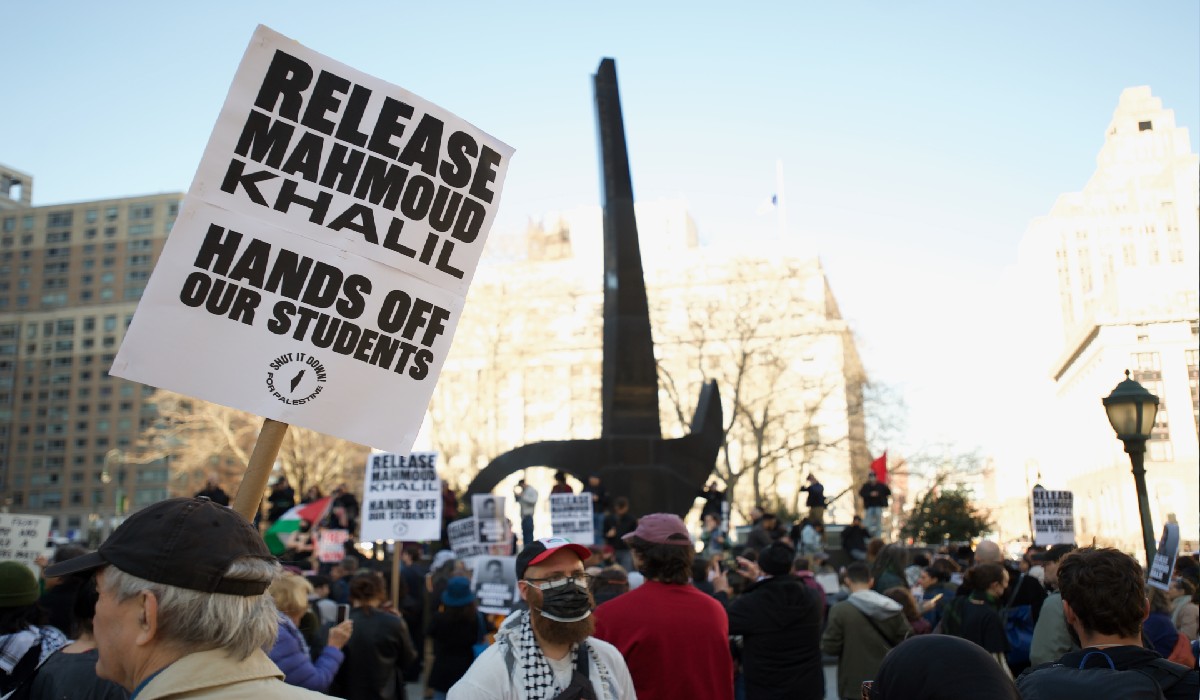
 Mahmoud Khalil protest in New York, March 2025.
Photo: Wikimedia Commons / SWinxy
Mahmoud Khalil protest in New York, March 2025.
Photo: Wikimedia Commons / SWinxy
The release of pro-Palestine protestors has vindicated the movement, while the US government is damaged and weaker as a result of Trump’s authoritarian actions, argues John Clarke
After more than three months in immigration detention, Columbia student and Palestine solidarity activist, Mahmoud Khalil, was released from an Ice facility in Louisiana on 20 June. He was the most high-profile of a group of students that the Trump administration had arrested with the intention of deporting them for the support they had given to the Palestinian struggle. He was also the last of the students to be released and he was freed over the strenuous but futile objections of Trump’s legal representatives.
According to the Guardian, as he emerged from captivity, Khalil told waiting reporters: ‘Although justice prevailed it’s very long overdue and this shouldn’t have taken three months. I leave some incredible men behind me, over 1,000 people behind me, in a place where they shouldn’t have been.’
Khalil responded to accusations that he poses a threat to national security by stating: ‘Trump and his administration, they chose the wrong person for this. That doesn’t mean there is a right person for this. There is no right person who should be detained for actually protesting a genocide.’
In ordering Khalil’s release, a federal judge decided that he was not a flight risk and that he ‘is not a danger to the community. Period, full stop.’ The judge also noted that it ‘is highly, highly unusual to be seeking detention of a petitioner given the factual record of today’ and he found ‘that the government had “clearly not met” the standards for detention.’ On this basis, Khalil will remain free while the attempt to deport him works its way through the courts.
Legal persecution
There was widespread relief that Khalil’s release has finally been achieved, given that the effort to hold him in custody was considered a shocking departure from previous norms. The use of such methods by the Trump administration was viewed as a form of legal persecution and ‘a dangerous escalation in the Trump administration’s campaign against speech protected by the first amendment to the US constitution. Khalil has not been charged with a crime.’
This victory for Khalil and the Palestine solidarity movement is very significant and it constitutes a sharp humiliation for Trump. Three other students who were arrested on similar grounds, Rümeysa Öztürk, Badar Khan Suri and Mohsen Mahdawi, have also been released and Khalil’s victory ‘marks the latest in a series of defeats for the administration, which had promised to deport pro-Palestinian international students en masse.’
The arrest of Khalil and other students active in Palestine solidarity brought together the elements of Trump’s racist immigration crackdown and his effort to stifle free expression on Palestine. In this context, Khalil’s case has attracted a lot of attention and garnered a great deal of support. Shortly after his release, he gave an interview to National Public Radio in which he highlighted the injustices he and others have faced and stressed his determination to carry on with his solidarity work.
Khalil was under no illusions that he faces a protracted battle. ‘My release is just the first step. The legal fight is still very, very long. The administration appealed the decision about my release, but we will prove our case – that what happened to Mahmoud Khalil was textbook retaliation against the First Amendment, that I was targeted because of speech the government did not like, and that there was nothing wrong with the speech I was engaged in.’
ABC News also asked Khalil to respond to particular accusations that have been made against him. ‘The White House has said that you distributed pro-Hamas fliers. Secretary Rubio said that you created an environment of harassment toward Jewish students. President Trump said we got to get him the hell out of our country. Why do you think that you are perceived as such a threat?’
Khalil replied, because ‘I represent a movement that goes against what this administration is trying to do. They try to portray me as a violent person. They try to portray me as a terrorist, as some lunatic, but not presenting any evidence, not presenting any shred of credibility to their claims.’
The inability of Trump to silence such a strong and respected voice of Palestine solidarity and the defeat it has suffered in the courtroom come at a very bad time for his administration. On 23 June, The Times of Israel ran an article that was indignantly headlined ‘Mahmoud Khalil resumes anti-Israel activism, appears at NYC rally.’ The article noted Khalil had stated shortly after his release: ‘Not only if they threaten me with detention, even if they would kill me, I would still speak up for Palestine again.’
Khalil’s activism for Palestine at Concordia took place in a context where considerable numbers of young people were being politicised. As was noted at the time, ‘college students who could not even find Gaza on a map a year ago have turned into activists who understand the genocide as a world historical event.’
Last year, there were 121 pro-Palestinian encampments set up at 117 US universities, with the one that Khalil was part of at Columbia being especially politically significant. The US establishment was thrown into crisis by this sweeping development and more than half of the encampments were forcibly dispersed.
Growing movement
Another major upsurge of Palestine solidarity is now to be expected, given the ever-worsening situation in Palestine and the Trump administration’s continued support for the monstrous criminality of Israel. It has also become clear that Israel’s brutal attack on Iran has provided a cover for intensified genocide and ethnic cleansing in Gaza and the West Bank.
As I write this article, it is unclear whether the ceasefire between Iran and Israel will hold together but the attack on Iran, in which the US directly participated can only fuel anger within the US and add momentum to both Palestine solidarity actions and the growing general movement against the Trump administration.
In recent weeks, we have seen determined and powerful resistance to Trump’s immigration raids. It took a particularly explosive form in Los Angeles but it is emerging as a national movement. At the same time, ‘No Kings’ protests against Trump’s self-serving military parade in Washington DC brought out between four and six million people.
The attempt to deport students who have played important roles in building such an opposition is an indication of how much those around Trump fear the prospect of mass mobilisation and popular resistance and how desperate they are to stifle it.
Though it is deeply reactionary and enormously dangerous, the Trump administration is very far from invincible. Its reckless decision to back Israel to the hilt in the assault on Iran revealed deep divisions within the administration and its base of support. The war hawks who urged Trump on were challenged by those within the Maga movement, like Marjorie Taylor Greene and Steve Bannon, who feel that Trump isn’t keeping faith with the America First doctrine.
For all his readiness to embrace an authoritarian approach and act with considerable brutality, Trump is a notoriously erratic and indecisive figure, precariously balancing competing interests and perspectives within his base. His administration, moreover, has sometimes pursued bold objectives without being prepared for the obstacles it will face. The notion that pro-Palestinian students could be simply rounded up and deported on flimsy legal pretexts and without regard for judicial oversight proved to be a miscalculation.
Trump and his administration have failed in the effort to silence Mahmoud Khalil and the whole matter has blown up in their faces. He is now free and able to point an accusing figure at those who tried to lock him away. His continued defiance and principled support for the Palestinian struggle will inspire others to follow his example. Trump’s effort to stifle a movement of resistance has only made it stronger and more determined.
Before you go
The ongoing genocide in Gaza, Starmer’s austerity and the danger of a resurgent far right demonstrate the urgent need for socialist organisation and ideas. Counterfire has been central to the Palestine revolt and we are committed to building mass, united movements of resistance. Become a member today and join the fightback.

John Clarke
John Clarke became an organiser with the Ontario Coalition Against Poverty when it was formed in 1990 and has been involved in mobilising poor communities under attack ever since.