
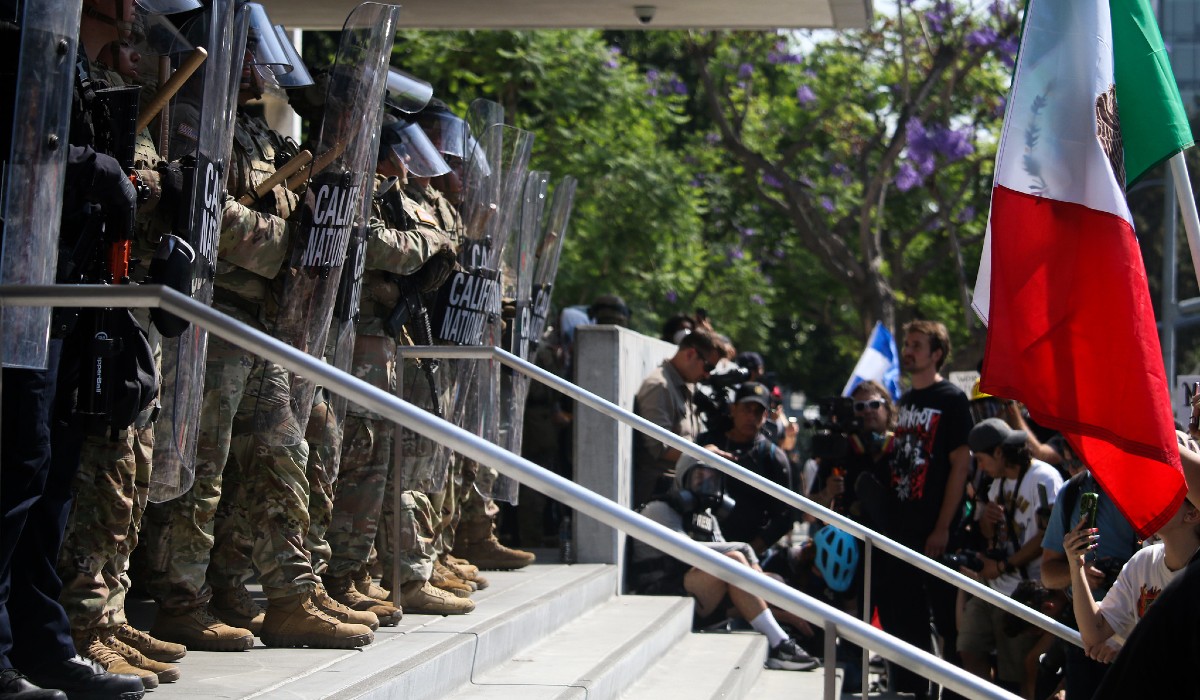
 California National Guardsmen stand off against protestors during a demonstration against ICE raids / Flickr / Photo: Walter Hammerwold
August Nimtz assess the LA uprising, the leadership of the movement and the tasks ahead
To a group of worried students on the eve of last November’s presidential election, I said that I couldn’t predict the winner. “But one thing is certain,” I continued. “If Trump wins, you’ll have another opportunity to vote—with your feet, in the streets—the most effective kind of voting, where power is actually exercised.” That moment may have come sooner than expected. But to that same class I had also quoted on several occasions Lenin’s all so prescient point in 1901: If a revolutionary working-class party doesn’t exist when a revolutionary moment occurs, it will be “too late to form the organization in times of explosion and outburst.”1
In other words, disciplined street actions with a tested leadership are necessary for such a moment to become truly transformative. Nothing I’ve seen so far in the Los Angeles and elsewhere indicates that such leadership exists. Luckily, in my opinion, it’s not a revolutionary moment. To be so, it would have to be on a scale approaching the upheavals of 1992, the Rodney King protests, or the 1965 Watts rebellion. Luckily, I say, because it would be a real tragedy if this was such a moment, but one that lacks the needed leadership to make it consequential—a wasted opportunity, in other words. History is strewn with the corpses—too many—of defeated revolutions due to such a deficit.
What makes this moment potentially different from 1965 and 1992 is the possibility of the working class providing the requisite leadership. For much of post-World War II history, the organized labour movement in the US was largely missing in action when it came to progressive causes, including the Civil Rights Movement. While the police brutality (which sparked the Watts and Rodney King rebellions) is indeed a working-class issue—and thus a union issue—the immigration question, which provoked the actions in Los Angeles is, however, an existential one for the labour movement. With more than twelve million undocumented workers in the U.S., their defense by organized labour is crucial for its future.
Rare is the labour official—especially a prominent one—willing to put their body on the line for a cause. But that’s exactly what David Huerta, president of the California chapter of the SEIU (Service Employees International Union), did when he went on June 6 to protest the ICE (Immigration and Customs Enforcement) raid on the garment shop to arrest undocumented workers. His militant but peaceful actions resulted not only in an arrest but head wounds that required hospitalization—the police actions he and others suffered that sparked the subsequent protests.
Huerta’s detention and injury prompted not only the labour movement officialdom nationwide to demand his release—accompanied by press conferences and mobilizations in several cities throughout the country—but also key figures in the Democratic Party establishment. His liberation a day or so later registered what organized labour can accomplish and points the way forward for its rank and file.
As well as its national and, in some cases, international character, the U.S. labour movement brings something else to the table—the tradition of militant and disciplined actions, how the movement has ever advanced. It’s the needed antidote to the ultra-leftist “vanguard,” always informed by the elitist assumption that the proletarian masses can’t do it for themselves or can ever be won to revolutionary actions. Engaging in actions such as looting and burning objectively alienate the proletarian majority and that play into Trump’s hands—giving him an excuse to take away civil liberties, as well as the political space the working class needs to do the preparatory work Lenin accurately foresaw as needed for doing something genuinely revolutionary as opposed to “revolutionary” performance.
Ultraleftism has a long history. It appeals to those who not only lack faith in the revolutionary potential of the proletariat but prioritizes the expression of outrage at social evils at the expense of seeking solutions—characteristic of too many of today’s social movements. The communist project, rather—the real one and not the pretenders—is about how the oppressed can win, to wit, put an end to social oppression. We’ve been expressing, as the Communist Manifesto famously chronicles, outrage and resistance against subjugation for more than ten millennia, ever since the emergence of class society. Knowing how to end it, however, has always been the challenge.
Only with the coming of the proletariat, beginning less than three centuries ago, has it been possible—this is the central argument of the Manifesto—for social inequality and its ever-horrific consequences to be confined to the dustbin of history for the first time. The proletariat is the only subject class whose own liberation makes possible the liberation of the rest of society.
The events in Los Angeles have the potential of being an important learning opportunity—the necessary preparatory work for the real revolutionary moment that Trump redux inexorably promises. Mercilessly, the actions of Trump’s administration compel progressive forces to think about how to forge a project that’s more than just expressing outrage but one rather for taking power—state power—and how to do so. They neglect to do so at their peril. With war now on the global center stage and the nuclear option increasingly being posed, the stakes couldn’t be higher for humanity. Only the proletariat of the US can stay the hands of capital’s most consequential war mongers.
It will be on US soil where the future of humanity will be decided: the heavyweight fight of all heavyweight fights in class society’s history—the US proletariat versus the US capitalist class. All that the Manifesto guarantees is the class struggle, not the winners and losers. “Inevitable,” it can’t be stated enough, appears only once in the document, immediately followed by instructions for the proletariat on how to win. Under Trump redux, the American working class, fortunately, is likely to have a steep learning curve.
August H. Nimtz is Professor of Political Science and African American and African Studies, and Distinguished Teaching Professor, at the University of Minnesota. Recent publications include Lenin’s Electoral Strategy from Marx and Engels through the Revolution of 1905: The Ballot, the Streets–or Both (2014), Marxism versus Liberalism: Comparative Real-Time Political Analysis (2019), and The Communist and the Revolutionary Liberal in the Second American Revolution: Comparing Karl Marx and Frederick Douglass in Real-Time (Brill, 2024).
1 V. I. Lenin, Collected Works, vol. 5, (Moscow: Progress Publishers, 1960) p. 18.
