
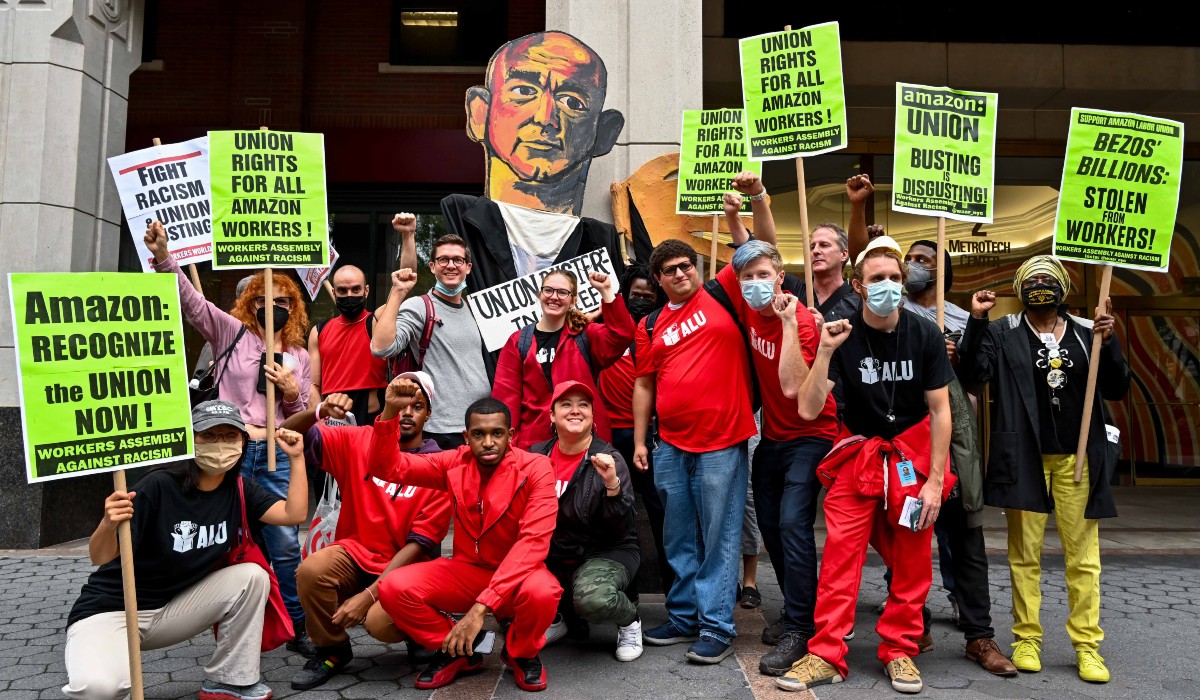
 Amazon workers fighting for union rights, USA. Photo: Joe Piette / CC BY-SA 2.0
Alex Snowdon on the central division in capitalist society
Class, we are often told, is no longer relevant. It is an archaic concept. If class does still exist, it is now terribly complicated –with maybe seven different classes determined by complex criteria.
Alternatively, there’s the idea that most people are middle class now. Sometimes the size of the working class is squeezed from the opposite direction, by emphasising the supposed growth of an ‘underclass’. Either way, the concept of a ‘disappearing working class’ is always with us.
Where the relevance of class is conceded, it is nonetheless just one of a range of demographic factors alongside sex, ethnicity, sexual orientation and so on. Class is often reduced from an objective matter to a question merely of identity – ‘working class’ as one of a range of possible identities.
As for what defines class, it can frequently be framed as a matter of lifestyle choices. Anything from someone’s accent to how somebody dresses or their cultural tastes can be a marker of class. There is little sense that class is rooted in material conditions. This ‘identity’ or ‘lifestyle’ approach also tends to treat class as an individual affair, rather than identifying what binds people together or what they have in common.
For Marxists, there are three fundamental points to grasp about class.
First, class is a material fact. It is objective reality, not subjective identity. Class is determined by people’s relationship to the means of production.
Class societies stretch back around 10,000 years to when some communities began to produce a surplus – more than they required in order to live. This allowed a small elite, or ruling class, to develop, based on concentrating control of that surplus wealth in its own hands.
In a capitalist society the fundamental division is between capitalist and worker, based on who owns and controls production (the capitalists) and who is obliged to sell their labour power in order to survive (the working class).
Second, class is a social relationship. This is not unique to capitalism, which is a few hundred years old. In the Communist Manifesto, Marx and Engels took a longer view when they wrote:
‘Freeman and slave, patrician and plebeian, lord and serf, guild-master and journeyman, in a word, oppressor and oppressed, stood in constant opposition to one another…’
They are referring here to a series of class relationships throughout history – from ancient slave societies through to the emergence of early capitalism, via the Roman world and feudal societies. In each of these forms of society, class was a social relationship. It was an inevitably antagonistic one, too, as it rested upon economic exploitation.
In each type of society, the ruling class depended upon those who produced the wealth. In modern capitalism, a tiny ruling class – with the owners of capital at the core – exploits a working class, which forms the majority of society.
Third, the division of society into classes – with opposing material interests – inevitably generates class struggle. The quotation above from the Communist Manifesto continues:
‘…an uninterrupted, now hidden, now open fight, a fight that each time ended either in a revolutionary reconstitution of society at large, or in the common ruin of contending classes.’
This draws attention to how struggle between the main classes is a constant feature of any class society, even if much of the time there appears to be little class conflict. It also implies that there have generally been two main ‘contending’ classes, though there may be other (less historically significant) classes.
In capitalism, it is the bourgeoisie (the capitalists) and the proletariat (the workers) that constitute the two main antagonists. This does not exclude the possibility of other class formations, such as a middle class including small business owners and those with managerial roles.
Nor does it stop us from analysing particular tendencies within a class – Marx did this often in his writings. It simply means grasping the main division in society and the way that provides the foundations for class struggle.
Marx and Engels were also highlighting the decisive role of class struggle in shaping the course of history. For example, the transition from feudalism to capitalism was rooted in technological and economic changes, but it also required a struggle – economically, politically, ideologically –by the emerging capitalist class to advance its interests.
It follows that further historical progress is possible. It requires working-class struggle to end capitalist exploitation. To quote the end of the Communist Manifesto: ‘The proletarians have nothing to lose but their chains. They have a world to win’.
Before you go
The ongoing genocide in Gaza, Starmer’s austerity and the danger of a resurgent far right demonstrate the urgent need for socialist organisation and ideas. Counterfire has been central to the Palestine revolt and we are committed to building mass, united movements of resistance. Become a member today and join the fightback.

Alex Snowdon
Alex Snowdon is a Counterfire activist in Newcastle. He is active in the Palestine Solidarity Campaign, Stop the War Coalition and the National Education Union. He is the author of A Short Guide to Israeli Apartheid (2022).