
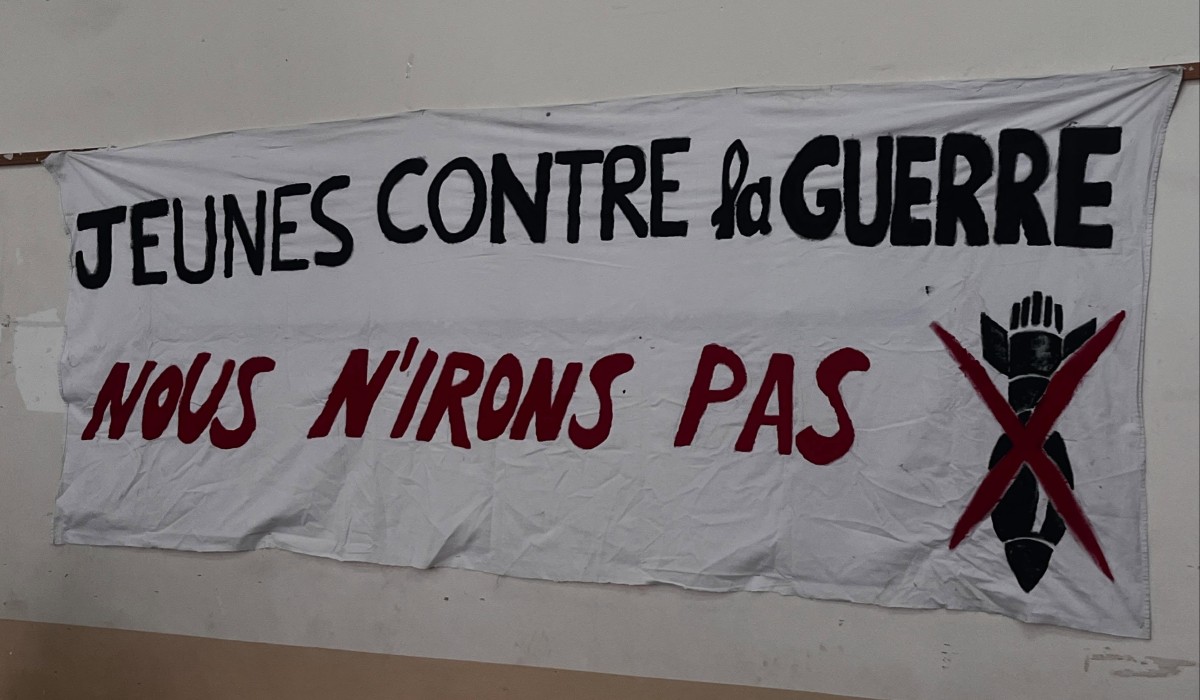
 Photo: Shabbir Lakha
On Saturday 30 May, 150 young people who had signed the call “We will not go to war”, and guests from the United Kingdom and Germany, met in Paris. They discussed building an organised movement to fight militarisation across Europe. André Coset reports
A follow-up to the anti-war meeting in Paris (5th October 2025), and to organise the next one in London on 20 June, this meeting started off with a clear assessment of the situation: imperialism is gearing up for global war.
The United States target sovereign peoples by kidnapping their heads of state; they arbitrarily bomb countries and finance ongoing genocides. All countries in Europe are rearming. Germany has changed its constitution to allow for a budget deficit in order to finance “the most powerful army in Europe”; on 5 December 2025 it introduced conscription, which entails the surveillance of every young person born after 2008, and is implementing a “voluntary” military service.
German young people, however, are clearly rejecting these policies, and 50,000 took to the streets in May to protest. In France, too, we have experienced austerity for the benefit of the military, and ‘voluntary work’ aimed young working class people. We have seen racist two-tiered university tuition fees introduced, which leaves foreign students worse off. Therefore, to oppose the barbarism looming on the young, the assembly of signatories has decided to stay connected through a network of platforms to organise joint actions and share information.
And, because the struggle isn’t limited nationally, a proposal has been launched to form a delegation for the anti-militarisation protests on 14 June in Brussels. Finally, faced with the warmongering forced on young people, days of action outside the JDC centres (“journée défense citoyenneté”) have been declared. It is in these centres, hotspots for enlisting young people, that a public message against any militarisation is being delivered loud and clear. We will not go!
Ethan, a student from Paris said:
“Never before, since World War Two have there been more wars in the world at the same time. In other words – there is a crisis of capitalism; world economy needs to renew itself: people all over the world will suffer. The priority of Macron’s mandate is not women’s rights but the deployment of war propaganda, and they’re using this organised misery to enlist us. Solidarity to students in Rennes, Grenoble, Nantes, Lyon…, who prevented the visit of members of the military at universities and high schools. The Army has no place in our places of study. We want teachers, not soldiers.
“Solidarity with the high school students in Marseille who have organised a blockade of their school to protest against teaching posts being cut by 4000, against Parcoursup, against the military budget. No to Parcoursup, no to militarisation.”
Shabbir, Stop the War officer and Counterfire member (UK):
“In the UK, £70 million has been given to the military directly recruiting in schools. In parallel to the rise in youth unemployment, the collapse of schools and universities, the government is putting in place a “military gap year”, thus surreptitiously introducing conscription. The need for an international movement against war could not be more urgent as imperialism is in full swing in Palestine.
“Freedom of speech is being curtailed, and the popular movement criminalised, all running parallel to insulting accusations of antisemitism. The government tried to use fascists to drive us off the streets, but 250,000 marched on the streets of London on 16 May and we listened to French MP Claire Lejeune announce that we had outnumbered the fascists.
“Movements such as those that have successfully fought against the Yadan law, that have caused the collapse of the Bayrou government, and that are fighting against conscription in Germany, are very much needed. The international conference on 20 June will show that these are not isolated actions but a united movement that goes beyond national boundaries.”
Felix, a high school student organising against conscription in Germany:
“On 5 December the German government has introduced a new law on military service. All boys born in 2007 onwards will receive a questionnaire which will be compulsory to fill out. Officially we are told that everyone will be free to choose (…) but when taking a closer look at reality, this so-called choice seems rather relative. One then clearly sees that this offer vastly targets the working and lower middle classes.
“In Germany we have succeeded in getting young people to take to the streets. They not only oppose compulsory military service, they are also developing a critique of capitalism. And, in spite of being under surveillance, we have managed to get between 50,000 and 60,000 young people to join each of our three big national demonstrations.
“In today’s world, international solidarity is more important than ever. And when leaders command us to serve the nation, we must respond clearly: we do not serve anyone.”
Abel, a high school student in Pont-Audemer:
“On 9 April, given the militarisation that the youth is facing, and following the mobilisation of high school students in Marseille and Le Havre, we have chosen to organise a blockade of our school in Pont-Audemer.
“The day before, in the space of one afternoon, we went from 15 in our organising group to 200, and on the D Day, 500 gathered in front of the school, out of 1400 students in total. We knew that repression would be stronger this time around, so we wanted to contact trade union organisations. We were then faced with a block from certain elements in these unions that didn’t want to support our movement.
“Faced with the number of students the first time around, our determination, and the undeniable overlap of our demands and theirs, these elements were eventually left with no choice but to support us, some via a written message, while others came in person.”
Lola, a high school student, and Rodolphe, a student in Nantes:
“On the occasion of the meeting of the signatories of the call “young people against war”, we want to speak out against the compulsory day of mobilisation for all young people from the age of 16. The day imposes an unacceptable national narrative to young people, with things like the raising of the flag, war-themed board games, military food rationing at lunchtime, and the handling of a laser weapon. To nip this narrative in the bud, we propose to assemble in front of these centres with anti-war and anti-militarisation arguments from the youth using leaflets and banners. This is how we plan to offer a counter narrative and show young people that their sole future is not in war.”
Thomas, a student in Paris:
“I was a militant at Solidaires étudiantes, and when the bombardments in Gaza started again in the spring of 2024, we wanted to do something. My sister and I proposed that we stood outside the university every day. There were eight of us at the meeting, but the next day there were four of us outside the university. But we came back the next day and there were six of us, the day after that we were eight.
“Then we got hold of flags, banners and megaphones. We contacted the GA of Compiègne, and they joined us. We contacted pro-Palestine groups, and they came.
“After a few weeks, nearly 100 gathered outside the university in protest against the genocide in Palestine. So, if you don’t know where to start, go up to your mates and tell them: ‘I see what’s been going on, it’s disgusting. What are we going to do about it? Don’t look the other way, don’t put your heads down.’ That’s what they expect from us”.
Jade, student in Marseille:
“I would like to comment on the evening event ‘Women and gender minorities against war” that took place on 21st May and was attended by 300 people. Among them were trade unionists, students, high school students, feminist activists, an organisation for the defence of trans people, pro-Palestine activists, anti-racist, decolonial and antifascist activists and a militant politician.
“What this event has shown, it is that there is a strong will to discuss things together, to transcend divisions and to build uniting frameworks against war.
It is not about renouncing one’s beliefs or organisation, it is about meeting where we are united: the refusal of war and the will to resist.”
Mouna, a student in Nice:
“The Youth against war weekender offered an opportunity to think over the topics of war, peace and the real priorities that are relevant to young people. It seemed rather interesting to look at the striking dichotomy between the principles professed by international law and what we see in the real world. International law is clear [on rules surrounding armed conflicts]: distinction between civilians and combatants, protection of journalists and health workers, the facilitation of humanitarian aid and a ban on using famine as a weapon of war. Yet this legal framework is often ignored in practice. The case of Gaza is striking: swathes of areas destroyed, huge numbers of civilian victims, journalists and health workers regularly targeted and humanitarian aid that can hardly reach the most vulnerable populations. These violations shed a light on the dramatic gap between these claimed principles and their real application.”
Théo, a teacher in Nice:
“I teach literature, history and geography. My students are convinced that a globalised conflict will happen and it will oppose France to Russia. Some of them, following our discussions, make some rather worrying comments, such as ‘I will go and fight for France’. They are aged 14 to 19, so some are already of voting age, and can enlist in the army. During my history lessons I was able to get them to think about the reality of today’s geopolitical context. These lessons help students think critically about what they hear on the media. However general knowledge subjects are being increasingly undermined and are replaced by internships or subjects that don’t require any critical thinking skills.
“We can see that the ministry for education is moving more and more towards the training of “children to be sacrificed”, to quote General Mandon, when it should instead be educating towards the development of critical, free, enlightened minds. We can reverse this trend with the help of powerful trade unions and powerful leftist political organisations.”
Reposted from Informations Ouvrières
Translated by Myriam Meguarbi
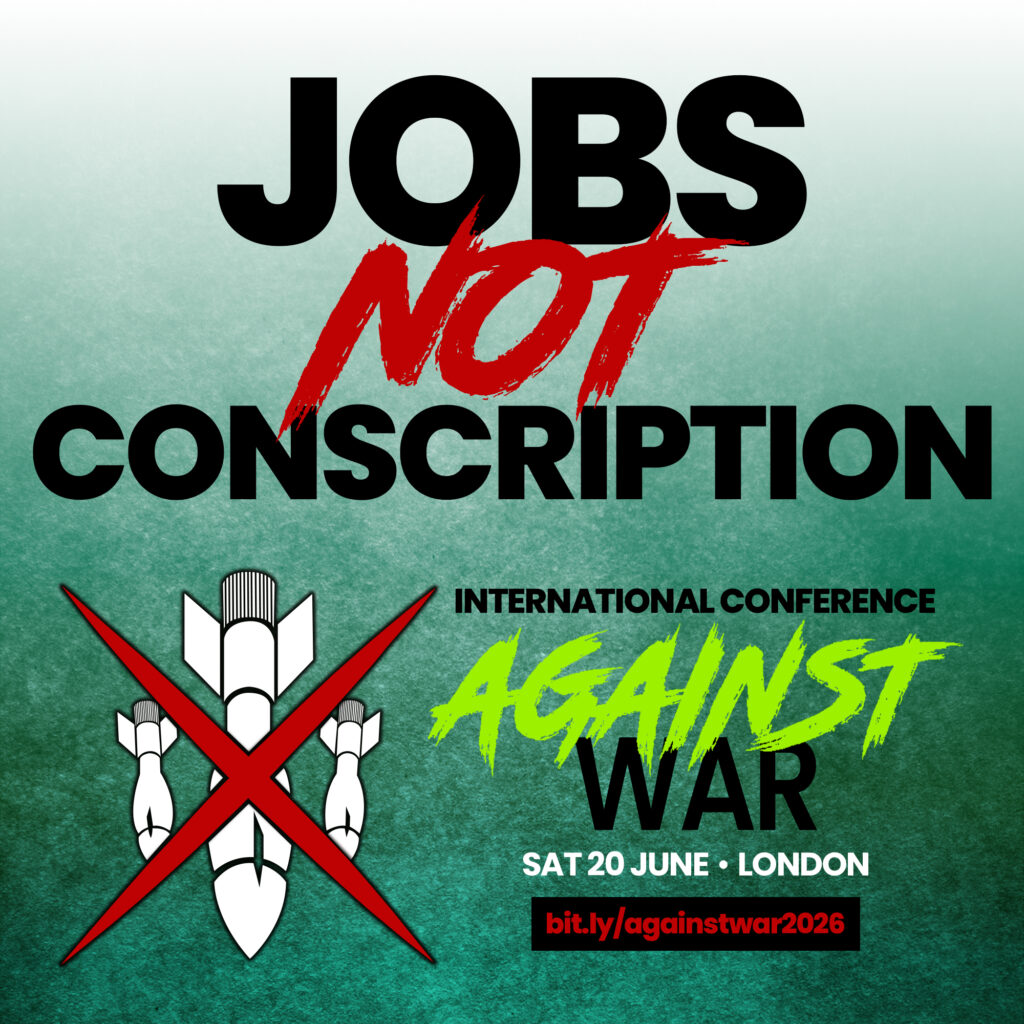
Book now for the International Conference Against War, 20 June in London
Before you go
The ongoing genocide in Gaza, Starmer’s austerity and the danger of a resurgent far right demonstrate the urgent need for socialist organisation and ideas. Counterfire has been central to the Palestine revolt and we are committed to building mass, united movements of resistance. Become a member today and join the fightback.
