
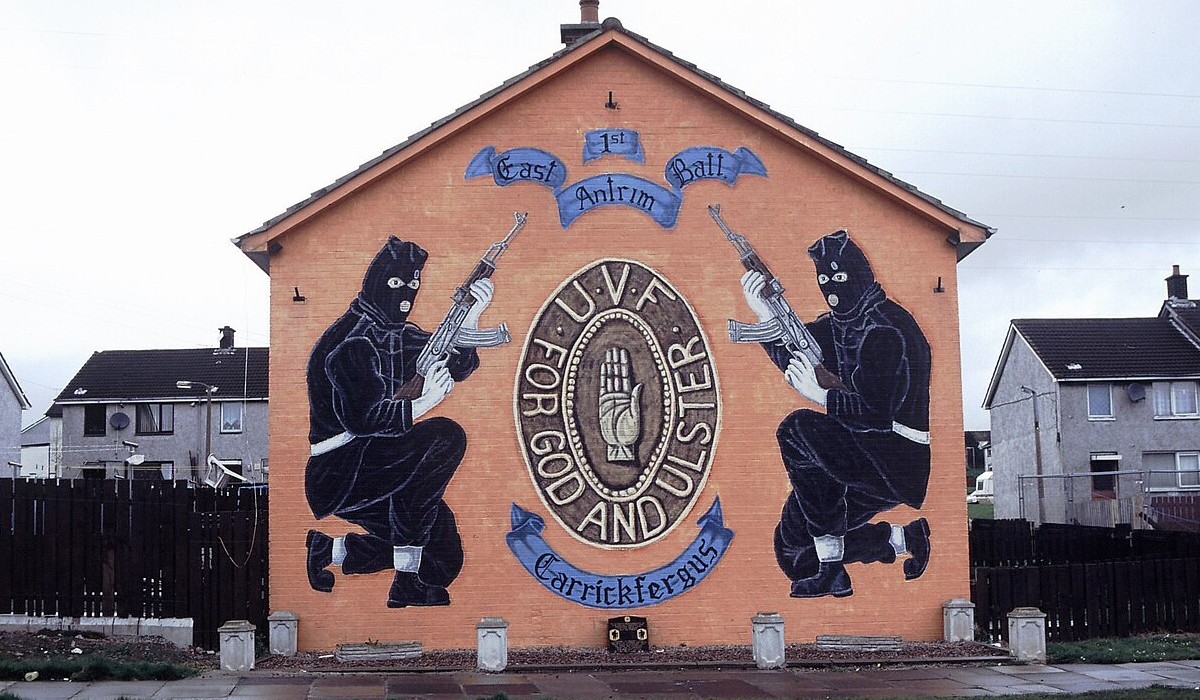
 Ulster Volunteer Force mural in Carrickfergus. Photo: Miossec / CC BY-SA 3.0
The riots in Belfast have their roots in the far right Loyalist organisations whose history is one of violent racism and discrimination, backed by a ruling class which benefited from sectarianism, writes Chris Bambery
What is behind the riots in Northern Ireland? The obvious answer is they are a racist, anti-migrant response, urged on by Tommy Robinson, Elon Musk and British fascist grouplets, in response to the stabbing on Monday night of Stephen Ogilvie by Hadi Alodid, a 30-year-old Sudanese man charged with attempted murder. Alodid had been granted asylum for five years until 2028.
So far that is in line with similar race riots we have seen in Britain targeting migrants. The racism on display on the streets of Northern Ireland is disgusting. For example, a mob pursued a nurse until she reached safety at the hospital where she works, targeted simply because she was not white.
But there is another dimension to this. These race riots have taken place in Protestant areas of Belfast and in Protestant towns or areas elsewhere. They have been carried out by supporters of Loyalist paramilitary organisations which, incredibly, have been allowed to legally exist 28 years since the 1998 Good Friday Agreement formally ended the Troubles and led to the IRA having to decommission its weapons and dissolve.
The Ulster Defence Association, Ulster Volunteer Force and other Loyalist gangs had been responsible for the killings of hundreds of Catholic, targeted not for political or military reasons but simply because they were Catholics. They still operate and have become criminal organisations, dealing in drugs. They retain their weapons and have displayed them publicly recently as internal feuds rage.
In poor Protestant areas like Belfast’s Sandy Row, where a pogrom took place earlier this week, a Loyalist paramilitary culture and organisation has a strong hold. Their far-right politics mean they are quick to murderously target migrants and Muslims when the opportunity arises but we should remember if you scratch the surface the same old anti-Catholic racism is still very much there. The difference is that where once they held the upper hand, today they are on the defensive and feel betrayed. Betrayed because they rightly see that a united Ireland is fast approaching and feel they have been ditched by Britain despite their attempts to display their supposed British identity – supposed because today it finds little echo in Britain outside parts of Central Scotland and Merseyside (where Loyalists also rioted this week).
In my book The Old Divide: A History of Sectarianism in Scotland (Luath Press, 2025) I obviously concentrate on Scotland, but anti-Irish racism there is closely tied to that in Northern Ireland. So, let’s look at what’s changed there and why Loyalists there feel left behind and alone.
Northern Ireland was created by Britain in 1921 from six counties of a nine county Ulster on the basis of a sectarian head count designed to give Protestants a two thirds majority. Britain had been forced by Republican guerilla war and political success to give up colonial control of the bulk of Ireland’s 32 counties. The new 26 county Irish Free State is today’s Republic.
Northern Ireland contained almost all of Ireland’s industry and was of strategic importance to Britain – it served as a staging post for the US army during the Second World War and was key to the submarine war in the Atlantic. But even in 1921 Belfast’s shipbuilding and engineering industries were in trouble. British industry as a whole was outmoded, lacked investment and had low productivity compared to its rivals. If things were bad in Britain they were worse in the branch economy of Northern Ireland,
Nevertheless, from 1921 until 1972, when the seperate Northern Ireland parliament was dissolved and Britain imposed direct rule, it was ruled as a one party state run by the Unionist Party, with an upper class leadership, officered by the Protestant middle class and with mass support in the Protestant working class. The glue keeping this cross-class alliance together was the Orange Order, created in the 1790s as a paramilitary adjunct of the British army in order to repress the United Irishmen, the first Irish republican organisation.
Its main activity was to parade in military ranks, often armed, with fife and drum bands playing sectarian tunes, through Catholic areas to demonstrate Protestant dominance. Violence commonly followed. As the majority of Ireland pressed for Home Rule, devolution, from the 1880s inwards, the Unionist industrialists and landowners of north east Ireland, determined to resist any weakening of British control at any cost, and finding ready allies across the water in the Tory Party, found the Orange Order the ideal vehicle to organise mass opposition.
When a third Home Rule Bill was presented in 1910 the Unionists raised a mass armed force, the Ulster Volunteer Force, importing German weaponry on the eve of the First World War. The Orange Order was central to that.
When the Northern Ireland state was created the Unionists were in permanent control. Every prime minister and cabinet member were members of the Orange Lodge, every 12 July leading its main march of the summer season commemorating King William of Orange’s 1690 victory at the Battle of the Boyne.
This was a celebration of a sectarian, Orange state where Catholics were discriminated against systematically, repression was used against them regularly (every decade of the Orange State saw at some point the introduction of internment without trial) and divide and rule ensured it was a political and economic slum. Protestant workers were, it was said, twopence halfpenny looking down on twopence. The Orange Order told them they could take solace in that.
But by the 1960s Northern Ireland desperately needed to attract investment and US and European multinationals had no interest in discriminating against Catholics. Young Catholics who had attended secondary school and university were not putting up with how their parents were treated. A civil rights movement began, met with police truncheons.
The upper class Unionist leadership were seen by those below as ‘soft’ and the Reverend Ian Paisley led a split of middle class, mainly evangelical Protestants from the Unionist Party. The old Unionist monolith had cracked and worse would follow with the rise of Loyalist paramilitary organisations which marked the mass killing of Catholics.
Fast forward to today. Belfast now has a Catholic majority, Sinn Féin is the largest party holding the First Minister’s position and post-Brexit much of the middle class, Unionist in the hearts, now accept Irish unity is coming because of their pockets. The party Ian Paisley created, the Democratic Unionists, now shares government as junior party to Sinn Féin, losing it support. Among working class Protestants abstentionism is prevalent.
Until relatively recently people in Northern Ireland could seek comfort that their state was still economically and socially more advanced than the Republic. Today that is far from the case. Many middle-class youngsters have got out leaving post-industrial Loyalist areas feeling deserted by all.
The Orange Order is a shadow of itself and aging. As one historian of the Orange Order I cite in in The Old Divide writes:
‘.. the collapse of Orange recruiting in the main cities and larger towns has created a vacuum which Orange paramilitaries have been keen to fill. The remaining Orangemen in Belfast and other urban centres must make peace with the paramilitary protection rackets and respond to an impatient, pseudo para-military youth culture in order to parade and recruit younger members.’(p.222)
A wounded beast is often at its most dangerous and Loyalism in Northern Ireland feels its wound. It despises the various Unionist parties and British politicians like Starmer and Badenoch. Above all it feels betrayed and left behind by history. But as we have seen it is still dangerous. They have bought into the racism of Tommy Robinson and the Stop the Boats Brigade and like Robinson they are virulently pro-Israel, in an island where there is mass support for Palestine.
A question to ask of the British government is why do the UDA, UVF and other such groups still legally function and why do they retain arms? Meanwhile, such pogroms we have seen this week will re-occur because the Loyalist paramilitaries need an ‘other’ and the one they traditionally targeted is too confident and too organised.
Before you go
The ongoing genocide in Gaza, Starmer’s austerity and the danger of a resurgent far right demonstrate the urgent need for socialist organisation and ideas. Counterfire has been central to the Palestine revolt and we are committed to building mass, united movements of resistance. Become a member today and join the fightback.

Chris Bambery
Chris Bambery is an author, political activist and commentator, and a supporter of Rise, the radical left wing coalition in Scotland. His books include A People's History of Scotland and The Second World War: A Marxist Analysis.