
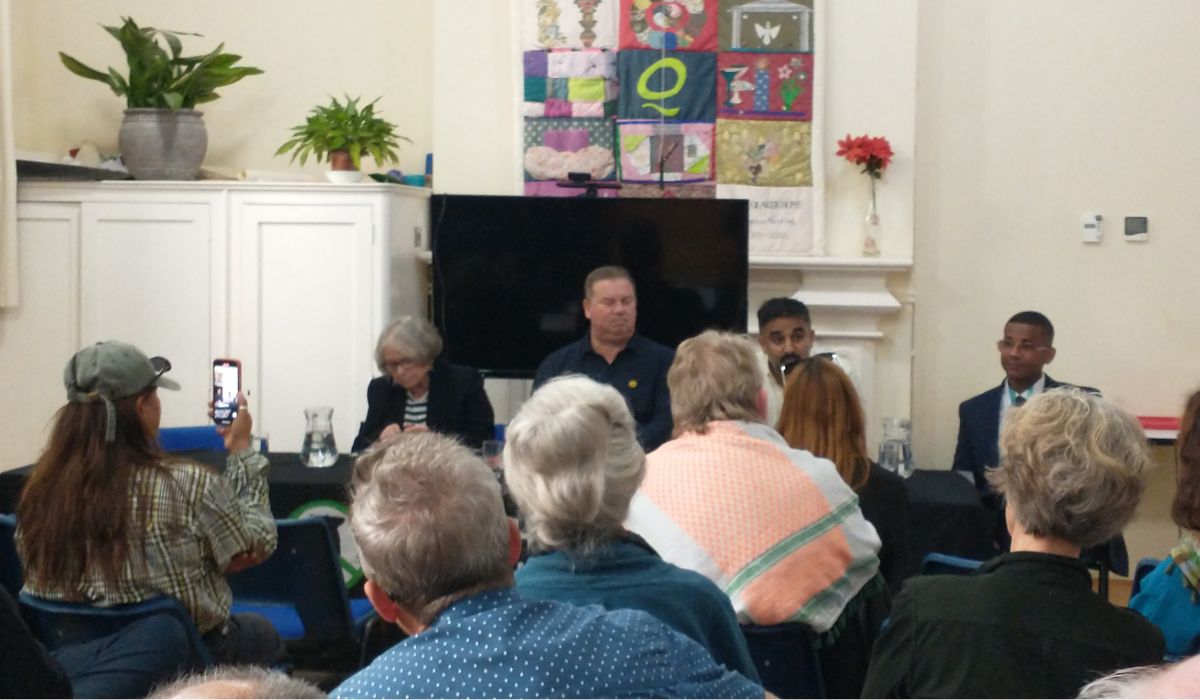
 Fringe meeting at the TUC conference in Brighton on Tuesday 9 September. Source: Richard Wistreich / cropped from original / with permission
The TUC vote against support for arms spending was welcomed at a fringe meeting at the conference in Brighton on Tuesday 9 September, reports Richard Wistreich
The meeting organised by Stop the War came on what the chair, Alex Gordon, described as an auspicious day for the trade-union movement: earlier, Congress had passed a historic motion, ‘Wages not Weapons’, ending the TUC’s support for increased defence spending. This reversed the position taken at the 2022 Congress, when Unite and the GMB argued to put jobs before the dangers of militarism. Yesterday’s motion, put by UCU and seconded by the RMT, argued instead that ‘in the current political context, ever-higher expenditure on arms will inevitably mean less money for our education, health and councils, and the green transition.’
Speakers at the meeting included political economist and UCU member, Ashok Kumar, who detailed the direct contribution of the UK arms industry to enabling the Israeli genocide. He pointed out that maritime and dockers’ unions in many countries have already succeeded in hampering Israel’s ability to import war materials and he urged UK unions to focus on transport ‘choke-points’ to stem the flow, for example, of F35 parts to Israel.
Daniel Kebede, General Secretary of the NEU, noted that the current government’s spending on education was far less than Starmer’s stated aim of spending 5% of GDP on ‘defence’ by 2030. Even the last Labour government was spending more on education than 5% of GDP; now it is hugely less than that figure.
Fran Heathcote, General Secretary of the PCS made it clear that claims by Labour and other parties that welfare spending was ‘out of control’ and had therefore to be cut back is a lie: the percentage of GDP that the UK spends on welfare has barely changed in the last fifteen years, and more than half of all people who rely on social security say they do not have enough money to live on. In fact, as Alex Gordon pointed out, even based on the most recent figures for 2022-23, 5% of GDP is £125 billion, enough to fund the rebuilding of schools, hospitals, railways, etc., lift the two-child cap, and give proper wage rises to millions of under-paid workers.
Stop the War convenor Lindsey German spoke last, and she started by praising the fantastic result of the vote by Congress. She punctured the argument of both the government and unions that voted against the motion that increased defence spending benefits both workers and the economy. In fact, almost all the money goes to arms manufacturers whose profits continue to rise exponentially. The true price of Starmer’s drive to militarism is paid for by workers and their families in the deterioration of educational, health and housing infrastructure, and massive rises in poverty.
Lindsey German ended by saying that the momentous TUC motion passed today is in the face of a hugely dangerous rush across the world towards war, that has been accelerating since the beginning of the twenty-first century. She described the current Ukraine-Russia conflict, for example, as a ‘mini First World War’, in which politicians, generals and arms manufacturers are refusing to allow the fighting to stop despite the overwhelming desire of those suffering its consequences for it to end. However, as the massive mobilisation against the genocide in Gaza has shown, people are ready to stand up and fight back. Organised labour now has a critical role to play in motivating and supporting all workers who want a different and better world.
Before you go
The ongoing genocide in Gaza, Starmer’s austerity and the danger of a resurgent far right demonstrate the urgent need for socialist organisation and ideas. Counterfire has been central to the Palestine revolt and we are committed to building mass, united movements of resistance. Become a member today and join the fightback.
