
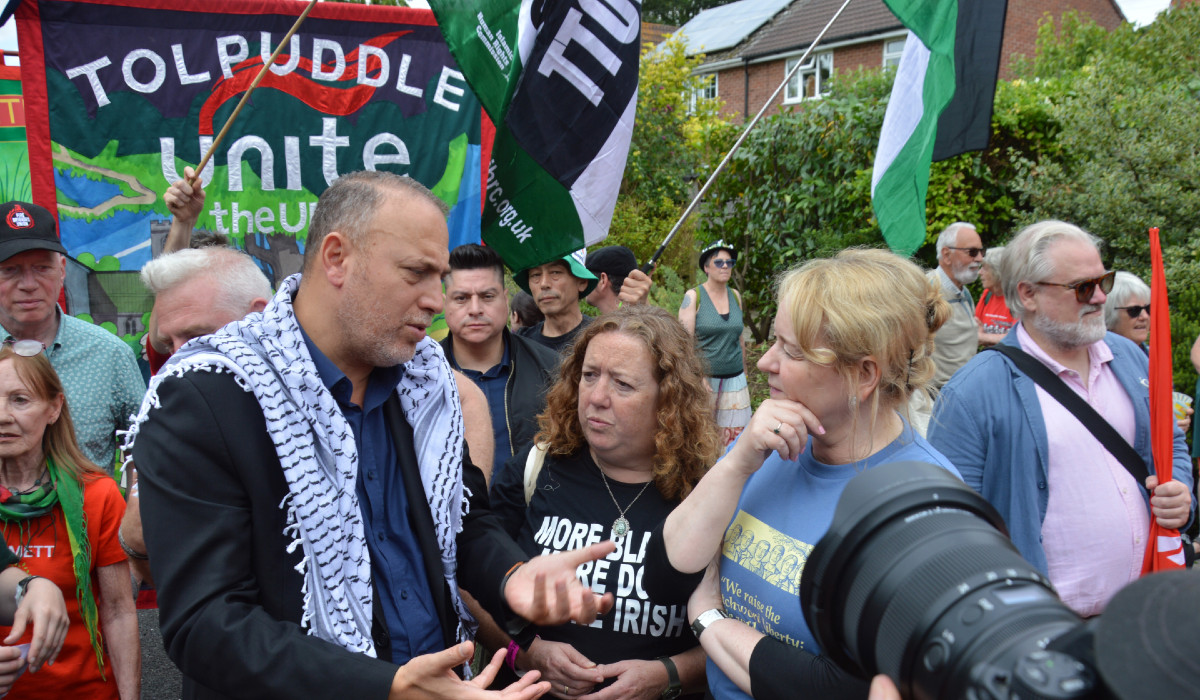
 Husam Zomlot Palestinian Ambassador to the United Kingdom, Fran Heathcote and Sharon Graham 2024. Photo: DimiTalen / CC0 1.0 Universal
Elaine Graham-Leigh examines the results of Unite’s recent Executive Council elections and the task for the left
The Unite Executive Council (EC) elections have ended with a decisive victory for the Back to the Workplace slate. With 41 seats compared to Members United’s eighteen (and two independents), Sharon Graham’s supporters now for the first time have a clear majority on the EC. It is not surprising that Back to the Workplace is celebrating, although the tone of its statement does not bode well for constructive working relationships on the EC over the next three years, nor for the EC’s ability to relate to the struggles union members face and pull wider layers into union activity.
The result has been hailed by some on the left as a commitment to a ‘militant industrial strategy,’ but it is difficult to see it as anything other than a win for right-wing ideas. Graham was elected as General Secretary in 2021 on the promise of withdrawing Unite from political activity, and she has done that. Unite has been conspicuous by its absence from the Palestine movement and even the anti-fascist movement. The union’s position on issues like militarism and climate crisis is broadly that anything that maintains jobs for Unite members is fine by it. This concentration only on ‘bread and butter issues’ was what the right-wing candidate, Gerard Coyne, promised in his attempts to become General Secretary in 2017 and 2021, and his supporters will presumably be pleased by this result.
Industrial militancy vs political activism
The much-vaunted industrial militancy hasn’t translated into a strategy to win major disputes like Port Talbot, Grangemouth or Vauxhall in Luton, while the need to avoid anything that smacks of a political position has hampered solidarity actions in the Birmingham bin strike, which have been largely organised from outside the union. This is not actually surprising. Sharon Graham and her supporters tend to portray political activity by trade unions as a distraction from their real work; at best as an optional extra and at worst as a waste of members’ time and money. If you see political work and workplace struggle as essentially separate, then it’s easy to slip into seeing them as competing. It’s a view that generates a seesaw theory of the relationship between union involvement in politics and industrial militancy. If you raise the importance of political involvement, then it automatically depresses the industrial side of the seesaw. Conversely, if you want to raise the level of industrial struggle, all you have to do is to push the political side of the seesaw down.
A more dialectical understanding would see that it is not possible to separate politics and workplace struggle in this way. All disputes, on some level, are political, and union members don’t check their political opinions at the door when they enter a branch meeting any more than they should be expected to ignore political issues when they’re at work. The union’s political activity in helping to build up the movement in return encourages an atmosphere which bolsters industrial militancy. Unite’s retreat from political activity under Sharon Graham is bad for the movement, but it is therefore also bad for Unite’s ability to be the genuinely militant, fighting union that Graham’s supporters say they want to see.
The task for the left
The urgent task now for the left in Unite is to build an open, non-sectarian grouping that can fight to take back the union. Platitudes about unity are not going to cut it; we need to be clear about the serious issues at stake. One crumb of comfort is that, while Back to the Workplace’s victory was decisive, the slate was still voted for by only a tiny percentage of Unite’s membership. The turnout was 5.9%, a shade lower than in the 2023 and 2020 elections. This sort of derisory turnout is not uncommon in union internal elections, but it does mean that the vast majority of Unite members have not yet expressed a view. Some of these members may have right-wing politics (Unite apparently believes that it has more Reform voters in it than any other union), but there will be many members who could be won to a strategy for a union that fights on both the industrial and the wider political stage. What the left has to do now is to organise to reach them.
Before you go
The ongoing genocide in Gaza, Starmer’s austerity and the danger of a resurgent far right demonstrate the urgent need for socialist organisation and ideas. Counterfire has been central to the Palestine revolt and we are committed to building mass, united movements of resistance. Become a member today and join the fightback.

Elaine Graham-Leigh
Elaine Graham-Leigh is an activist and writer of history, politics and fiction. She is the author of The Southern French Nobility and the Albigensian Crusade, (Woodbridge: The Boydell Press, 2005), A Diet of Austerity: Class, Food and Climate Change, (London: Zero Books, 2015), Marx and the Climate Crisis, (London: Counterfire, 2020), The Caduca, (Canterbury: The Conrad Press, 2021) and Revolution in Carcassonne: The Story of a Fourteenth-Century Rebellion, (London: Whalebone Press, 2025). She is a founding member of Counterfire.