
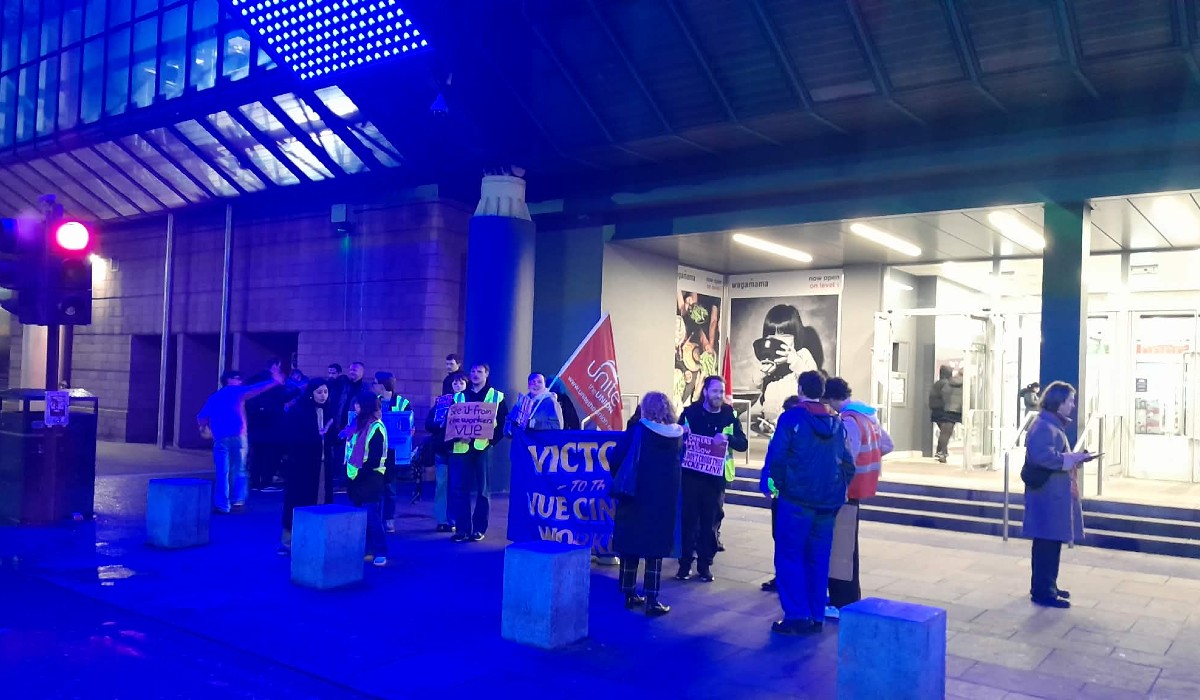
 Zarah Sulrana Visits the Vue picket line
Workers at the Vue cinema in the St Enoch’s shopping centre have gone on strike for a real living wage reports Steven McWilliam
The sounds of a busker on Argyle Street singing Stevie Wonder’s ‘Stand by Me’ as the workers stood together for a photo; the smell of cigarettes wafting from shoppers who light up immediately as they leave the shopping centre; the chilling cold of the Scottish winter tingling on the end of everyone’s fingers and toes. There was something verging on poetic about the scene that began the strike on 11 December 2025.
Despite the frigid conditions, the workers of the Vue were out on the streets represented by Unite the Union. The strike is calling for four actions from their employers at the Vue cinema: a real living wage, paid travel home for late-night shifts, contracted hours and recognition of the union.
Workers are energetic and enthusiastic, but are not convinced that management will be quick to move. The strike is set to last through to the new year into the start of January. The Vue has brought in workers from their other Glasgow location for the period of the strike. Due to the industry practice of hiring young people, the demographic of the strike is very young in comparison to many other strikes.
The strike has attracted support from a number of local councillors as well as MPs including a visit to the picket line by Zarah Sultana who spoke to workers at the St Enoch’s centre.
Unite Across Glasgow
The strike comes in conjunction with other industrial action in Glasgow by Unite. A few months ago, hospitality staff went on the first strike against the village hotel located in the Southside of Glasgow and began another round of strike action at the end of November. This was the first strike action against a major hotel chain in 46 years. Vue workers hope to achieve similar goals.
One common ambition of both strikes is to get safe transport home paid for by the companies for any late-night shifts. This is channelled through Unite the union’s ‘Get Me Home Safely’ campaign which aims to standardise and normalise paying for workers’ travel home. For many workers, this can end up being a massive expense which makes them debate if it’s worth risking walking home late versus paying the equivalent of multiple hours of work to get home safely. I remember working in bars where one female member of bar staff would be paid £45 for a four-hour shift then spend £20 to get a taxi home to Paisley which baffled me because I would not have worked there for effectively £6 per hour. In a world that claims to be concerned with the safety of women and girls, this seems like a clear and easy place to put their money where their mouth is.
Workers are also striking for a cinema-wide living wage rather than the current minimum-wage pay. This demand is for all staff to be paid equally, including younger people who are currently on the lowered minimum wage for under eighteens and eighteen to twenty-year olds. The disparity in the minimum wage always seemed like an obvious contradiction in capitalism. If one is meant to be paid for work done, then how is it possible for two people occupying the same role to be paid differently due to age?
Another overlapping issue is the recognition of the union. Vue employee accounts have mentioned that contracts include statements that indicate the Vue is unwilling to recognise a union or other forms of collective bargaining. This has also been shown by the lack of such organisation in Scottish cinemas historically.
Lastly, they are looking to change the contracts under which they currently work. Most customer assistants in the Vue are offered minimum-hour contracts which are like zero-hour contracts but with a minimum-shift guarantee, normally one four-hour shift. However, this style of contract is very difficult to plan around. Hours and shifts can be highly variable, easily stretching between the four-hour minimum up to forty-plus hours in a week during peak season or for large premiers. Unite argues these contracts fail to offer a secure living.
Vue’s ownership history and Jersey
Vue cinemas was established in Scotland during 1999, and were known at the time as Spean Bridge Cinemas. Over the next decade, the company would go on to acquire cinemas in Ireland, Portugal and Taiwan and this success led to the first major payout in 2010 to its executive team of £70m, including an estimated £25m payout for current CEO Tim Richards, after it was bought out by Doughty Hanson & Co.
Shortly afterwards, it was bought by Canadian pension funds Alberta Investment Management Corporation and Omers for £935m. The pension funds would maintain ownership until 2022. Following the pandemic, which caused severe issues for the cinema industry, Vue was in dire straits and had borrowed significant sums of money which led to the pensions having to exit the company in a corporate restructuring through a debt-for-equity swap, causing a significant loss of investment for the pension companies.
Following the restructuring, Vue moved in 2023 from being a UK-based incorporation to a Jersey-based incorporation. This means that instead of paying the UK corporate tax rate of 25%, they are able to pay the Jersey rate of 0%. I don’t understand how this isn’t considered to be tax-avoidance.
This change might account for its sudden jump in profitability as reported in the Unite article which states that Vue profits in the UK and Ireland, one of its only profitable operations, jumped from £10.5m in 2023 to £25.3m in 2024.
It’s clear that the money is there, that the UK workers are the ones who generate profits and that they are the ones not being paid appropriately for the labour they do.
If you find yourself wanting to watch Wicked for Good in Glasgow over the winter, I’d look elsewhere for another cinema.
