
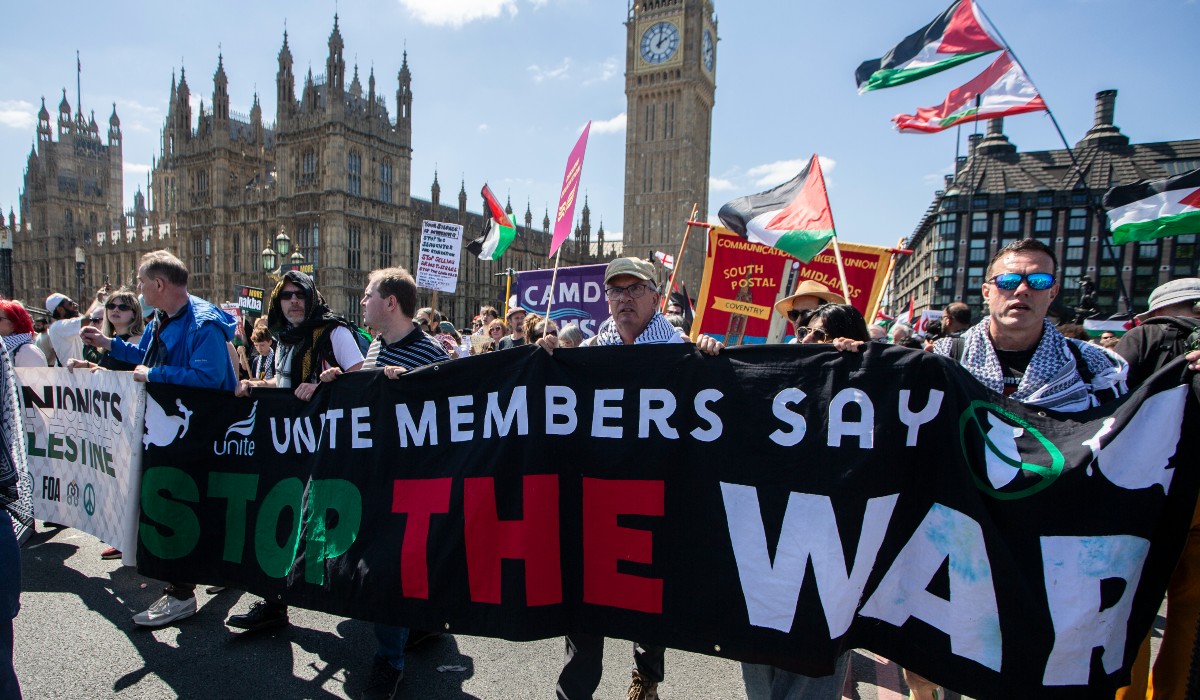
 Nakba 77 National demonstration march / Flickr: Steve Eason
As momentum builds for the June International Peace Conference both Unite and GMB are calling for increased arms spending, John Westmoreland argues against their position
A declarations of war on a foreign country involves a declaration of war on workers’ rights at home. Modern wars emerge from capitalist crisis, failing economies and a consequent crisis of governance, and represent a desperate gamble that victory will restore economic and political stability.
Trade union support for the International Peace Conference in June suggests that many workers understand this. But the calls by some trade union leaders to back increased military spending is threatening our demand for peace and cooperation, in favour of war.
Europe’s Nato leaders are keen to ramp up arms spending as Germany, France and the UK are considering the introduction of conscription. Conscription is being touted as a means to increase military personnel and civil defence. Patriotism and the militarisation of civilian life is being actively encouraged.
Last week an open letter to the prime minister, signed by three ex-defence secretaries, retired senior military chiefs, and former MI6 head Sir Richard Dearlove, says that the UK faces a ‘1936 moment’, with global conflict likely amid rising tensions and the threat of further Russian aggression in Europe. The letter, published in The Telegraph, calls for defence spending to reach 5 per cent of GDP. This contrasts with Keir Starmer’s pledge to increase it to 2.5 per cent next year and 3 per cent after the next election.
The warmongers are quite clear that the 5 per cent of GDP must come from ‘welfare entitlement’. War abroad clearly means class war at home. It was therefore deeply troubling to hear Unite’s Sharon Graham blithely endorsing increased arms spending during the recent Munich Security Conference. Graham’s call is echoed by the leadership of the GMB union. Matt Roberts, GMB National Officer said: ‘Defence spending can be a powerful force domestically for growth and levelling-up in our regions’. This is fanciful to say the least. It shows no understanding of what neoliberalism has done, and lacks any idea of how to put things right.
Both Unite and GMB leaders are going against the TUC’s call for ‘wages not weapons’, and the demand to defend our public services from the government’s desire to divert resources to fund the military.
Racing to war
Starmer’s enthusiasm for war, when the fabric of society is falling apart at the seams, is disgraceful. His government has assisted Israel in carrying out genocide in Gaza and has backed Trump’s bombing of Iran. It is a huge mistake for trade union leaders to associate themselves with his drive to war in the mistaken belief that it might mean more jobs. We should note that the union leaders backing Starmer’s war drive have done nothing to support the victims of genocide in Gaza, or his authoritarian stance against Palestine Action.
When Starmer announced an increase of military spending from 2.3 to 2.5 per cent through cutting £6 billion from overseas aid, Sharon Graham welcomed it. This fuels the racist arguments of the far-right, that we should put Britain first, and helps to break British workers from international solidarity.
The Unite and GMB leadership has fallen for the war propaganda of the right, that we are in a ‘1936 moment’, where, unless we rapidly arm up, we may be overrun by Russia. Graham has supported increasing the military budget as a matter of urgency, telling Starmer to ‘stop dithering’ and to change fiscal rules to allow a surge in arms spending.
Both Unite and GMB leaders argue that weapons spending is fine if it is supplying British-made kit. This chimes with Starmer’s line that arms spending will lead to economic growth and jobs. But the arms industry produces very few jobs compared to investments in services. And in any case, Trump is insisting that Europe needs to buy US weapons. Starmer is currently allowing US weapons onto UK soil at an unprecedented rate.
The myth of economic recovery based on arms spending needs to be exposed for the nonsense it is.
Increased weapons spending will not help the sacked workers at Port Talbot and Luton, whose lives were decimated without any meaningful fight. Furthermore, unemployment rates are climbing because of AI, and a lack of investment in public services. This is hitting young workers hard with bosses demanding the repeal of minimum wage legislation, and points to the need for a serious campaign from the unions over these issues rather than hoping in some miracle from weapons production.
Trade union leaders should steer clear of patriotic posturing and get to grips with the real issues confronting workers. If arms spending is made possible by cutting welfare this will hit the working class as a whole, including Unite and GMB members who work in the service sector and rely on what remains of the welfare state.
The NHS came about because wartime casualties demanded a national response to a health crisis caused by war. Any future war funded by the diversion of resources from health to military spending is going to take us back to the 1930s, which after the war ended we vowed never to go back to. A 1936 moment indeed.
Thankfully, the anti-war mood in the trade unions is on the rise, as support for the International Peace Conference in June grows.
Internationalism against war
It is heartening to see that the wider movement is not following the patriotic posturing of the Unite and GMB leaders. Trade union branches and trades councils across the UK are supporting the International Peace Conference in June, including eight Unite branches.
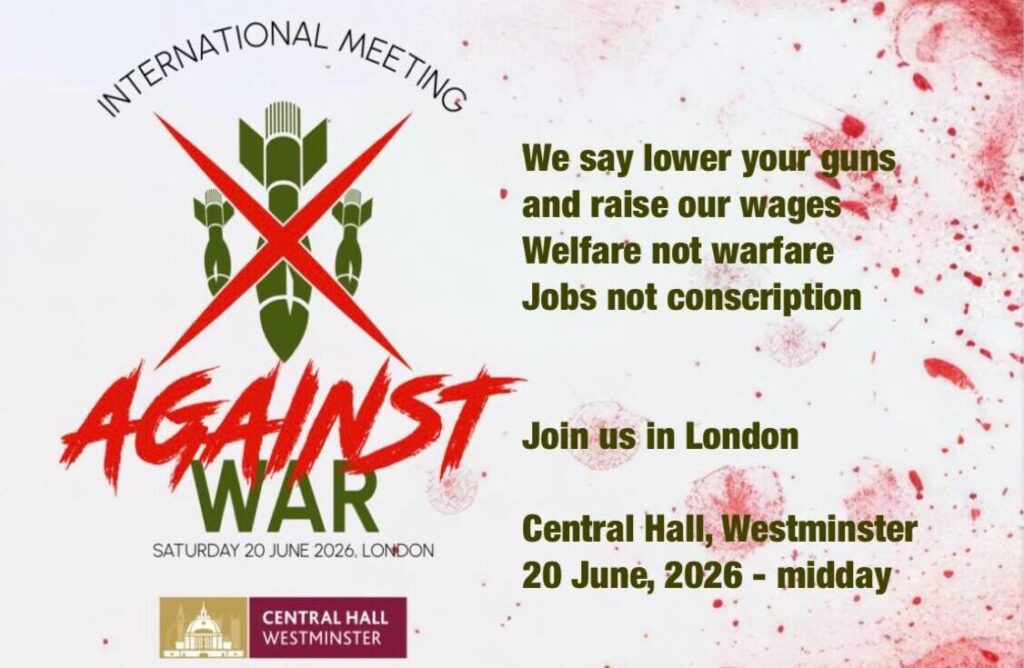
The conference organisers are warning of the danger of slipping into major war and that ‘the wolf is at the door and it is time to raise the alarm’. We have to redouble our efforts for peace and break the imperialist doom loop that Trump and his vassals are trying to lock us into.
In contrast to the banalities of some trade union leaders, the conference is driven by the knowledge that the same governments who bang on about our security have actively helped Israel carry out a genocide in Gaza, and have fed the meat grinder of war in Ukraine.
The conference is calling for the labour movement to defend peace, freedom of speech and protest, and jobs that are useful to society and that can save the planet. All our trade union leaders should be thinking about the jobs we need to make the world safer and healthier for the coming generation. We have an historic duty to act:
‘It is our task to say to the new warlords, we will not pay for, nor accept rearmament that imperils our world’.
This sentiment is widely popular and we need to give it a voice that drowns out those beating the drums of war.
Over 1100 signatures from 23 countries support the international meeting against war.
Before you go
The ongoing genocide in Gaza, Starmer’s austerity and the danger of a resurgent far right demonstrate the urgent need for socialist organisation and ideas. Counterfire has been central to the Palestine revolt and we are committed to building mass, united movements of resistance. Become a member today and join the fightback.

John Westmoreland
John is a history teacher and UCU rep. He is an active member of the People's Assembly and writes regularly for Counterfire.