
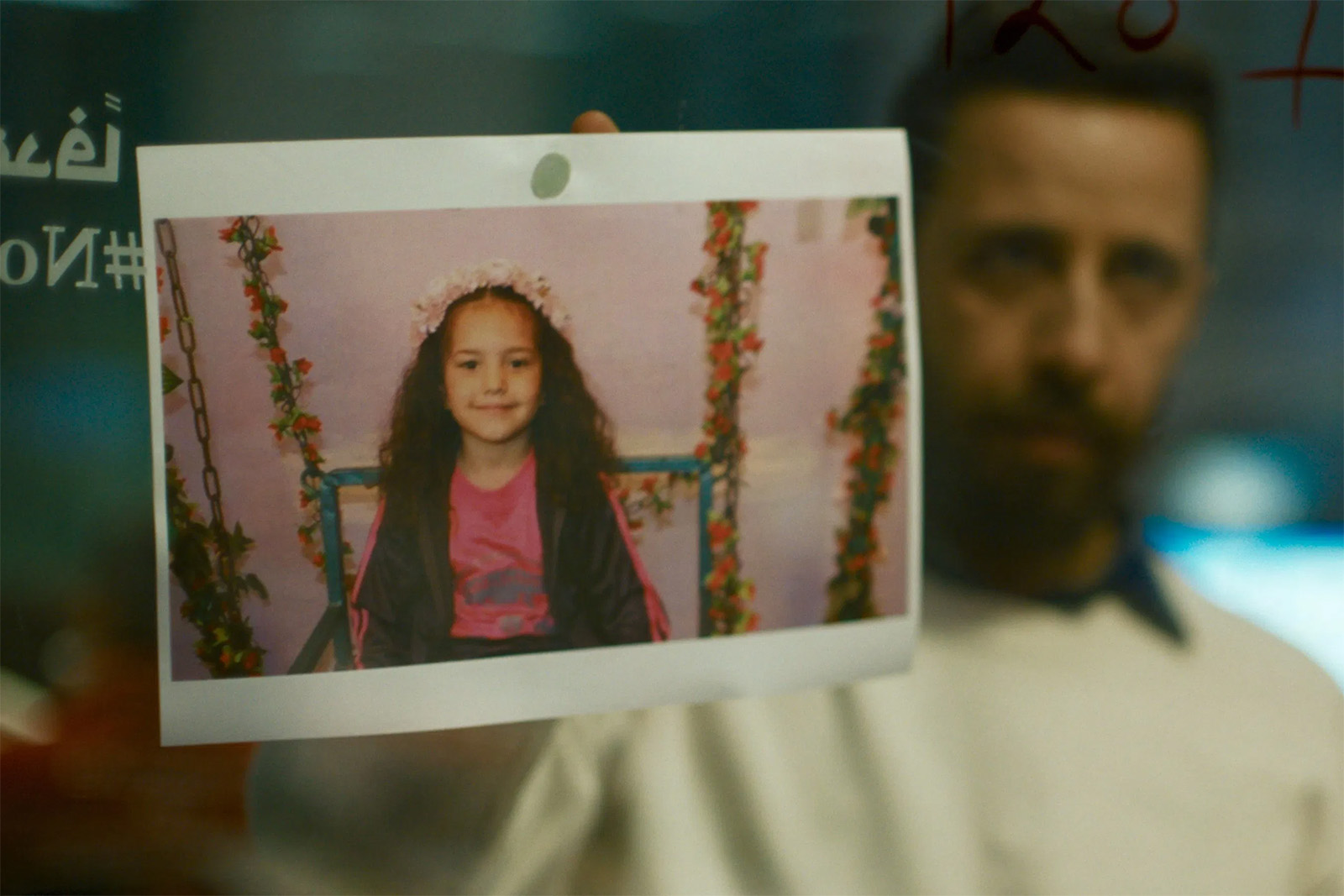
Winning eight awards at the 2025 Venice International Film Festival, this is a heart-rending account of the final hours of a 5 year-old Palestinian girl awaiting rescue and a magnificent tribute to her and the children of Gaza, finds Katherine Hajiyianni
The Voice of Hind Rajab reconstructs the harrowing events of 29 January 2024, from the moment emergency call centre staff at the Palestinian Red Crescent’s Ramallah office first answer the call from five-year-old Hind Rajab Hamada.
Hind and six of her family members had attempted to flee Gaza City before coming under fire from an Israeli tank. Only Hind survived the initial attack. Alone and trapped in the car with the dead bodies of her family, she pleads with the team to save her life. It is from their perspective that this story is told.
For three unabated hours, Omar Alqam (Moaz Malhees), Rana Hassan Faqih (Saga Kilani), and Nisreen Jeries Qawas (Clara Khouri) try to find the words to comfort Hind through unimaginable terror, as IDF gunfire is heard in the background, a tormenting reminder to them and us that Hind is running out of time. Simultaneously, centre leader Mahdi Aljamal battles to coordinate an approved safe route for an ambulance, stationed only eight minutes away, to come to her rescue. In the endless space between exasperating calls between the Ramallah centre, the International Red Cross, and the Israeli military, he is forced to wait, and to push back against the increasingly desperate team promising Hind they won’t abandon her. To send an ambulance without agreement from the IDF would likely be a death sentence.
The slow drag of Mahdi’s narrative, juxtaposed against the urgency in Hind’s petrified voice and the team’s rising desperation, mirrors the sadistic reality of Israel’s military occupation and systems of apartheid. Such administrative strangulation is part of a broader, sustained and calculated strategy of systemic violence disguised as bureaucracy, which is designed to eradicate Palestinian life in Gaza, and which has existed long before 7 October 2023. Since then, this same system has obstructed aid convoys, engineered a famine, and decimated Gaza’s healthcare infrastructure.
The cruel truth of the film is that we, the audience, know how it ends. After hours of painstaking back and forth and waiting for answers while Hind begs them to come to her rescue, a route is finally approved by the IDF for an ambulance to make the eight-minute journey. We watch as the emergency team rejoice, but we know how this ends. With 335 bullets. 335 bullets fired at one terrified little girl and her family, because they were Palestinian.
As Mahdi points out, the IDF know a child is in the car. They have advanced infrared surveillance technology. They can probably hear her, the same frightened little girl’s voice we hear. The ambulance, though granted safe passage, is bombed on arrival. Paramedics Youssef Zeino and Ahmed Madhoun are killed instantly. And Hind is alone again with her murderers. Soon after, her voice falls silent. Her body, the bodies of her family, and the remains of the paramedics were recovered 12 days later.
The heart of the film is the voice of Hind Rajab. The real audio recordings of Hind’s calls to the Red Crescent are used. Fragile, terrified, innocent. None of the actors listened to the recordings until the moment of shooting the scenes. They are responding to her, the emotion in their performances is real.
The choice to tell the story through Hind’s voice, rather than through dramatised scenes of war, demands our full attention. Undistracted by the spectacle of violence we are forced to be fully present with Hind and her deeply committed but ultimately helpless rescue team. To bear witness to their trauma in a way that is devastating but essential. It reminds us that for the endless footage we’ve seen of bombing and indiscriminate gunfire, within those videos were people, terrified, fighting for life, fighting to protect each other, begging to be saved.
One of the film’s most heartbreaking moments comes when Hind’s mother is put on the line over speakerphone. We know she is speaking to her daughter for the last time. Wissam Hamada has not been able to listen to the recordings of her daughter’s voice since her murder. Nor can she watch this film.
We know this is a true story, and moreover that it isn’t unique. Hind is one of at least 20,000 children Israel has murdered in Gaza since October 2023. That figure is likely much higher, as numerous bodies of Palestinians still lie under the wreckage, and babies have been born and killed before their lives were ever recorded.
In one brief moment of calm, Nisreen, the team psychologist, leads Hind through a meditative breathing exercise. She tells Hind to imagine that she is swimming in the sea. Hind tells her she’s afraid of the dark.
“There’s still some light left. We still have some time”.
This film is a magnificent tribute to Hind, and it is a call to action. When Director Kaouther Ben Hania first heard Hind’s voice pleading for her life, she asked herself what she could do. Her answer was to make this film. We must all keep asking ourselves that question, for Hind and all Gaza’s children.
Before you go
The ongoing genocide in Gaza, Starmer’s austerity and the danger of a resurgent far right demonstrate the urgent need for socialist organisation and ideas. Counterfire has been central to the Palestine revolt and we are committed to building mass, united movements of resistance. Become a member today and join the fightback.
