
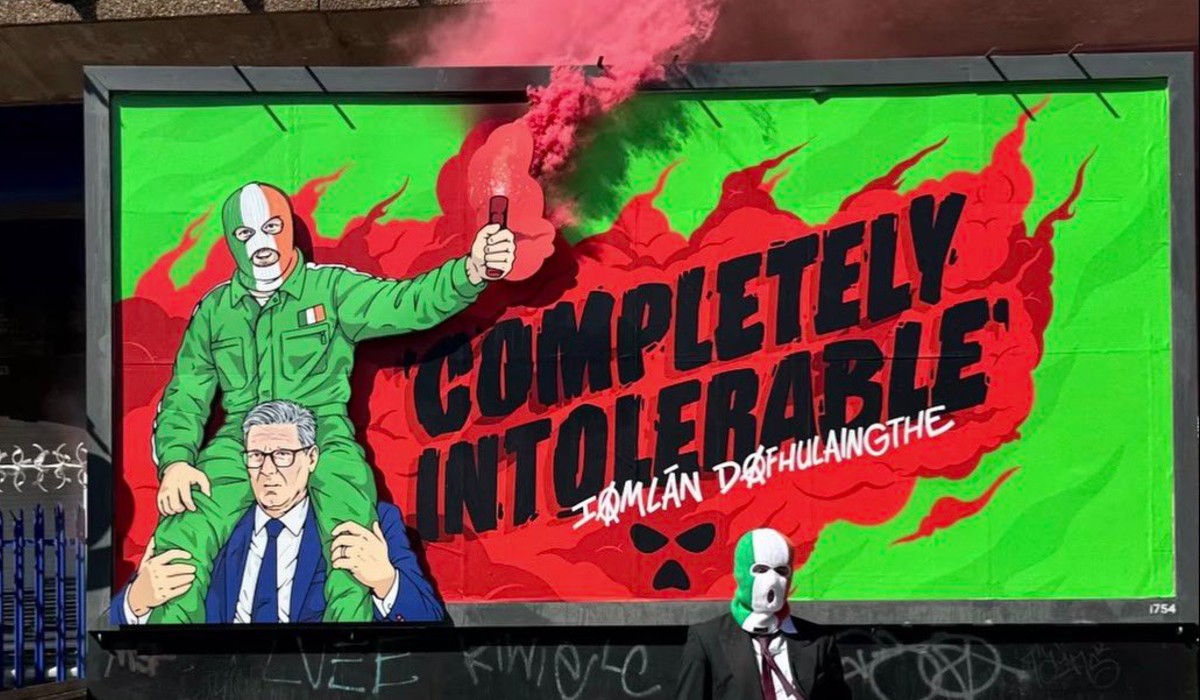
 DJ Próvaí poses with Kneecap’s billboard quoting Keir Starmer’s comments about the band. Photo: Kneecap / X
After defeating the British government in court, Kneecap has released a new album which is unapologetically pro-Palestine and anti-establishment, writes Lucy Nichols
Following a turbulent couple of years for Kneecap, their second album is a rebellious slam on the British establishment, not only for its attempts to silence the band, but also for its involvement in the genocide in Gaza, and abuses of the Irish people, historic and modern.
Made up of West Belfast natives Móglaí Bap, DJ Próvaí and Mo Chara, the rap trio spent seven weeks making Fenian. During these seven weeks, Mo Chara appeared before Westminster Magistrates Court and Kneecap headlined Wembley arena, both experiences forming inspiration for the anger and resistance woven through the album. Chants of ‘free Mo Chara’ from the protest outside the trial are sampled in ‘Carnival’, an early song detailing the farce: ‘investigate the people joining armies far away / instead of the people opposing genocide.’
The album cover features DJ Próvaí, wearing his signature tricolour balaclava and a blindfold with ‘Fenian’ (a slur often levelled at Irish Catholics but originally used by Irish revolutionaries who derived it from Irish mythology) scribbled across it. The name of the album is, according to an interview the band gave NME, part of attempts to reclaim the word from its colonial uses. Mo Chara explained that slurs had been similarly used against resistance fighters in Palestine, India and Kenya.
From the very outset, Kneecap’s belief in the power of language has been obvious. As a result of the band’s success, the Irish language (Gaeilge) is surging in Ireland, and more children are taking up learning it, hundreds of years after early attempts to ban Irish people from speaking Irish.
Much of the album is in Gaeilge, though this is certainly no barrier to understanding it for a non-Irish-speaking listener. Lyrics include ‘Fuck Keir Starmer … genocide armer’, or ‘Tiocfaidh ár lá’; sentiments that are easy enough to understand for most.
Throughout, rappers Mo Chara and Móglaí Bap weave Irish and English together, with Arabic also making an appearance on the song ‘Palestine’, featuring Palestinian rapper Fawzi.
Fenian is perhaps Kneecap’s most political work yet, taking aim at the government and Israel’s genocide in Gaza: ‘It might be the Fenian in me, but I think it’s quite clear to see / The Brits are at it again / Repeatin’ history’ (from ‘Carnival’). The single ‘Liar’s Tale’, referring to the British government, is another example of this, the video featuring a clip of Margaret Thatcher as a zombie.
This album is also more mature than previous work. Softer than their previous album Fine Art, Fenian is more accessible to a mainstream listenership, though remains loyal to Kneecap’s roots. The album’s producer, Dan Carey, has worked previously with bands like Fontaines D.C., Wet Leg and Foals, which you can hear at points throughout, like in the opening bars to ‘Cocaine Hill’.
More traditional hip-hop elements appear in Fenian, but so do the raunchy drum-and-base beats that make Kneecap. The first half of the album, featuring bigger hits ‘Fenian’, ‘Smugglers & Scholars’, ‘Liars Tale’ is loud, passionate and defiant.
This transitions into a more introspective, reflective mood, featuring history and Gaeilge lessons. ‘Occupied 6’ is about the British army’s crimes in the Northern Ireland: ‘In the Occupied Six / Wasn’t all about teenage kicks / International laws they were abusing / MI5 death squads collusion’. ‘Gael Phonics’ is Kneecap’s very own English/Irish lesson. The album closes with ‘Irish Goodbye’, featuring veteran wordsmith Kae Tempest, an emotional goodbye to Móglaí Bap’s late mother.
Having already reached No. 1 in the Irish Charts and No. 2 in Britain, Fenian fully deserves its popularity. Kneecap have announced that they are donating all royalties from the album to two Irish language organisations and the Palestine Solidarity Campaign.
That an album so unapologetically pro-Palestine and anti-establishment can do so well is likely a reflection of the power of the Palestine movement over the last few years, but also demonstrates how crucial it is that we have culture that stands up against injustice.
From this month’s Counterfire freesheet
Before you go
The ongoing genocide in Gaza, Starmer’s austerity and the danger of a resurgent far right demonstrate the urgent need for socialist organisation and ideas. Counterfire has been central to the Palestine revolt and we are committed to building mass, united movements of resistance. Become a member today and join the fightback.
