
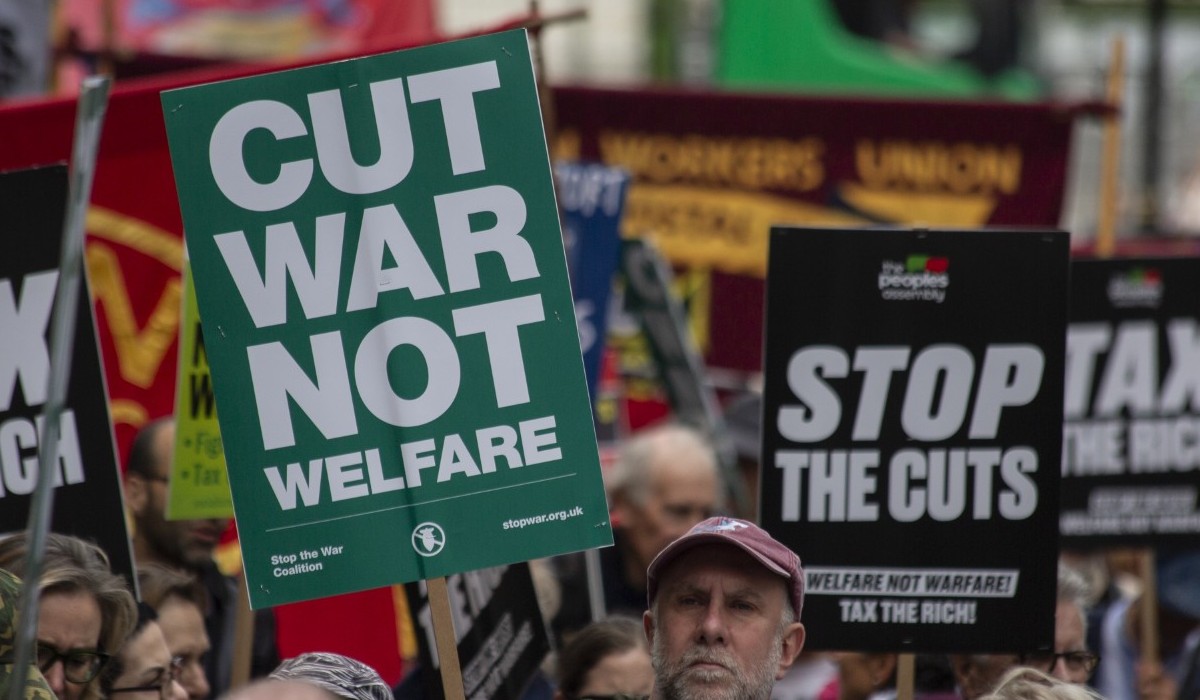
 People's Assembly demonstration. Photo: Steve Eason / CC BY-NC 2.0
John Rees on the forms of political parties in the history of the labour movement and what kind of party Your Party can be
The Pandora’s Box of politics from which all evils fly is the alienation of large parts of the working class from the political system. Out of the desperation felt against a society which seems to have abandoned them has come the catastrophic decline in support for Starmer and his Labour government, the rise of Reform, and the street mobilisation of the far right in unprecedented numbers.
The establishment of a successful broad left party would not in itself solve all these problems, but it could be a long stride in the right direction.
In the midst of the swirling, sometimes destructive, debate about Your Party, some clarity about the different sorts of organisational model available might be of some use.
In its long history, the labour movement has produced two types of party.
The best known is the broad reformist party. The British Labour Party and the German Social Democratic Party are two important examples. This model is avowedly parliamentarian and reformist.
In its left-wing variant, it is argued that capitalism can be transformed into socialism by successive reforms introduced through parliament by parties who win office in the electoral arena, although they may also enjoy support from, and participate in, trade-union struggles and social movements.
In its right-wing variant, it merely aspires to administer the capitalist state in a more worker-friendly way than openly capitalist and conservative parties, rejecting any significant interference in the market and any aspirations to creating a socialist society. In its twenty-first-century version, this wing of social democracy has largely abandoned even this restricted aim and limits itself to claiming greater technocratic efficiency and competence than its rivals.
The second type of party common in the labour movement is the vanguard or Leninist party. Revolutionary socialist parties and Communist parties are in this tradition. This kind of party does not claim, outside intense moments of class struggle, to represent majority opinion in the working class. It aims to organise a militant minority, or class-conscious vanguard, of the class and to use this relatively coherent and active minority as a lever to move the whole class, or a socially significant section of it.
The vanguard party does not primarily focus on elections but on more immediate forms of struggle such as strikes, demonstrations, protests, and direct action. Revolutionary parties are in favour of the struggle for reforms but they see the direct mobilisation of class power as the main means of attaining reform. They do also see elections as an important, if secondary, field of struggle.
The formal method for revolutionaries to link up with those sections of the working class who want to fight for reforms but who do not accept, or yet accept, the need to overthrow the system is the united front. By forming an agreement to fight for a limited reform, supporters of social democracy and revolutionary socialists can unite the working class in pursuit of immediate aims and, through the confidence that such unity brings, open the road to a more fundamental transformation of the system.
What kind of party is Your Party?
So what kind of party could Your Party become? To answer this, its best to move away from purely formal programmatic issues alone. It’s not that they don’t have their importance but it is well to look at the actual historical experience of the supporters of the new party as well.
Supporters of Your Party are largely formed by three experiences. The first is participation in mass social movements. In the decades since the Seattle anti-capitalist protests in 1999, this has become an age of protest. The protests against the Iraq war radicalised a generation, and the protests after the bank collapse of 2008 and the austerity that followed, deepened that radicalisation. Palestine has reenergised and extended the protest movement base of the left for the last two years.
Secondly, Your Party members often were among those activists who took the opportunity and poured into the Labour Party to create Corbynism in its first formation.
Thirdly, they are products of bitter defeat at the hands of Starmer. Now they are attempting once again to forge an alternative to what Tariq Ali calls the ‘extreme centre’.
They reject Labourism in its right-wing variant, and want a Corbynism that works, freed of the constraining limits of the Labour Party right wing, and strongly related to social movements and trade-union struggle.
There are obvious areas of overlap with the aspirations of many on the revolutionary left who have never been part of Labourism and who have an in-principle attachment to extra-parliamentary forms of struggle as well as a desire to see that struggle represented in the parliamentary arena.
Avoiding twin dangers
For this symbiosis to work, as it can, in a dynamic and energising way, two dangers have to be avoided.
One is the responsibility of the revolutionary left. Revolutionaries need to understand that this project is not simply a reconfiguration of the far left. It is not revolutionary regroupment, and many of the 800,000 that initially showed interest in Your Party are not Marxists, or revolutionaries of any description. They are radicals, they have a strong attachment to extra-parliamentary struggle as well as to winning elections, but they are not convinced of revolutionary Marxism and, in the immediacy, they aren’t going to accept either Marxist theory in its totality or all the tactical and strategic goals that flow from it.
There is indeed a huge interest in Marxist ideas, and a willingness to listen to the tactical arguments of revolutionaries, but not if they are delivered as ultimatums or as programmatic requirements.
But if revolutionaries have a duty to avoid sectarianism, those coming from a reformist tradition also have responsibilities. The bureaucratic habits of the trade-union and Labour Party machine have to be left behind. So does the tendency to treat social movements instrumentally, as vote banks for which there is no requirement that electoral parties should build, sustain, and mobilise.
And it would certainly be helpful if the ritual abuse of revolutionaries as ‘Trots’ or ‘sectarians’ were brought to a halt. Not that the revolutionary left is free from fault, including the fault of sectarianism. But the recent short history of Your Party shows that it has no monopoly on that since it is largely figures with a Labour Party past that have been engaged in the most damaging internal rows.
And as well as its faults, the revolutionary left has some real achievements of which it can be proud. Without the revolutionary left, there would have been no Anti-Nazi League in the 1970s and 1990s, no national Anti-Poll Tax campaign in the 1990s, no Stop the War Coalition against the Afghan and Iraq wars, no People’s Assembly Against Austerity, and a very much weaker Palestine solidarity movement. This is not mention the intellectual contribution of the far left, and not simply by the efforts of individual thinkers but institutionally in the creation, for instance, of Verso and Pluto Press as left publishers.
So what co-operation between these forces could mean is a dynamic, movement-rooted, broad party of the left that could sink real roots in the abandoned and neglected working-class communities in every part of the land. It could challenge the despair induced by the desertion of the working class by the Labour Party, and it could help in combatting the appeal of the far right.
To do this requires careful thought and a less-is-more approach. A clear, simple set of demands that can be put before the electorate. A democratic structure and a wide, but clear and principled, programme.
Before you go
The ongoing genocide in Gaza, Starmer’s austerity and the danger of a resurgent far right demonstrate the urgent need for socialist organisation and ideas. Counterfire has been central to the Palestine revolt and we are committed to building mass, united movements of resistance. Become a member today and join the fightback.

John Rees
John Rees is a writer, broadcaster and activist, and is one of the organisers of the People’s Assembly. His books include ‘The Algebra of Revolution’, ‘Imperialism and Resistance’, ‘Timelines, A Political History of the Modern World’, ‘The People Demand, A Short History of the Arab Revolutions’ (with Joseph Daher), ‘A People’s History of London’ (with Lindsey German) and The Leveller Revolution. He is co-founder of the Stop the War Coalition.