
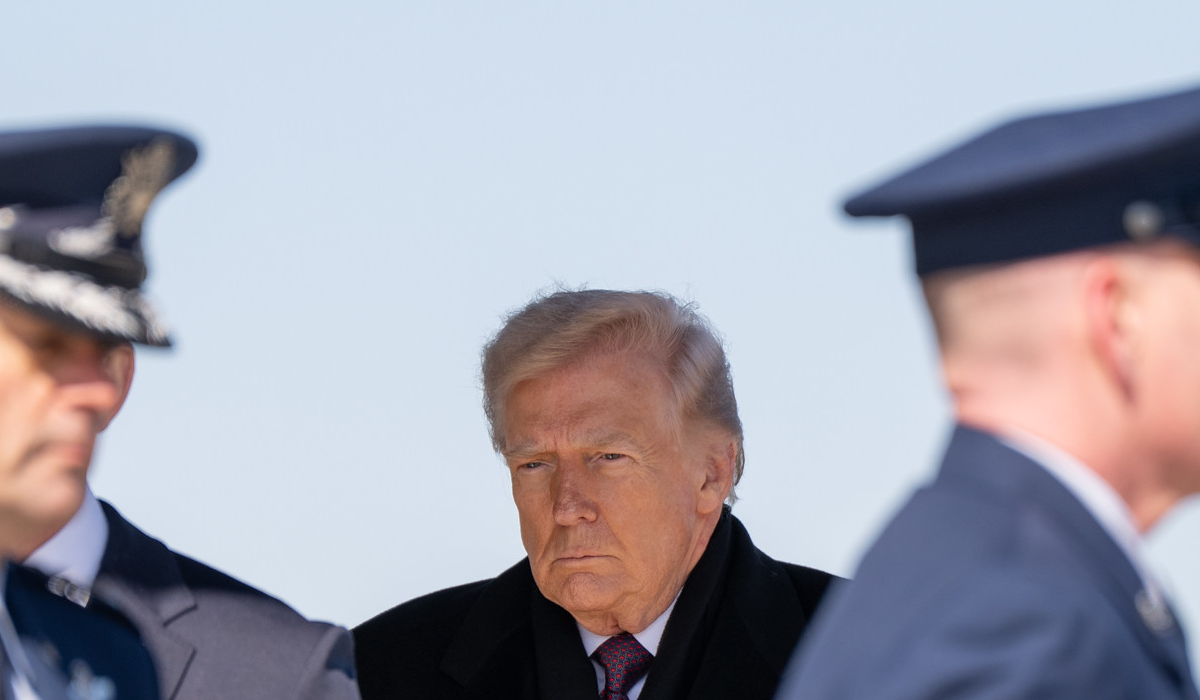
 Trump at Dover Air Force Base (Delaware), March 2026. Photo: Flickr/Abe McNatt
Alex Snowdon on unhinged warmongering and anti-racist unity
The enormity of the crisis created by Donald Trump and Benjamin Natanyahu’s decision to attack Iran is becoming clear.
On the military level, we are seeing ongoing destruction. The US-Israeli assault has required more firepower than Trump anticipated. It has killed over 1,400 people, and injured nearly 20,000, in Iran.
Iran’s response, though, is what has really shaken the myopic US president. Iranian missiles have continued to strike Israeli cities. Iran has hit targets in the wider region, while Israel’s ongoing assault on Lebanon has also served to widen the conflict. Israel sees an opportunity to strengthen its role as regional hegemon, at the expense of Iran and Lebanon as well as the Palestinians.
On Sunday, Iran indicated it would ‘irreversibly destroy’ infrastructure in the region – above all, energy and oil sites – if the US carries out threats to destroy Iran’s energy sites. The US threats emerged from exasperation in Washington that Iran continues to the keep the Strait of Hormuz closed. The strait is essential for the passage of about a fifth of global oil and natural gas supplies.
This is not the swift regime change that Trump anticipated. The relative ease of removing Venezuela’s president led to a completely false expectation that something similar could be achieved in Iran, via the same sort of gangster imperialist methods. The assassination of Iran’s supreme leader, Ayatollah Ali Khamenei, has made barely any difference, while anti-regime protests internally have subsided in response to external bombardment.
The war has become so serious that UK government ministers have been forced to comment on whether Iran could even attack Britain. This was prompted by Israeli Defense Forces claims that Iran possesses missiles “that can reach London, Paris or Berlin”. It was one of the many cynical attempts by Israel and the US to draw European states more directly into the war.
British cabinet minister Steve Reed said that there is no reason to believe Iran plans to attack the UK – and it will be incapable of doing so. He also insisted that ‘the UK is not going to be dragged into this war’, illustrating the massive problems the Trump administration faces in getting more European participation in the war.
This has been another surprise for Trump. The assault on Iran has been too dangerous, irresponsible and illegitimate even for normally pro-Washington political leaders to get behind. On Friday, Trump called Nato a ‘paper tiger’ and denounced European allies as ‘cowards’.
Keir Starmer has ended up in an incoherent mess. His government initially refused US requests to use British bases for strikes on Iran, but quickly caved in to pressure. It has tried – and failed miserably – to maintain a distinction between using them for ‘defensive’ actions (OK) and ‘offensive’ actions (not OK).
Starmer and his team have felt it necessary to distance themselves from Trump but have lacked the courage to go further than weak rhetoric. The British PM has ended up appearing to be ‘Trump’s poodle’ while gaining nothing in return.
Polls here make it clear there is majority public opposition to both the US-Israeli war itself and to prospective British participation in it. Saturday’s anti-war protests were a step forward in building a movement that expresses that sentiment.
Inside the US, meanwhile, Trump is looking weaker all the time. In the US political and military establishment, Trump is viewed as having blundered terribly. Leon Panetta, former CIA director and US defence secretary, called Trump naïve for failing to realise that Iran would use the Hormuz strait as a weapon. Panetta also observed that Trump’s decisions have led to Iran’s government becoming ‘more entrenched’.
There is a major public backlash, including among Trump supporters, that could still get much worse for the president. This is particularly likely to worsen if the economic fallout is as serious as many are now speculating.
The economic costs of war
A new word has entered the lexicon: Trumpflation. The war in the Middle East is driving a new cost-of-living crisis. Control of energy supplies is at the core of this, but the effects are increasingly spreading across the whole economy.
The closure of the Strait of Hormuz has pushed up oil and natural gas prices. Military strikes against oil and gas production facilities has also had an effect on energy prices.
The International Energy Agency has referred to ‘the largest supply disruption in the history of the global oil market’. While US oil companies look forward to spectacular profits – helped by plunging supply from their competitors – most people can expect to suffer, as the prices of everyday goods rise.
What is really crucial is that the squeeze ahead is against a backdrop of stagnation in living standards for working class people. We have already had successive crises and a widening of the gap in spending power between those at the top and everyone else.
War abroad is going to turn, rather quickly, into a living standards crisis at home. Rising energy bills are very likely to be a visible and major effect, but there are serious risks of wider inflation and other knock-on effects.
Furthermore, this crisis is developing in the context of European governments ramping up arms spending to a huge degree. In Britain, the scale of hikes being planned is going to lead to savage cuts in public-sector funding. Working-class people will be paying the price for increased militarisation.
The combined effect of these two things – Middle East war fuelling a fresh crisis together with public sector and welfare cuts to fund militarisation – will be enormous. We need to develop mass opposition to war, militarism and economic attacks alike. The international anti-war conference on 20 June takes on special significance in this context.
Together against the far right
The Together Alliance’s national demonstration on Saturday will be a milestone in building effective resistance to the far right. My own trade union, the National Education Union, is taking it very seriously, recognising that it provides an opportunity to lift opposition to racism and fascism to a new level. It also specifically offers a chance for trade unions to demonstrate their relevance to wider society.
What always matters with really big, unifying demonstrations is what happens next. The challenge is to build broad, coordinated campaigning in local areas. The sharp focus of the demonstration is driving back the organised far right, but a genuinely mass movement inevitably helps us shift the climate around racism and the threat posed by Reform.
I will be travelling to London on Saturday as part of a big contingent from the North East. I am also helping organise a Sunderland Together demonstration for May Day weekend. We need organising in our communities to ensure this movement reaches into every corner of society.
Before you go
The ongoing genocide in Gaza, Starmer’s austerity and the danger of a resurgent far right demonstrate the urgent need for socialist organisation and ideas. Counterfire has been central to the Palestine revolt and we are committed to building mass, united movements of resistance. Become a member today and join the fightback.

Alex Snowdon
Alex Snowdon is a Counterfire activist in Newcastle. He is active in the Palestine Solidarity Campaign, Stop the War Coalition and the National Education Union. He is the author of A Short Guide to Israeli Apartheid (2022).