
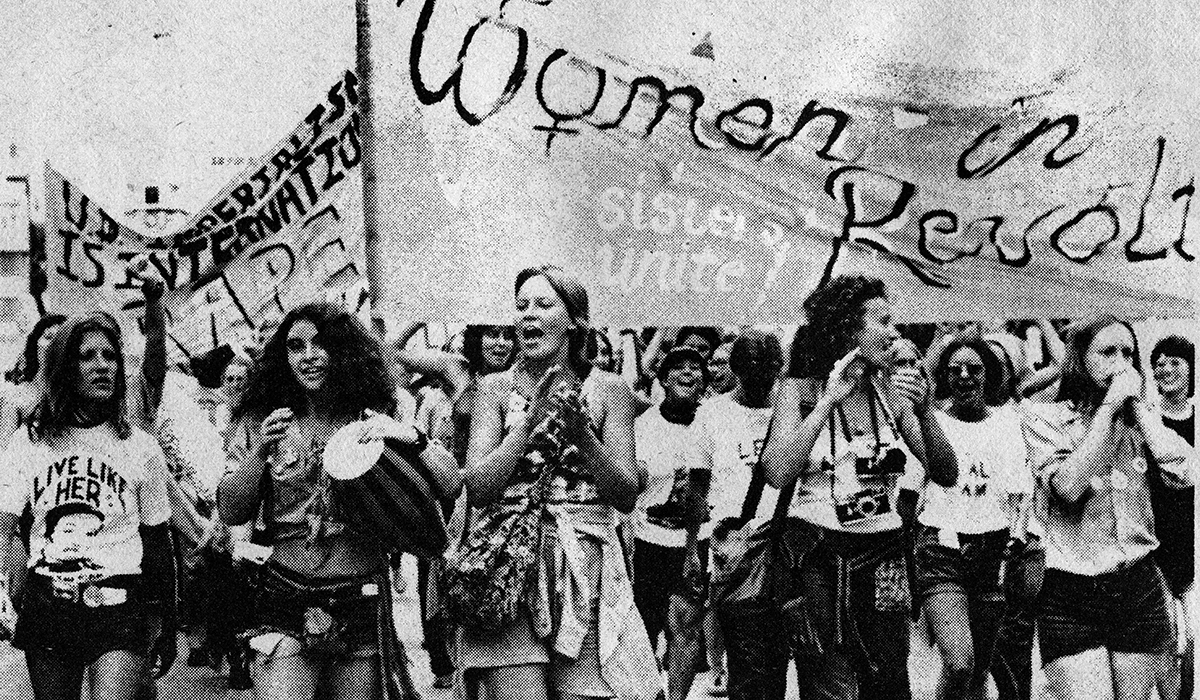
 Women March Against Nixon, Miami 1972. Photo: Liberation News Service / CC BY-NC 2.0
Alex Snowdon explains why the oppression of women is not eternal or natural and is bound up with class exploitation
Karl Marx and his close collaborator Frederick Engels, using insights from anthropologists, understood that human societies had not always been divided by class. There had been a transition from egalitarian pre-class societies to the earliest class societies.
Similarly, there had not always been women’s oppression. Rather than being part of universal human nature, the subjugation of women arose in tandem with the earliest development of class society.
Engels developed his analysis in two important works: The Part Played by Labour in the Transition from Ape to Man (1876) and The Origin of the Family, Private Property and the State (1884). His account of the origins of women’s oppression was located in a broader historical overview of how human society developed, in particular how exploitative class societies emerged.
His understanding of human development was underpinned by the historical-materialist method that he and Marx had pioneered in the 1840s, complemented by Darwin’s theory of evolution by natural selection (Darwin’s Origin of Species was published in 1859). It was further strengthened by new anthropological studies showing that humans had not (as commonly supposed) always been competitive, warlike and unequal.
Marx and Engels were materialists not idealists. But they rejected crude materialism, whereby humans are seen as merely responding to external stimuli or as driven entirely by biology. They viewed humans as very much products of the natural and biological world, shaped by natural history and constrained by biology, but also as a species capable of acting upon and re-shaping the natural world.
In the introduction to his Origins, Engels noted that any historical-materialist account of communities thousands of years ago must examine how humans produced their means of subsistence (i.e. how they used labour to sustain themselves), but also how they reproduced themselves as a species. This is something that immediately draws attention to women’s role in social reproduction: the time-consuming processes of pregnancy and child-rearing were both biological and social.
Engels argued that for a very long time humans lived in communities with no acquisition of private wealth, no class division and no male domination. He described a ‘primitive communist’ existence where small-scale social groups had common ownership of land, food and resources.
Women’s hugely important role in gathering food sources, in hunter-gatherer communities, had been compatible with breastfeeding and child-rearing. Early forms of agriculture were likewise accessible to women, irrespective of their role in raising children.
Innovations in productive technology changed the relations between people. Around 10,000 years ago, new agricultural techniques were developed that generated a surplus. They also privileged men’s labour over women’s labour.
Practices like heavy ploughing, herding of cattle and so on were less compatible with pregnancy and looking after children. An unequal division of labour increasingly developed. As the Marxist archaeologist Gordon Childe wrote, ‘The plough … relieved women of the most exacting drudgery, but deprived them of the monopoly over the cereal crops and the social status which it conferred.’
Alongside the cattle-drawn plough, there was the development of irrigation systems. Settled communities developed. Surplus wealth was generated. Long-distance trade was established.
In tandem with all this, a new elite began to control and direct the surplus wealth. Embryonic states, including administrative systems and the earliest armies, emerged.
All of these developments strengthened the role of men at the expense of women. The new elites were overwhelmingly male. As the Marxist writer Chris Harman put it, ‘Warriors and merchants were overwhelmingly male – and, as they increasingly exercised control over the surplus, ownership and power tended to become male prerogatives.’
The patriarchal domestic household – where the father is in control – was conditioned by these economic changes. Women certainly still worked – alongside their domestic roles of raising children and looking after the household – but it was lower-status work in the context of men maintaining control of relations between the household and wider society. Engels called this ‘the world-historic defeat of the female sex’. From this point onwards, women were oppressed, though the forms this oppression took varied between classes and across different types of class society.
It was common, though, for women to be economically dependent on men and for them to be denied rights like the right to divorce or the right to own property. This was a regression from the conditions of ‘primitive communism’ that had lasted for hundreds of thousands of years.
This deeply historical account illustrates two things above all. One is that women’s oppression is not eternal and natural. The other is that class exploitation and women’s oppression are bound together.
Before you go
The ongoing genocide in Gaza, Starmer’s austerity and the danger of a resurgent far right demonstrate the urgent need for socialist organisation and ideas. Counterfire has been central to the Palestine revolt and we are committed to building mass, united movements of resistance. Become a member today and join the fightback.

Alex Snowdon
Alex Snowdon is a Counterfire activist in Newcastle. He is active in the Palestine Solidarity Campaign, Stop the War Coalition and the National Education Union. He is the author of A Short Guide to Israeli Apartheid (2022).